
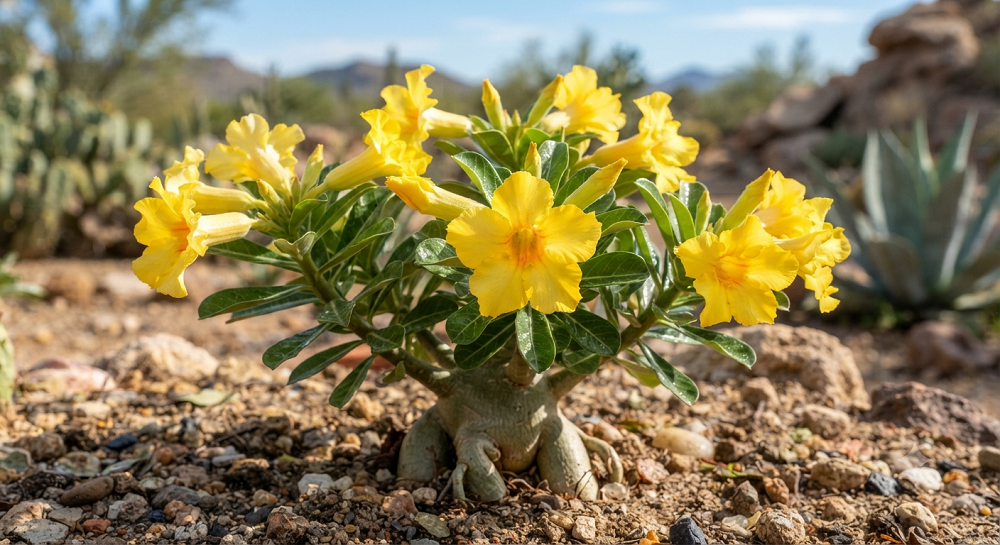
My neighbor once asked me why her desert rose looked like a sad stick in a pot of dirt. She’d bought it because the picture online showed thick, twisted trunks and clusters of hot pink blooms, and what she got instead was a leggy plant that dropped leaves the second October hit. That’s the thing nobody tells you before you buy your first Adenium: there isn’t just one “desert rose.” There are dozens of varieties, and picking the wrong one for your climate, your patience level, or your windowsill space is how a lot of people end up giving up on this plant entirely.
I’ve grown desert roses on a sunny back patio for over a decade now, and I’ve killed my fair share along the way. Overwatered a Black Night cultivar into root rot in my second year. Left an arabicum outside during a surprise cold snap and watched half the caudex turn to mush. So before you buy the first pretty pot at the garden center, here are 11 desert rose types worth knowing, what makes each one different, and which ones are actually worth your money.
What Makes a Desert Rose “Unique” Anyway?
Desert roses (Adenium species) get grouped by three things: the shape of the caudex (that swollen base that stores water), the flower form, and the growing habit. Some stay compact and bonsai-like. Some sprawl. Some bloom nonstop, others sulk through winter no matter what you do. Knowing which category you’re buying saves you from the disappointment my neighbor felt.
1. Adenium Obesum (The Classic Desert Rose)
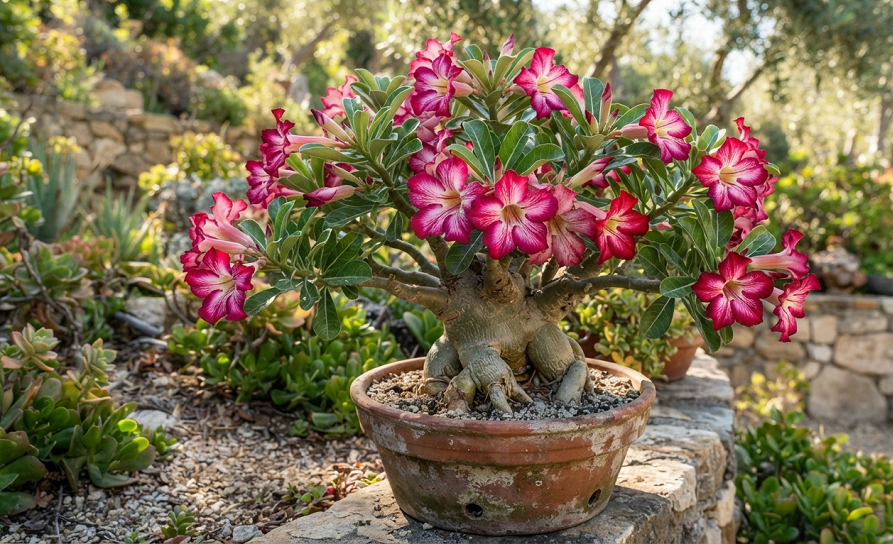
This is the one most garden centers sell, and it’s the one most people picture when they hear “desert rose.” It has a rounded, bulbous caudex, glossy dark green leaves, and simple five-petaled flowers in pink or red with a lighter throat.
I recommend this variety to every beginner who asks me where to start. It’s forgiving, it’s widely available, and the growth habit is predictable. You won’t get anything too exotic here, but you also won’t need a horticulture degree to keep it alive.
The downside is that because it’s so common, a lot of nurseries sell weak, overwatered stock. I’ve bought three “obesum” plants from big box stores that turned out to be grafted onto cheap rootstock that rotted within a year. Buy from a specialty succulent nursery if you can, even if it costs a few dollars more.
Give it full sun, sandy well-draining soil, and water only when the top two inches of soil are bone dry. That’s really the whole formula for this one.
2. Adenium Arabicum (The Fat Bonsai Desert Rose)
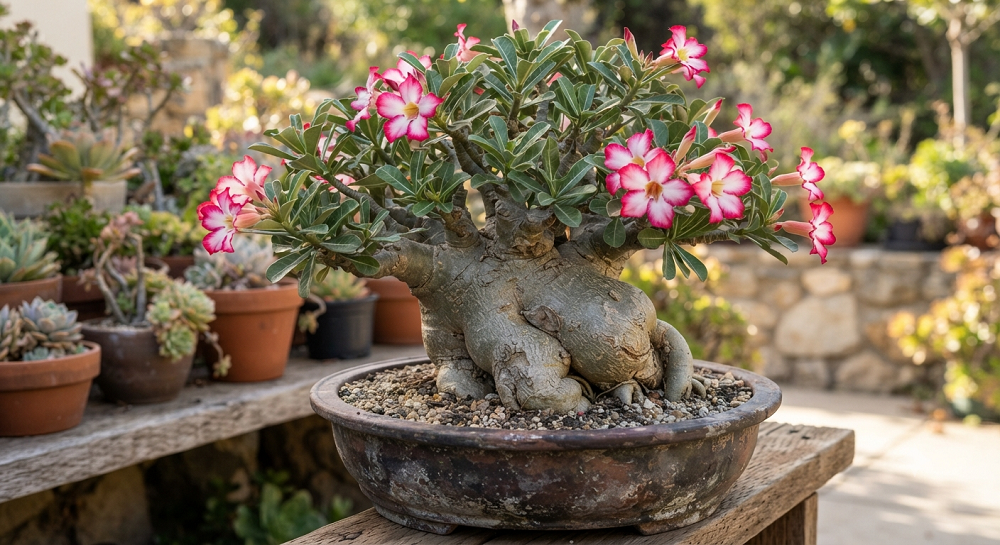
Arabicum is the showoff of the desert rose world. Its caudex grows wide and low to the ground, almost flat, with thick roots that flare out like tree buttresses. Growers use it constantly for bonsai-style displays because the trunk does most of the visual work without any pruning.
I planted my first arabicum in a shallow bonsai tray, and it’s still the plant guests ask about most when they visit. The leaves are fuzzier and rounder than standard obesum, and the flowers tend toward a deeper pink with a more ruffled edge.
Here’s my honest opinion: arabicum is worth the higher price tag if you want a statement plant, but it grows painfully slowly. If you’re impatient, this isn’t your variety. Mine took nearly four years to develop a caudex I was proud of.
It also needs slightly grittier soil than standard obesum, since arabicum is more prone to rot if water pools around that flat base. Add extra pumice or perlite and don’t skimp on drainage holes.
3. Adenium Somalense (The Tall, Skinny Desert Rose)
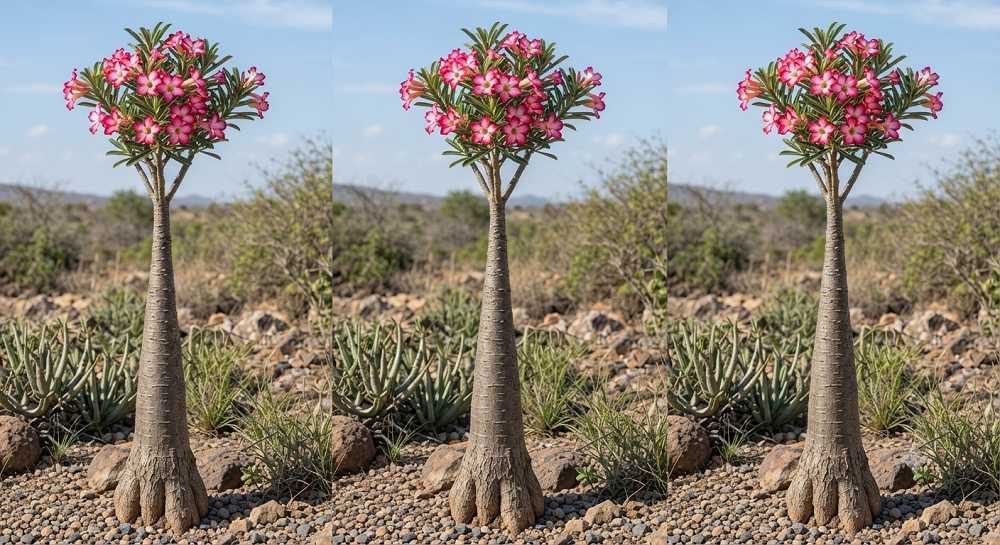
Somalense flips the script on everything you expect from a desert rose. Instead of a squat, round caudex, it grows tall and narrow, almost like a small tree trunk, with branches that reach upward rather than sprawling outward.
This is my pick for anyone with limited floor space but decent vertical room, like a sunny corner near a window. The flowers are usually a rich magenta to deep red, narrower and more star-shaped than the classic obesum bloom.
Somalense also tends to hold its leaves longer into cooler weather than other types, which I appreciate since I hate staring at a bare pot all winter. That said, it’s more sensitive to overwatering because the root system is proportionally smaller compared to that skinny trunk.
If you’re growing this indoors, rotate the pot every week or two. Mine leaned so hard toward my kitchen window one year that it looked like it was trying to escape through the glass.
4. Black Night (Double Black Desert Rose)
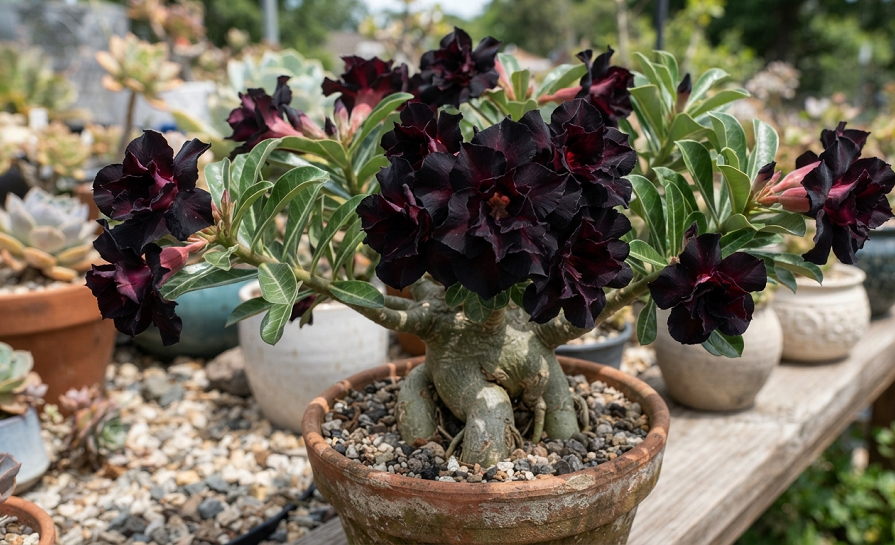
Black Night is a cultivar bred for one thing: the darkest, most dramatic bloom color you can get in this plant family. The petals are a deep maroon-black with a nearly invisible throat, and the flowers are fully double, meaning they look almost like tiny ruffled roses instead of the typical simple five-petal shape.
I bought my first Black Night purely because it looked so different from every other desert rose on the shelf, and it did not disappoint once it settled in. The color reads almost velvety in direct sunlight.
Real talk: this cultivar is fussier than a standard obesum. It’s usually grafted, which means the graft union can fail if you’re rough with repotting or if the rootstock and scion grow at different rates. I lost my first one to a graft failure about eighteen months in, and it was genuinely disappointing after how well it had been blooming.
Buy from a seller who can show you a clean, healed graft union, and avoid moving the pot around too much in the first year while the graft fully establishes.
5. Triple Pink (Double Pink Desert Rose)
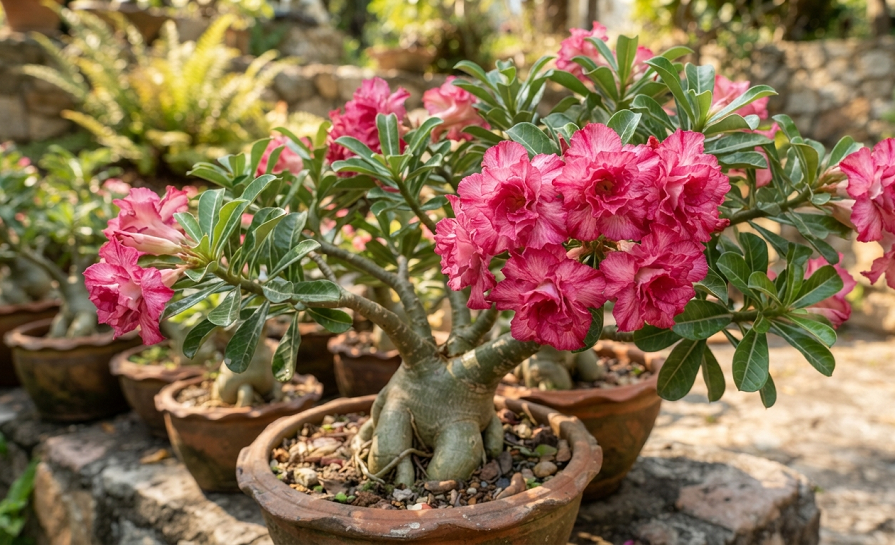
Triple Pink is another double-flowered cultivar, but instead of the moody black tones, you get layers and layers of soft pink petals that genuinely resemble a miniature rose. It’s the variety I recommend to people who want something that photographs well for social media, since the blooms hold their shape for days.
The plant itself grows fairly compact, which makes it a solid container choice for a patio table or a bright kitchen windowsill. I keep one near my back door specifically because it blooms for months at a stretch in warm weather.
One quick side note: double-flowered varieties like this one often produce fewer flowers overall compared to single-petal types, even though each individual bloom looks fuller. Don’t panic if your Triple Pink seems less prolific than a friend’s classic obesum. That’s just how doubled genetics work.
Feed it a phosphorus-heavy fertilizer during the growing season if you want to maximize bloom count, and deadhead spent flowers to keep new buds coming.
6. Crimson Star
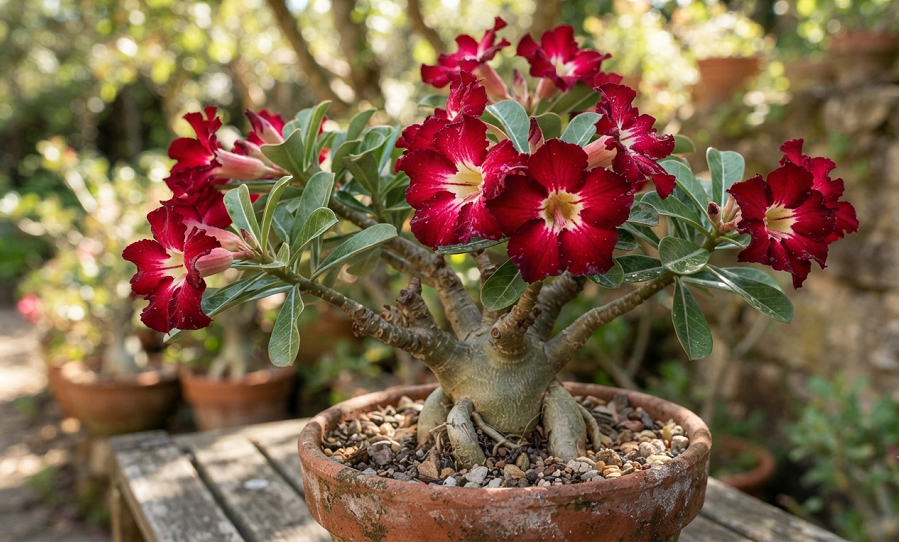
Crimson Star produces star-shaped flowers with a sharp white edge outlining each deep red petal, almost like the bloom was hand-painted. It’s a striking contrast variety, and it tends to bloom in flushes rather than a slow trickle throughout the season.
I planted mine next to a plain classic obesum specifically for the color contrast, and it’s one of the better pairing decisions I’ve made in that garden bed. The white edging really pops against neighboring greenery.
This variety is a little more temperature-sensitive than standard obesum in my experience. Mine sulks and drops leaves faster than my other desert roses once nighttime temperatures dip below 55°F, so I bring it inside earlier than the rest of my collection every fall.
If you live somewhere with mild, consistent warmth year-round, Crimson Star will reward you generously. If you get real winters, plan on this being a container plant that migrates indoors.
7. Rainbow Desert Rose (Multi-Graft Variety)
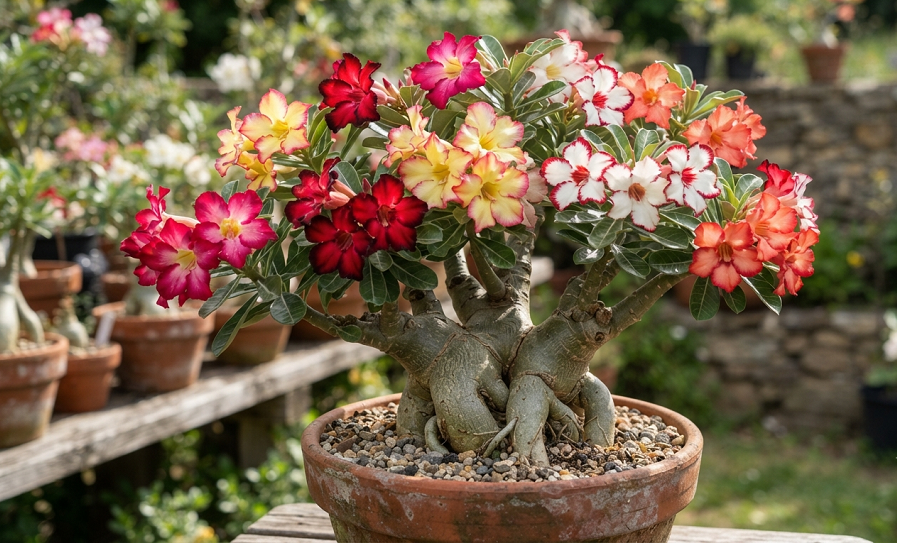
Rainbow desert roses aren’t a single genetic variety. They’re created by grafting several different flower-colored cuttings onto one rootstock, so a single plant can produce pink, red, yellow, and white blooms all at once. Nurseries love selling these because they look incredible in photos.
Honestly, I’ve found that Rainbow varieties are a total waste of money for long-term growers, even though they look amazing on Pinterest and in nursery displays. The different grafts grow at different rates, and within a year or two, the strongest graft usually dominates and the others die back, leaving you with a lopsided plant that’s really just one color again.
If you want a Rainbow desert rose purely for the fun of the multicolor phase, buy one, enjoy it, and don’t expect it to look that way forever. Trim back the dominant graft periodically if you want to keep the balance longer, though it’s genuinely hard to maintain past the second year.
For a plant that stays multicolored reliably, you’re better off growing several single-variety desert roses side by side in one large planter instead.
8. Adenium Socotranum (The Rare Giant)
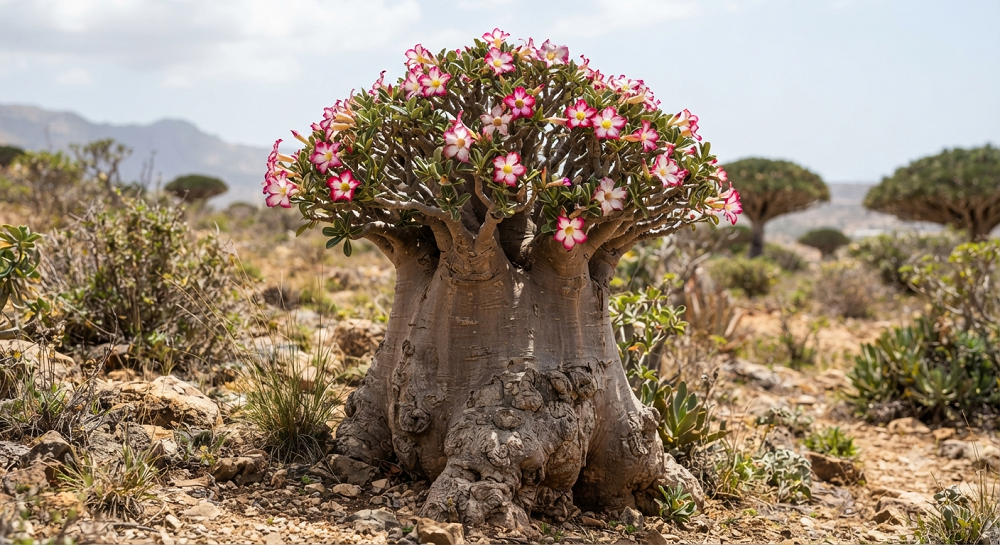
Socotranum comes from the isolated island of Socotra, and it’s the rarest, most sought-after desert rose among serious collectors. It develops a massive, tree-like caudex over time, some specimens in habitat grow trunks several feet wide, and the flowers are a soft pink with a deep pink throat.
This is not a beginner plant, and I’ll say that plainly. Socotranum grows even slower than arabicum, seeds are expensive and hard to find, and the plant is genuinely fussy about temperature swings and soil composition.
I’ve grown one from seed for six years, and it’s still smaller than a grapefruit. I love it anyway, but I wouldn’t recommend it to anyone who wants quick results or a plant that “does something” every season.
If you’re patient and you want a genuine collector’s specimen, track down a reputable seed source and be ready to wait. This is a decade-long relationship, not a quick weekend project.
9. Adenium Swazicum (The Non-Dormant Desert Rose)
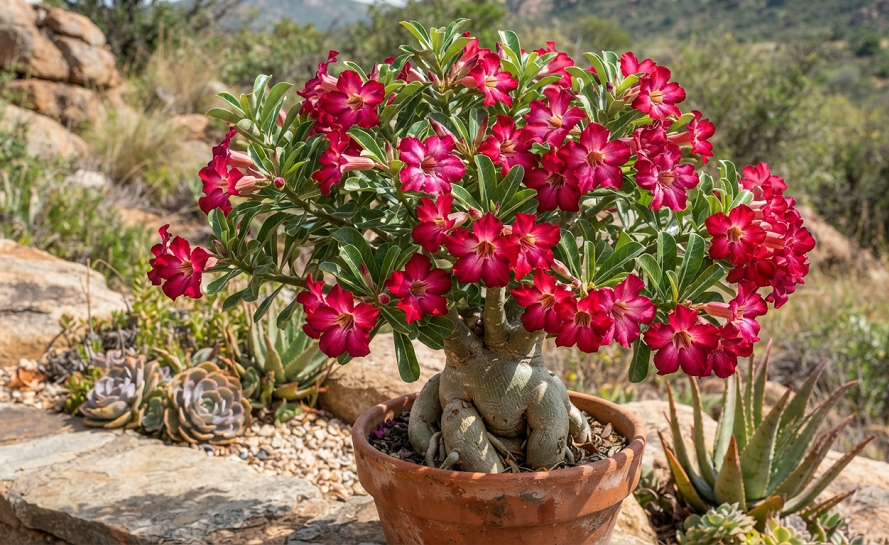
Swazicum breaks the typical desert rose rulebook because it doesn’t go fully dormant in cooler months the way most Adenium species do. It keeps its leaves and often keeps blooming even when other varieties in your collection have dropped everything and gone quiet.
The flowers are usually a soft lavender-pink, smaller and more delicate looking than the bold blooms of obesum or somalense. The caudex stays modest in size too, so this isn’t the variety to pick if you’re chasing a dramatic trunk.
I keep a swazicum specifically because it gives me something blooming through my region’s mild winters when everything else in the desert rose collection is resting. It’s a nice reminder that the garden isn’t completely asleep.
Because it doesn’t go dormant, you also need to keep watering it a bit through winter, unlike your other Adeniums where you cut back drastically. Adjust your watering schedule per plant, not as a blanket rule across your whole collection.
10. Yellow Desert Rose
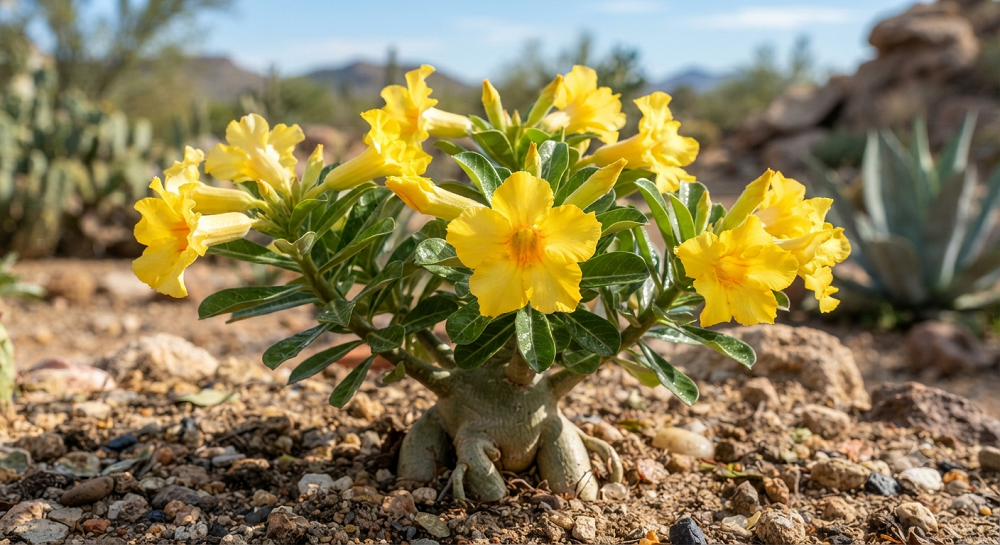
True yellow-flowering desert roses are uncommon and usually cost more because the color is genetically harder to stabilize. Instead of the typical pink-to-red spectrum, these cultivars produce pale to golden yellow blooms, sometimes with a deeper yellow or orange throat.
I bought my first yellow desert rose at a specialty succulent show, and I paid more than I’d like to admit for it. It was worth it for the novelty, honestly, since I hadn’t seen one in person before that.
Real talk on this one: yellow desert roses tend to be less vigorous growers than the standard pink and red varieties. Mine blooms less often and grows more slowly, which I suspect comes down to the breeding work required to get that unstable yellow pigment to show consistently.
If you want one, buy from a grower who can show you an actual blooming photo of the specific plant you’re purchasing, not just a stock catalog image. Yellow tones can fade toward cream or pale pink as the plant matures, and you don’t want a surprise.
11. Variegated Desert Rose
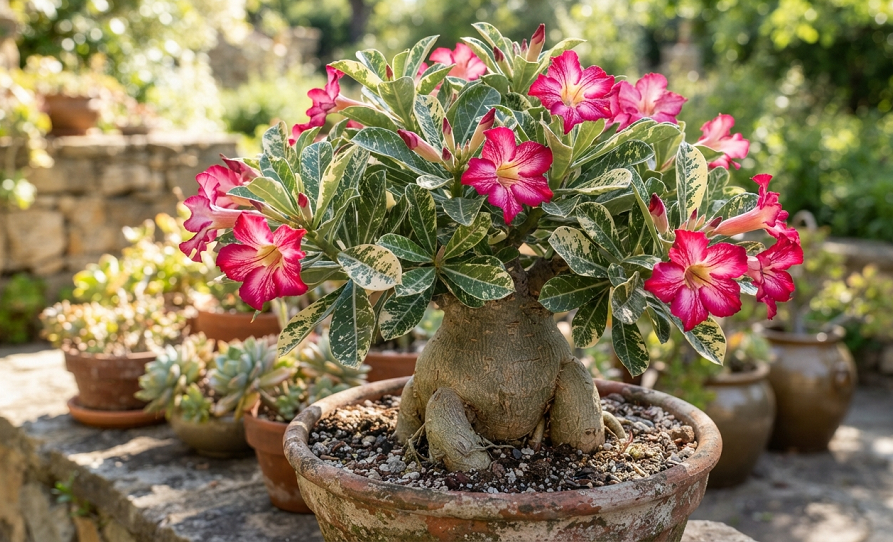
Variegated desert roses aren’t defined by flower color at all. Instead, the leaves show streaks or patches of cream, white, or pale yellow mixed into the green, which makes the plant visually interesting even when it isn’t blooming.
I picked one up mostly out of curiosity, and it’s turned into one of my favorite plants because it gives me something to appreciate in the off-season. The variegation pattern is different on every leaf, so no two look identical.
Here’s the catch: variegated sections of the leaf contain less chlorophyll, which means the plant photosynthesizes less efficiently overall. Mine grows noticeably slower than my solid-green desert roses, and I’ve had to be more careful about giving it strong, consistent light so it doesn’t lose vigor entirely.
If a stem reverts back to solid green (which happens sometimes), prune it off promptly, or the plant will often favor that stronger, faster-growing green growth over the variegated sections.
Quick Bonus: Seed-Grown Mystery Desert Roses
If you ever grow desert roses from hand-pollinated seed pods instead of buying named cultivars, you’ll get what collectors call “mystery” seedlings. Every single one is genetically unique, and you won’t know the flower color or caudex shape until the plant matures. It’s a fun, cheap way to expand a collection if you don’t mind a little unpredictability.
Real Talk: What Actually Goes Wrong With Desert Roses
Every desert rose type above shares the same core weakness: rot. These plants store water in that swollen caudex specifically because they evolved for drought, not for the “water it every Sunday” schedule a lot of new plant owners default to. Overwatering is, without question, the number one killer I see in this plant family, in my own garden and in every desert rose horror story a reader has ever sent me.
Grafted varieties, like Black Night and most Rainbow desert roses, come with an extra risk: graft failure. If the union between rootstock and the grafted color variety doesn’t heal properly, you can lose the entire top growth and be left with plain rootstock. Inspect the graft site before buying, and avoid repotting a newly purchased grafted plant for at least a few weeks.
Cold snaps are the other big threat. Desert roses are tropical and subtropical plants at heart, and temperatures below 50°F for extended periods can cause leaf drop, stem softening, or worse. If you live somewhere with real winters, plan on bringing container-grown desert roses indoors well before the first frost warning, not after.
And honestly, some of these varieties just aren’t worth chasing if you’re a beginner. Socotranum and true yellow cultivars are beautiful, but they’re slow, expensive, and unforgiving of mistakes. Start with a classic obesum or a somalense, get comfortable reading your plant’s watering needs, and work your way up to the fussier varieties once you’ve built real confidence.
Final Thoughts
Desert roses reward patience more than almost any other plant I grow, and picking the right variety for your space and skill level makes all the difference between a thriving collection and a sad, leafless stick like my neighbor’s first attempt. Start simple, watch how your specific plant responds to your specific conditions, and resist the urge to water just because the soil looks dry on the surface.
Which desert rose variety are you growing right now, or thinking about adding to your collection? Drop a comment below and let me know, I read every one and I’m always curious what other gardeners are experimenting with.

About Syprose Kiche
Syprose Kiche is the creator and writer behind My Besuited Home, a practical home and garden website covering DIY projects, gardening, lawn care, landscaping, home improvement, and outdoor living. She focuses on turning everyday homeowner questions into clear, practical guides backed by careful research and useful real-world considerations.