
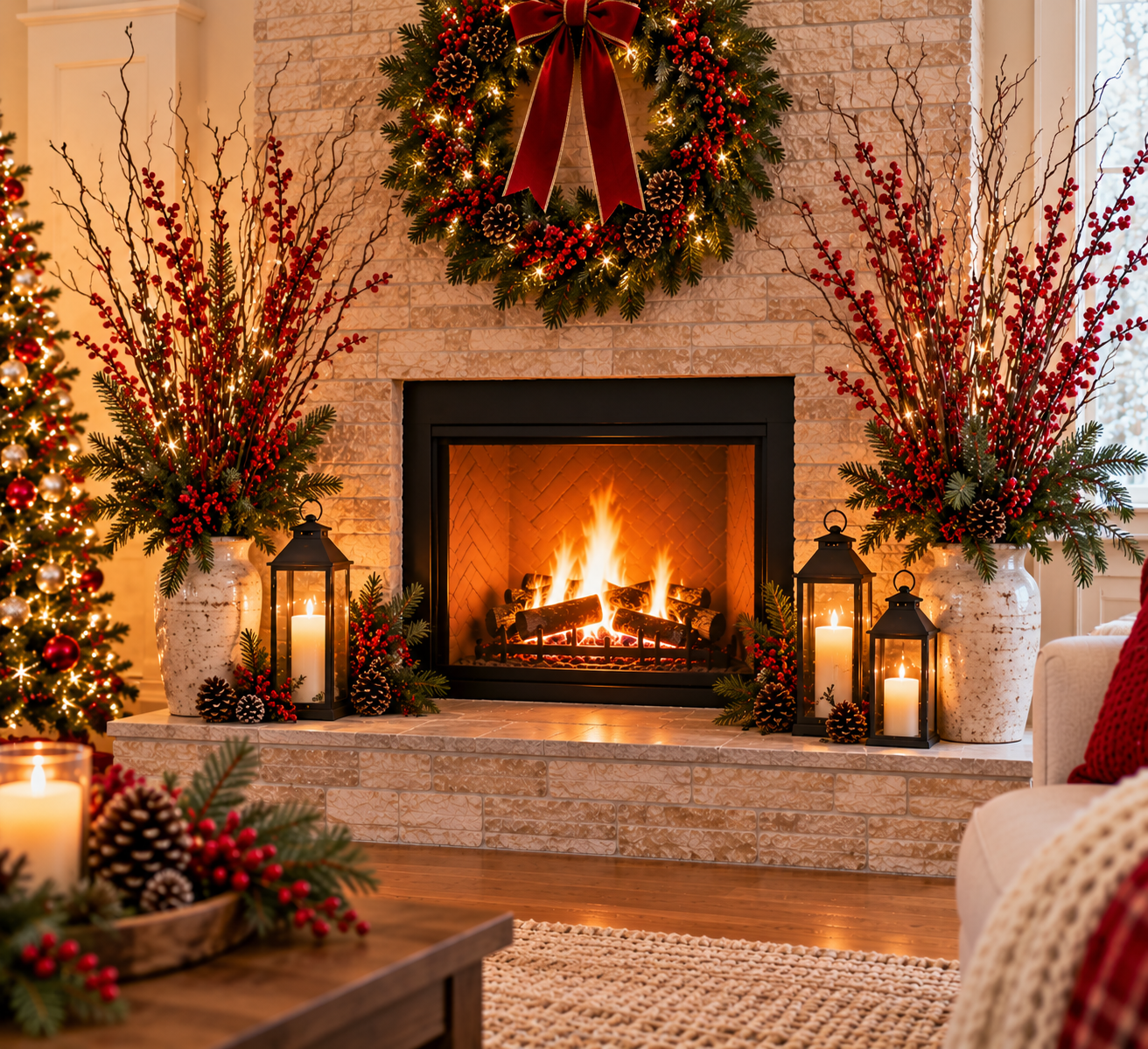
A mantel does a lot of quiet work at Christmas. It holds the garland, carries the stockings, and gives candles and little figurines a spot at eye level. Take it away and a fireplace can look oddly bare: a flat face of brick, stone, or tile with a dark opening in the middle and nothing to hang anything from.
Most holiday decorating advice assumes the shelf is there, so people end up copying photos that simply can’t work on their wall. The better move is to stop trying to rebuild a mantel and use what a mantel-less fireplace does offer: a deep hearth, a tall blank wall above, a surround you can frame, and open floor on both sides.
One question decides which of those options are safe, though, so it comes first.
Decide First: Will You Actually Light a Fire This Season?
Fire safety groups put the risk plainly. The National Fire Protection Association reports that more than two of every five home decoration fires start because the decoration was placed too close to a heat source, and its guidance on Christmas trees is to keep them at least three feet from fireplaces and other heat sources. Fire departments commonly extend that three-foot rule to anything flammable near an open flame.
A fireplace you never light is a display space. A fireplace you light every evening is a heat source with sparks, and the decorating plan changes accordingly. Here is how the main types compare.
| Fireplace type | What works | What to avoid |
| Wood-burning, used regularly | Metal, glass, and stone on the hearth; LED candles; garland and stockings on side walls or the wall well above the opening | Anything flammable inside the firebox or within about three feet of the opening; fresh greenery within reach of sparks |
| Wood-burning, going unused this winter | A full firebox display; more freedom around the opening | Forgetting the display is there when a cold night tempts someone to light it |
| Gas logs or gas insert | Decor to the sides and well above, kept clear of vents and glass | Anything on or against the glass, over vents, or near the burner; always follow the manufacturer’s manual |
| Electric | Most placements, with items kept off the heater vents | Draping fabric or greenery over the vent openings, which are usually on the top or front |
If you’re not sure which category applies, treat the fireplace as the most cautious one. The ideas below note where each one fits.
1. Frame the Opening With Garland Hung From the Brick Itself
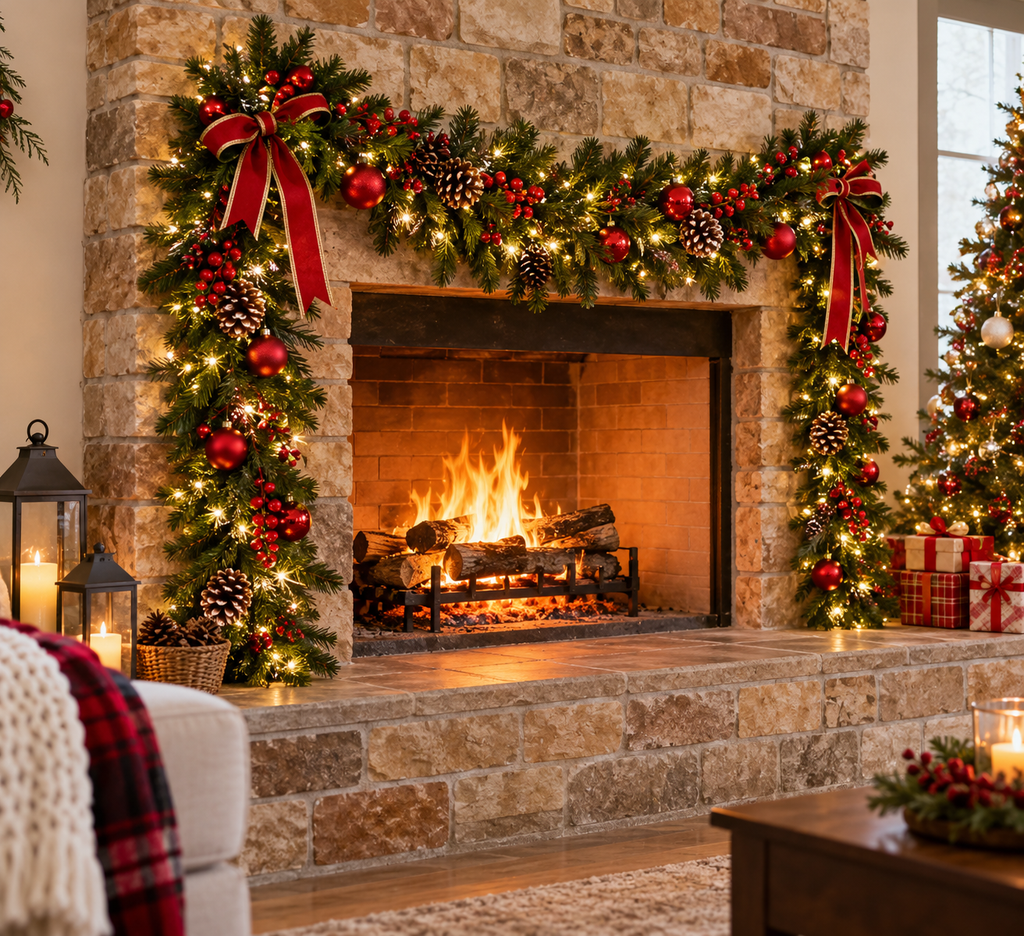
On a mantel, garland drapes along a shelf. Without one, the garland can trace the opening instead: up one side, across the top, down the other, like a picture frame. This is one of the few decorations that makes a flat fireplace face look deliberately designed rather than merely unadorned.
The obstacle is attachment, and the right answer depends on the surface.
- Brick: Brick clips hook over the edge of a brick or sit in a mortar joint, and they leave no holes. They come sized for standard brick heights, so measure one course of brick before buying. Adhesive hooks tend to fail here because brick is rough, porous, and dusty.
- Smooth tile: Removable adhesive hooks grip glazed tile far better than brick. Wipe the surface with rubbing alcohol first, let it dry fully, and check the weight rating on the package. Surfaces that stay warm from regular fires can soften adhesive, so test one hook for a day before committing the whole garland.
- Natural stone or stone veneer: The uneven face rarely accepts clips or adhesive. Hang the garland from hooks in the wall above and let it swag down the sides instead of hugging the stone.
For material, artificial garland labeled flame-resistant is the sensible choice anywhere near a fire you actually use. Fresh cut greens dry out quickly in a heated room, and dry needles ignite far more readily than fresh ones. If you want the smell and look of real cedar or fir, keep it on the far side of the room or confine it to an unused fireplace.
Warm-white battery-operated lights wound through the garland add glow without a cord running to an outlet near the hearth. Switch any lights off before bed or before leaving the house, which fire departments repeat every year for good reason.
2. Hang Stockings From a Rail or Stand Rather Than a Shelf
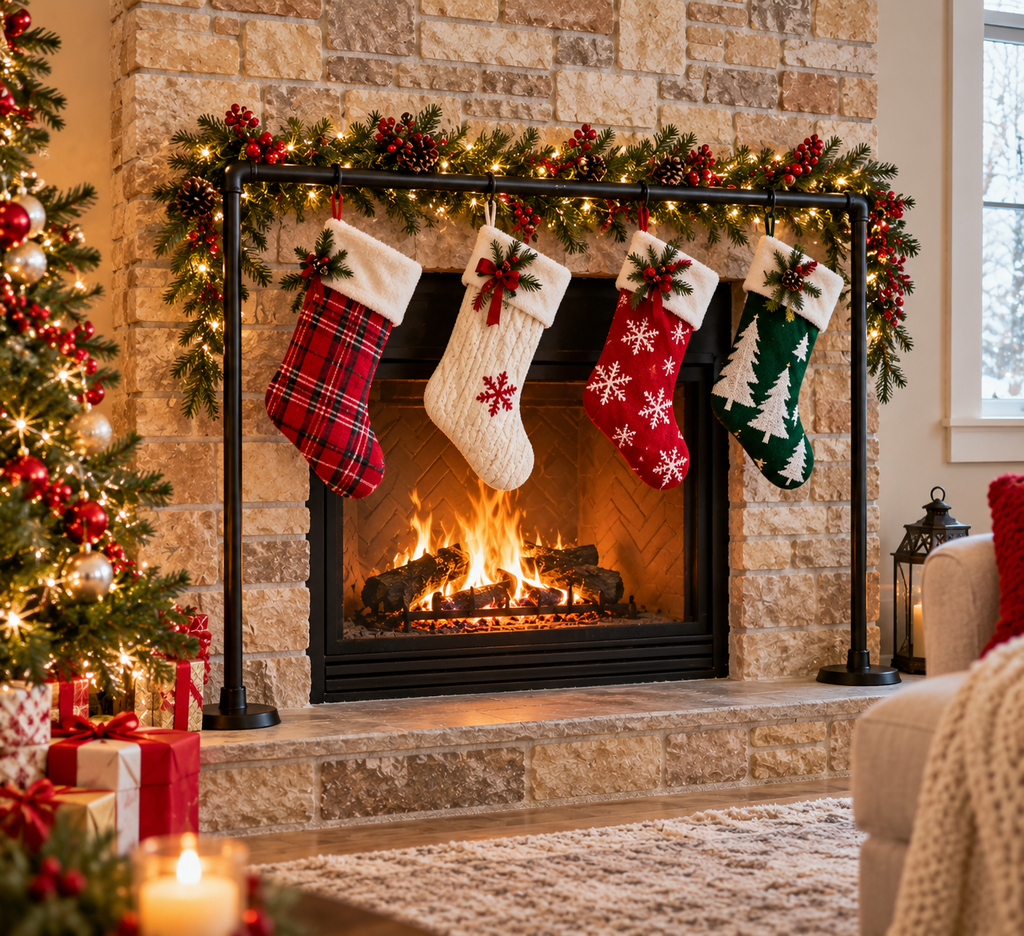
Stockings are the hardest thing to place without a mantel, and the most common workaround, nailing hooks into the surround, is rarely a good idea. Three alternatives work better.
A wall-mounted rail or rod above the opening. A simple wooden rail or a metal rod with hooks, screwed into wall studs or secured with proper wall anchors, replaces the mantel’s holding function. Filled stockings are heavier than they look once they hold oranges, chocolate, and small toys, so don’t trust a light-duty adhesive strip with a whole family’s worth.
A freestanding stocking stand. Metal stands with a weighted base and several arms can sit beside the hearth or anywhere in the room. They’re the safest choice for a fireplace that burns wood, because you control the distance.
A side wall. If the fireplace is flanked by blank wall, a row of hooks on one side keeps stockings out of the heat zone altogether.
There’s one firm rule here. Fabric stockings, especially knitted or felt ones, are fuel. If the fireplace is in use, they belong well to the side or across the room, never dangling over the opening.
3. Turn the Blank Wall Above Into the Main Event
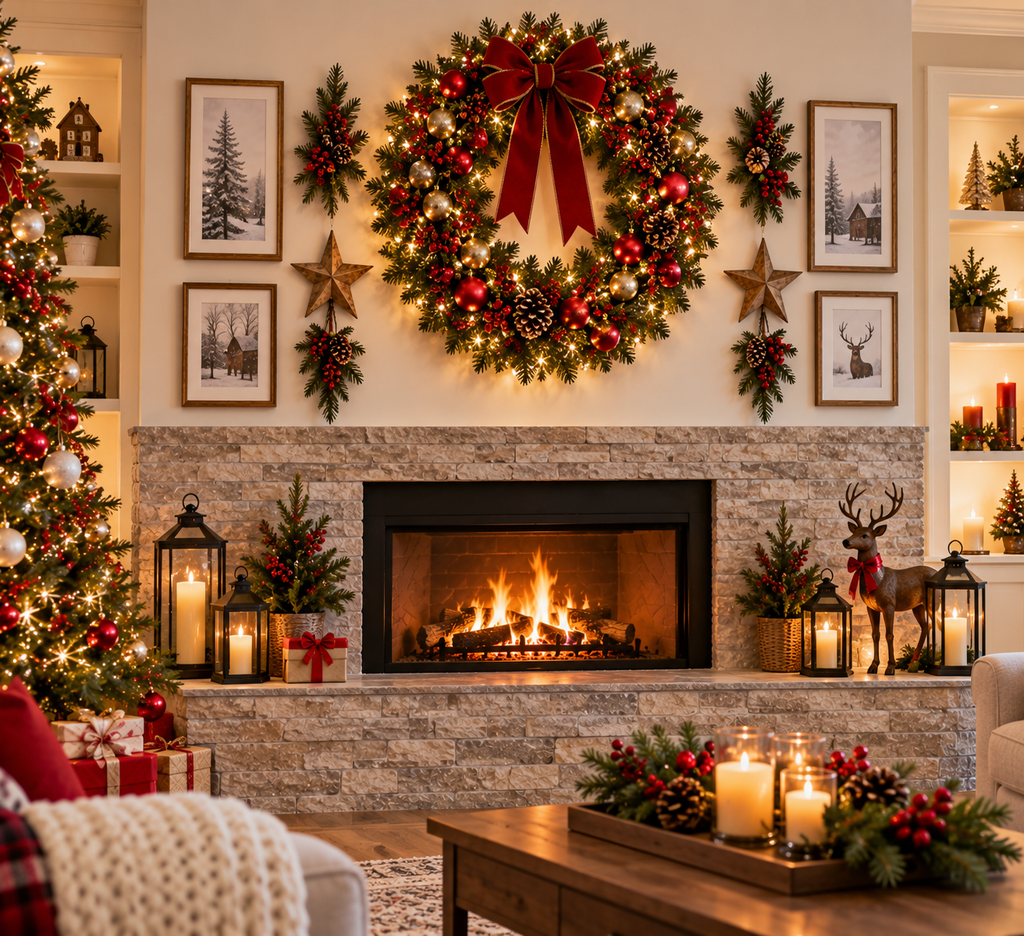
The stretch of wall above a mantel-less fireplace is often the largest empty surface in the room, and it’s where the eye lands first. Treat it the way you’d treat a mantel scene, but flat.
A few options that hold up well:
- One oversized wreath. A common design guideline says art over furniture looks balanced at roughly two-thirds to three-quarters of the furniture’s width. Applied to a fireplace, a wreath or mirror that spans about two-thirds of the opening’s width tends to look intentional rather than lost.
- A mirror wrapped with garland. The glass bounces tree lights and window light back into the room, which helps a dark corner feel livelier.
- A cluster of three framed prints or a single large piece of winter-themed art, swapped in for the season.
Two practical points. A large mirror or heavy wreath needs to hang from a stud or a correctly rated anchor, not a small nail. And the wall above a fireplace that’s used often runs warmer than the rest of the room, which is hard on dried flowers, natural-fiber wreaths, and anything with wax or glue. Choose sturdier materials such as artificial evergreen, metal, or wood, or hang the display a bit higher than you normally would.
4. Flank the Fireplace With a Pair of Small Trees
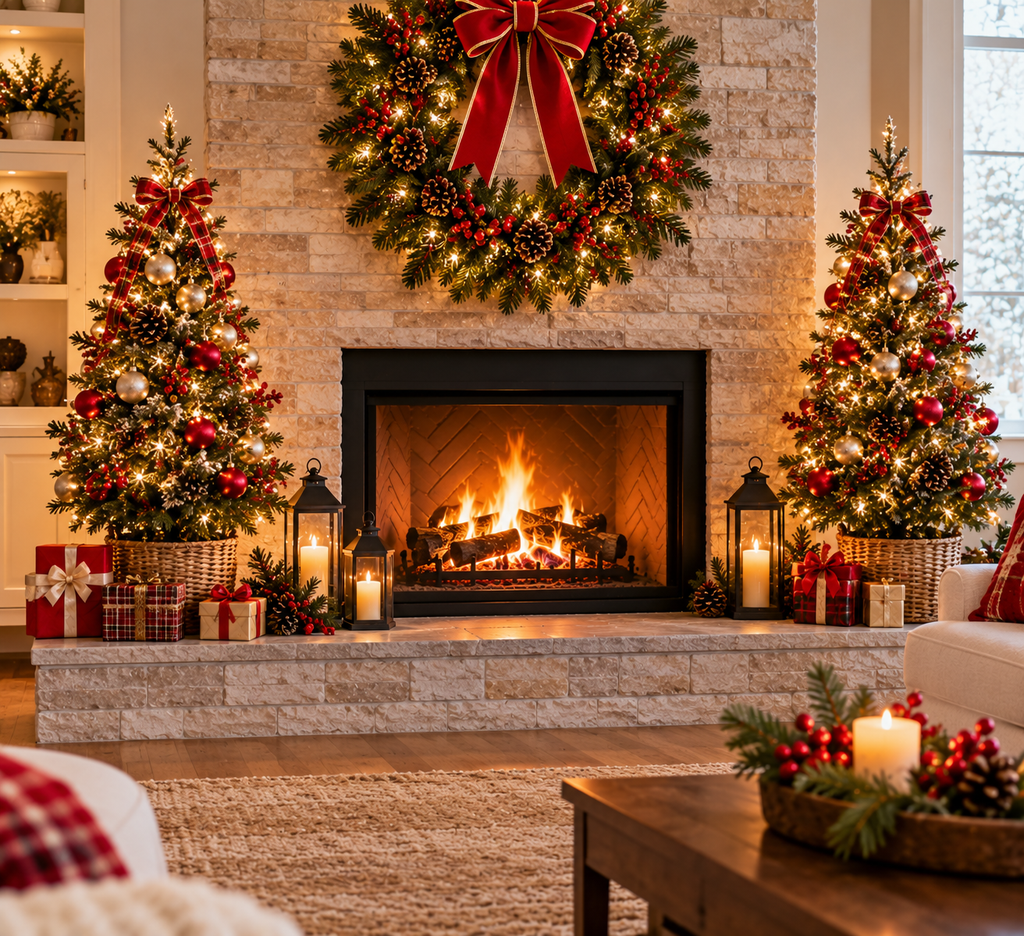
Symmetry does what the mantel’s horizontal line would otherwise do. A matching pair of slim trees, one on each side, sets the width of the whole arrangement and fills the awkward floor space beside a flush hearth.
Size matters more than most people expect. Trees that stop well below the top of the opening look stubby, while trees at about the height of the opening or a bit taller give the fireplace a framed, built-in look. Pencil-shaped artificial trees in the 4- to 6-foot range suit many fireplaces; measure yours first.
Live potted options also work and tie in nicely with a garden-minded home:
- Dwarf Alberta spruce, which has a naturally tidy cone shape
- Rosemary trained into a topiary cone, which smells good and tolerates indoor light better than many evergreens
- Small potted cypress or boxwood topiary
Live plants still need light and water, so a dim corner shortens their lives. Mist-free, cool, bright spots do best, and a plant stored by a working fire will dry out faster than one across the room.
The three-foot guidance for Christmas trees applies here too. Keep tree-shaped plants, live or artificial, at least that far from a burning fireplace. If your hearth is shallow and the trees would sit closer, use tall slim vases of branches instead (see idea 9).
5. Build a Glowing Scene on the Hearth Itself
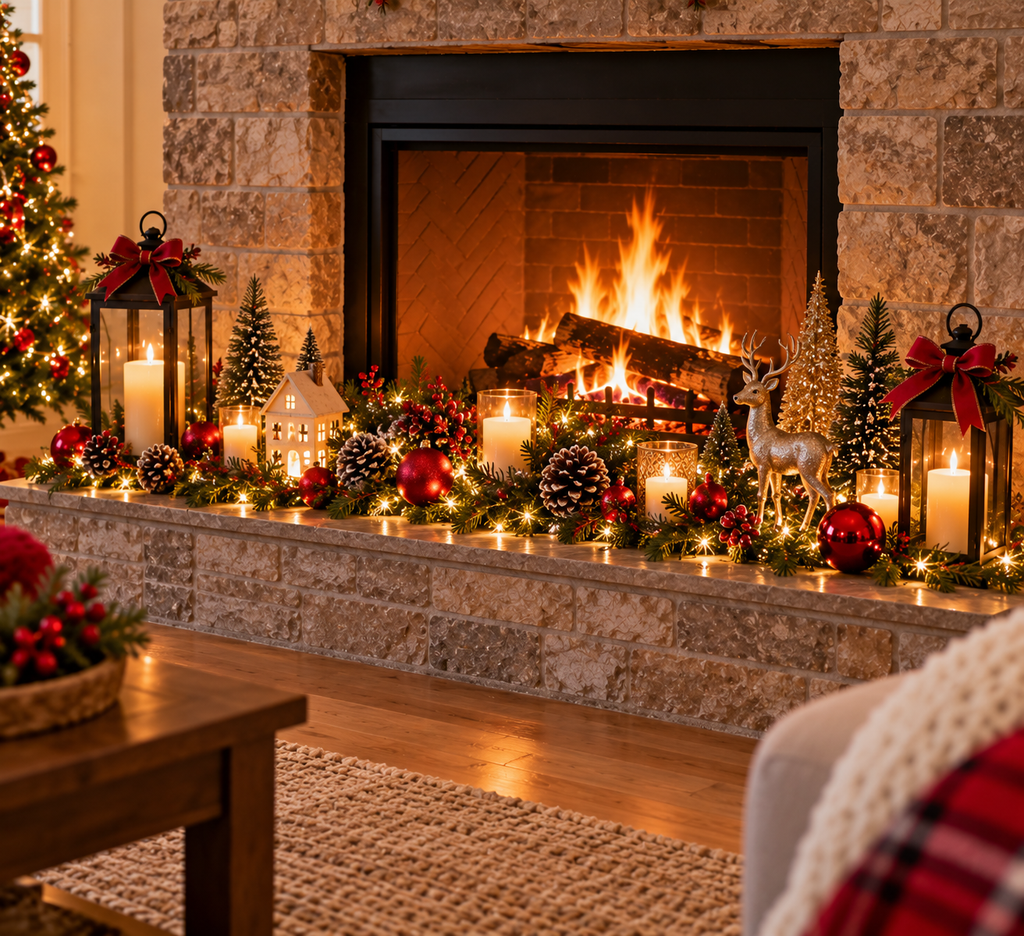
A raised or deep hearth is the closest thing a mantel-less fireplace has to a shelf, and it’s non-combustible by design, which makes it the best surface for anything that glows.
What works: a cluster of lanterns in different heights, a few pillar-style candles on a metal tray, glass hurricane vases, small mirrored trays, and a bowl of pinecones or ornaments. Group in odd numbers and vary the height, so the arrangement climbs from the floor toward the wall.
On flame, be conservative. NFPA data show that candles start more than a third of home decoration fires, and its guidance is to keep lit candles at least 12 inches from anything that can burn. Christmas Day, New Year’s Eve, and New Year’s Day are the peak days for home candle fires. Real candles on a hearth need clear space from stockings, garland, and ribbons, and they should never burn unattended.
Battery-operated flameless candles solve most of that and look convincing in lanterns, particularly the warm-white ones with a flickering setting. They’re also the better choice around children and pets.
If the hearth is only flush with the floor, which many fireplaces without mantels are, set items on a tray or a low wooden riser so the scene doesn’t disappear behind a coffee table or an ottoman.
6. Fill an Unused Firebox
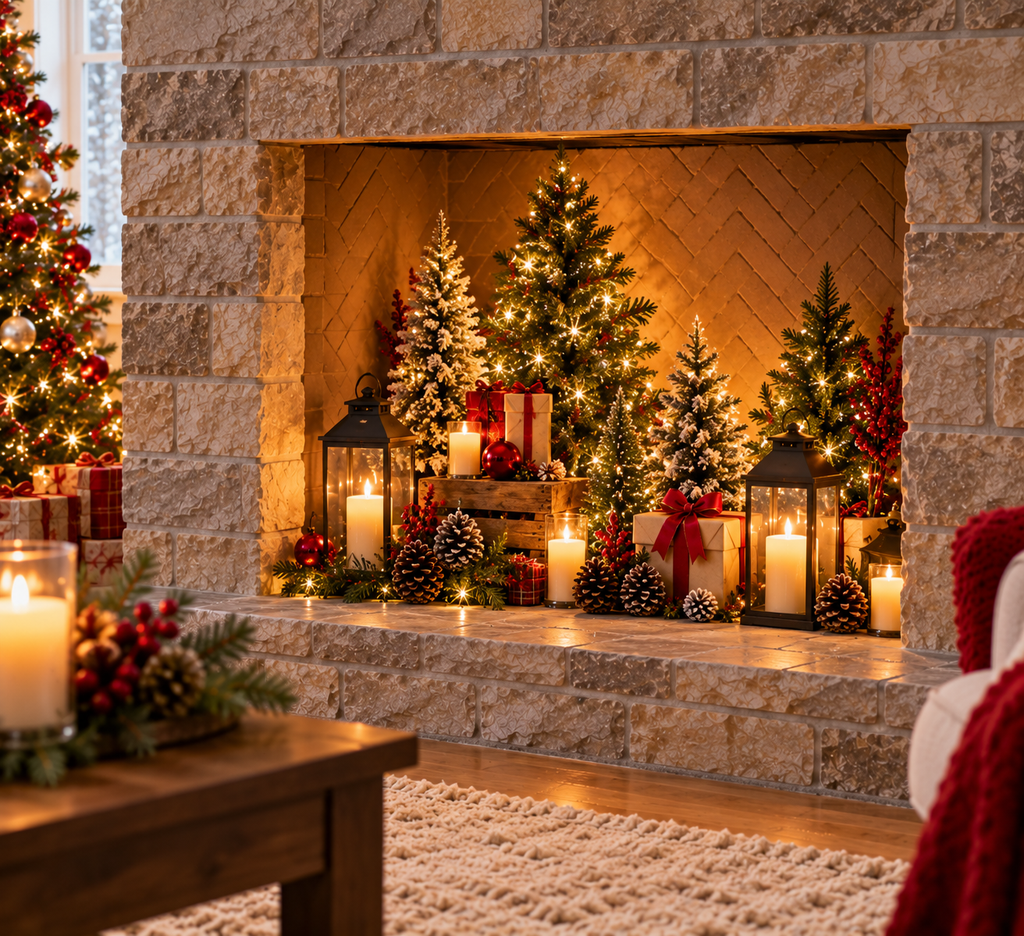
A firebox you won’t light this winter is the one part of the fireplace that can hold a display, and it’s a good one. A dark recess photographs beautifully when it’s filled with light.
Options include:
- A stack of birch logs with a battery string of warm-white lights tucked between them
- Lanterns of varying heights
- Pillar-style flameless candles on a log round
- Pinecones, oranges, or ornaments in a shallow basket
- A mix of real firewood with a few evergreen sprigs
Three cautions come with this idea. First, it only applies to a fireplace that really is out of service for the season. Anyone in the household who might light it on a cold night needs to know, and it helps to post a visible note on the screen. Second, if a fire is lit even once, everything combustible has to come out first, including paper, fabric, and dry greens. Third, gas fireplaces and inserts are a different case: don’t place items on or around the burner, logs, or vents, and read the manufacturer’s manual before putting anything in the firebox.
Smoke from a poorly vented fireplace is also a safety matter that goes beyond decorating. A chimney that hasn’t been inspected should be checked before its first use of the season, which is a job for a certified chimney sweep.
7. Let Firewood Be the Decoration
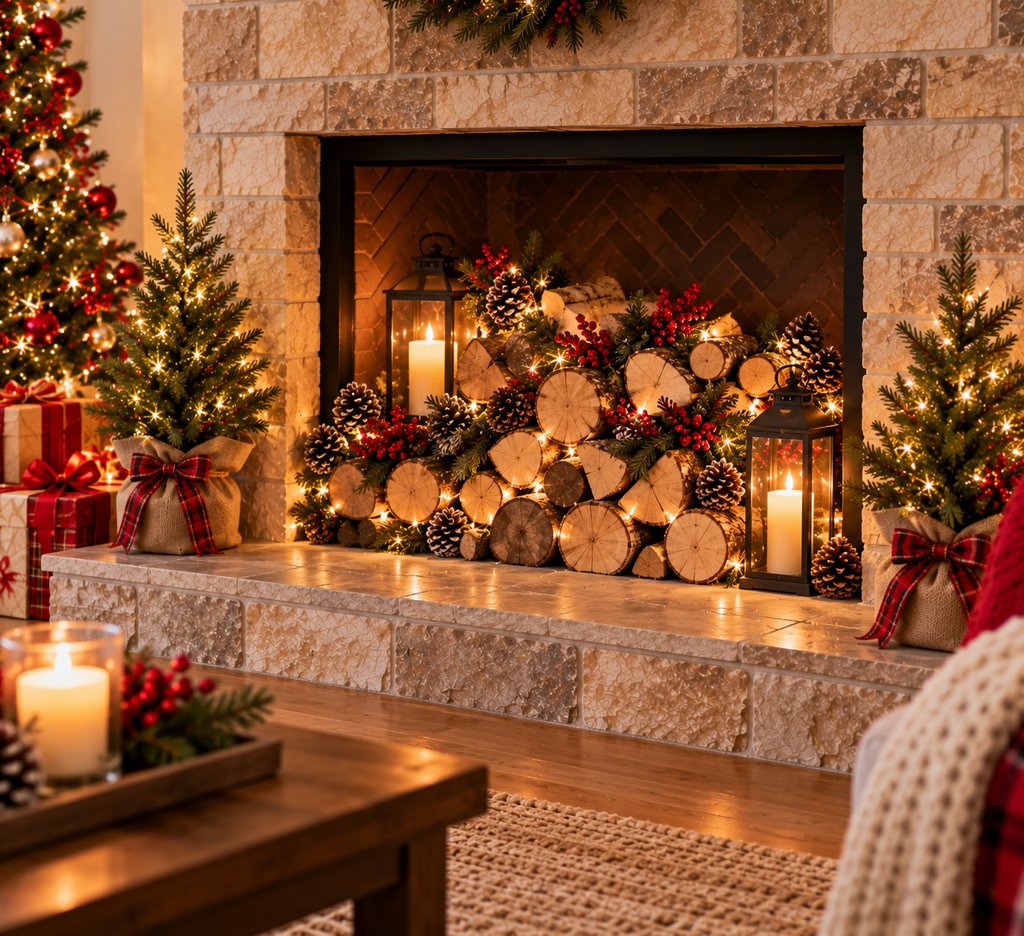
With no mantel to dress, one of the simplest ideas is to feature the fuel. A wide basket, a wrought-iron log rack, or a tall metal bin filled with split logs reads as warm and rustic, and it’s useful in a household that does burn wood.
To make it feel seasonal rather than just practical:
- Tuck a few sprigs of pine, cedar, or fir into the gaps between logs
- Tie a plaid or velvet ribbon around the basket handle
- Add a few pinecones on top of the stack
- Use stacked logs under a floating shelf or beside the hearth for added texture
The greenery in this setup should be removed before any logs are used, and the stack should sit off to the side rather than directly against the firebox opening. Firewood stored indoors can also carry insects, so stacking only a day or two’s supply near the house is a sensible habit.
8. Add a Slim Picture Ledge or Floating Shelf With the Right Clearance
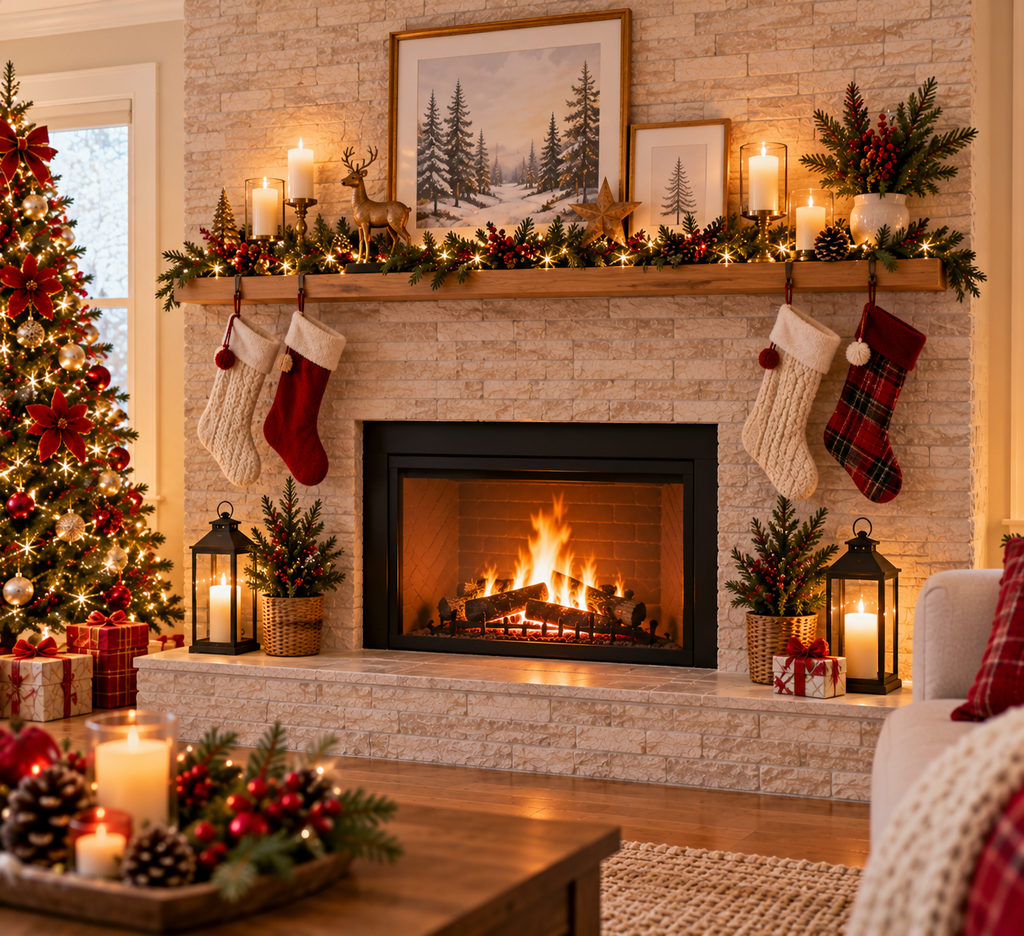
If you miss the mantel itself, a slim shelf above the opening can serve in its place. Narrow picture ledges are especially useful because they hold small items without protruding far into the room.
There’s an important catch, which most decorating articles skip. Wood-burning fireplaces are subject to clearance rules for combustible material above and beside the opening, and the specifics depend on the fireplace design, local building codes, and the manufacturer’s instructions. A wooden shelf mounted too low could be a fire risk, and it could also be a code issue. Gas and electric units have their own manufacturer requirements, since heat can exit upward through the top of some models.
Before buying or mounting anything, check three things: the manual for your specific fireplace or insert, your local building code, and, if you’re uncertain, a qualified fireplace or chimney professional. I’d treat the exact clearance numbers as something to confirm for your own unit rather than assume.
If a shelf turns out to be a poor fit, a non-combustible option such as a metal or stone ledge may be allowed closer. Alternatively, mount the shelf high enough that it sits well above the heat zone and use it for lightweight pieces such as a few small frames, a row of paper stars, or a short garland.
9. Bring in Tall Branches and Berried Stems
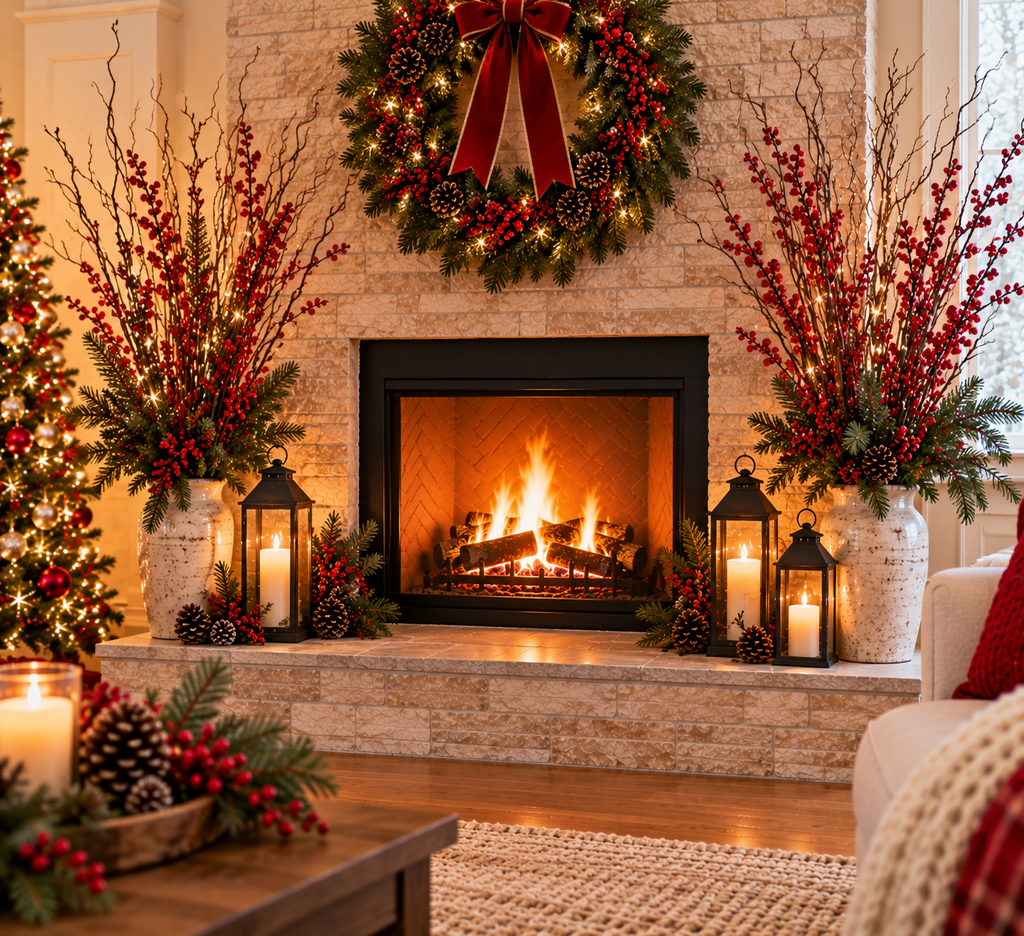
Tall vases of branches fill the vertical space on either side of a fireplace, and they work particularly well where a pair of trees won’t fit. They’re also an inexpensive way to bring in texture that artificial trees can’t match.
Stems that tend to hold their appearance in water:
- Birch branches, for white bark and a graphic look
- Red-twig dogwood, for color without any flowers
- Winterberry holly, for clusters of red berries
- Evergreen boughs, such as fir, cedar, or pine
- Eucalyptus, for a silver-green, aromatic accent
Use heavy, wide-based vases, since long branches are top-heavy. Fill them with water, not just to hold the stems but to keep greenery from drying quickly. Check the water every few days and re-cut the stems occasionally. How long a cut branch lasts varies with the species and the warmth of the room, so rotate out any that start to shed.
A safety note on plants: holly berries and mistletoe can cause illness if eaten, and some are especially risky for pets and small children. Keep them out of reach, and check the ASPCA’s plant list if you have animals.
As with trees, keep cut greenery away from the opening of a fireplace that’s in regular use.
10. Work Around a TV Instead of Pretending It Isn’t There
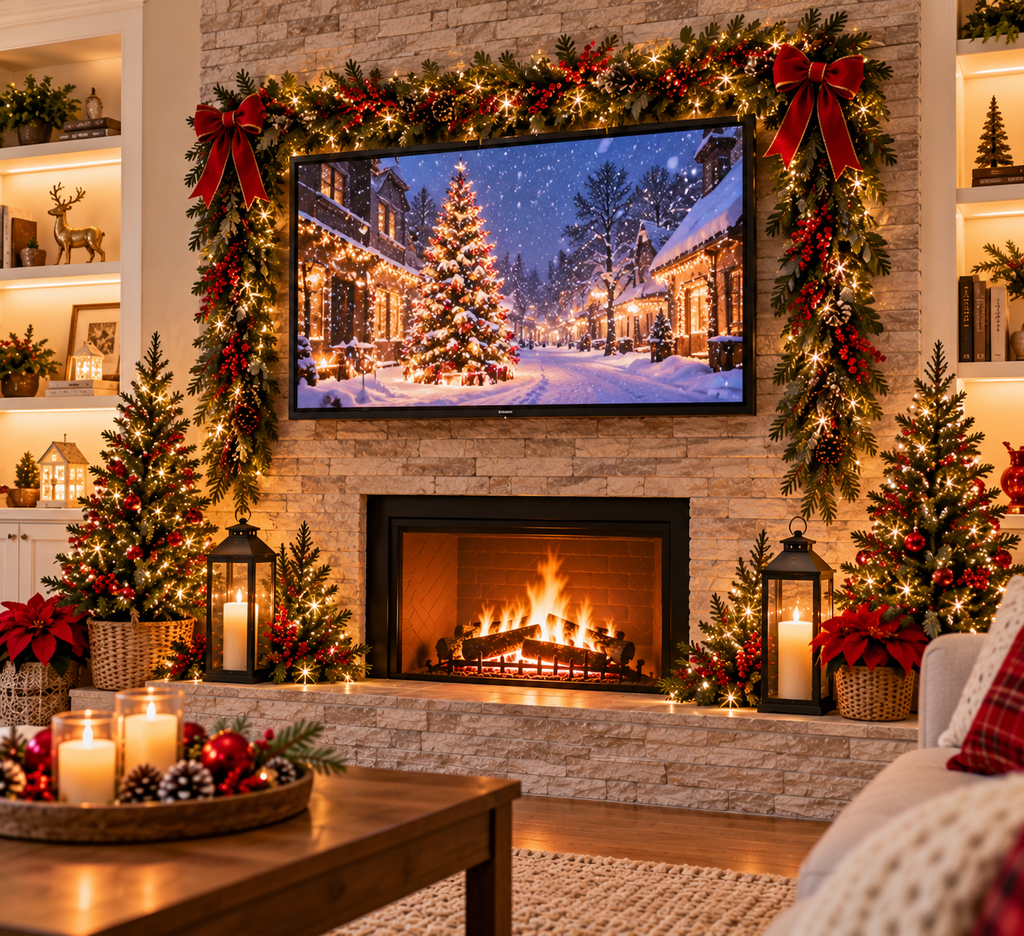
A television mounted above the fireplace is one of the most common reasons people say they can’t decorate. The usual advice, a big wreath, runs into the screen. The cleaner solution is to decorate around the TV rather than over it.
- Frame it: A garland along the sides and top of the TV, if the TV is mounted flush against the wall, makes the set look like part of the display. Use hooks above and beside the screen, not on the TV itself.
- Use the sides: Tall pairs of trees or branch vases on each side pull the eye outward and make the screen feel smaller.
- Use the hearth: Put the glowing scene from idea 5 below it. When the TV is off, the arrangement still carries the room.
Two cautions apply. First, heat rising from a lit fireplace can shorten a television’s life, and many manufacturers advise against mounting above an active wood fire, so check the TV’s manual if yours is in that position. Second, keep cables and chargers neat, because decorations that tangle with cords are an easy trip and fire hazard.
How to Pull the Whole Look Together
A few rules keep a mantel-less fireplace from looking either empty or crowded.
Pick two or three materials and repeat them: say, evergreen, warm metal, and white birch. Mixing a dozen finishes is what makes a hearth look busy.
Build height in layers. Floor-level items such as baskets and lanterns, mid-height items such as trees and branch vases, and wall-level items such as a wreath or mirror give the eye a path upward, which compensates for the missing shelf.
Leave breathing room. A hearth with three well-chosen groupings looks better than one crowded with twenty small pieces.
Last, check the electrical side. Use lights with a UL or similar safety listing, avoid running too many strands end to end, and use clips rather than nails to hang cords so the insulation isn’t damaged.
Key Takeaways
A fireplace without a mantel needs a different plan, not a lesser one. Start by deciding whether the fireplace will burn this season, because that determines how close anything flammable can go. Use brick clips, studs, or freestanding stands instead of forcing hooks into surfaces that won’t hold them. Put anything that glows on the hearth, use flameless candles wherever you can, and confirm clearances for your specific unit before adding a shelf or hanging a TV. Three or four well-placed groupings will do more than ten scattered ones.

About Syprose Kiche
Syprose Kiche is the creator and writer behind My Besuited Home, a practical home and garden website covering DIY projects, gardening, lawn care, landscaping, home improvement, and outdoor living. She focuses on turning everyday homeowner questions into clear, practical guides backed by careful research and useful real-world considerations.