
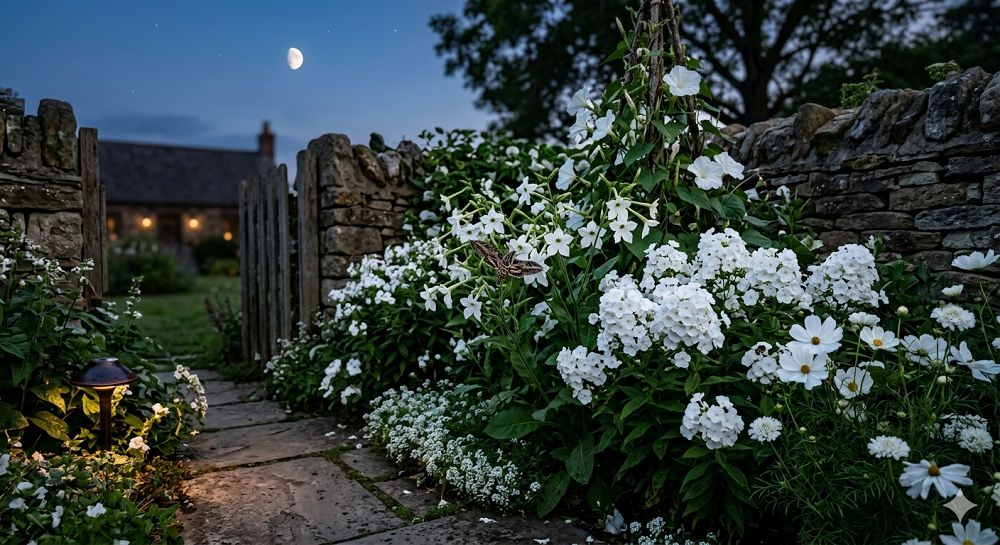
Your backyard is completely forgettable after dark. That’s the honest truth. Most gardens look like a black void once the sun goes down — all that effort, all those hours of weeding and watering, and you can’t even enjoy it after 7 p.m. I’ve been there. My garden used to roll up like a shop closing for the night the moment dusk hit.
Then I stumbled into moon gardening completely by accident. A neighbor had planted a corner bed with nothing but white blooms and silvery-leafed plants, and at 9 p.m. on a summer night it looked like something out of a fairytale. I stood at her fence like an absolute weirdo for a solid five minutes. She eventually came outside and gave me a cutting of her nicotiana, and my obsession officially began.
A moon garden isn’t just a garden with white flowers. It’s a sensory experience designed for evening. It glows. It smells incredible. It makes you actually want to sit outside with a glass of wine instead of retreating to the couch. Here are 11 ideas that’ll transform your outdoor space into something magical after dark.
1. Start With White Flowering Shrubs as Your Moon Garden Anchor
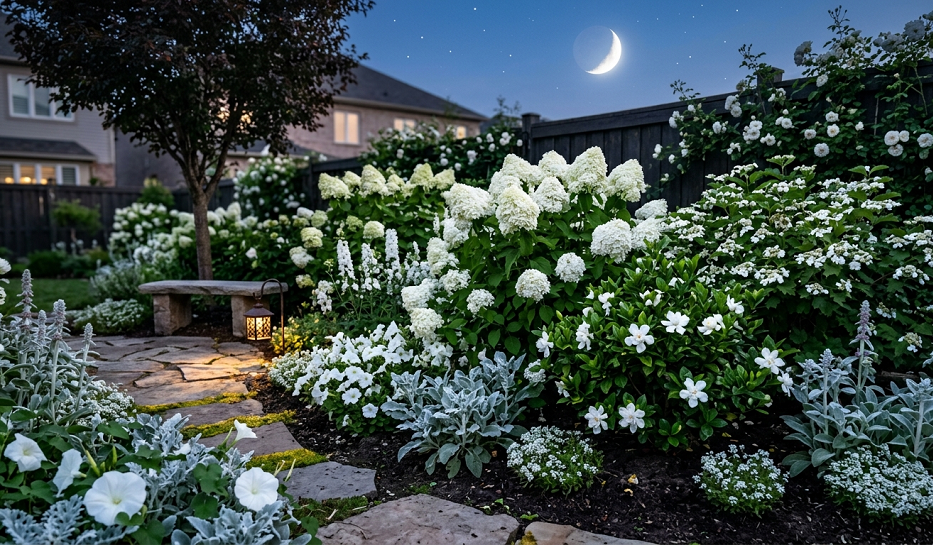
Every great moon garden needs a backbone, and white flowering shrubs are the workhorses that give it structure year after year. I made the mistake of planting only annuals my first season. By July I had a patchy, uneven mess because a few things died and the whole design collapsed. Shrubs fix that problem permanently.
Gardenia is my absolute number one recommendation here. Yes, it can be fussy about humidity and pH. Yes, I’ve killed two of them through sheer stubbornness about not adjusting my soil. But when it blooms and that fragrance rolls across your yard on a warm evening — there is nothing else like it. Get your soil to a pH of 5.0–6.0, mulch heavily, and it will reward you every single year.
White hydrangeas — specifically Hydrangea paniculata ‘Limelight’ or ‘Incrediball’ — are far more forgiving and absolutely luminous at night. The big mophead blooms catch whatever ambient light exists and seem to generate their own glow. They’re also drought-tolerant once established, which I appreciate deeply after the summer I nearly flooded my foundation trying to keep a fussier shrub alive.
For something with a looser, wilder feel, consider white-flowering spirea (‘Bridal Wreath’ is the classic) or mock orange (Philadelphus). The mock orange is a total sleeper hit. It blooms in late spring with a fragrance that smells like, well, orange blossoms, and at night those clusters of white flowers look almost supernatural against dark foliage.
Space your anchor shrubs at the back or edges of your bed. They’re the frame; everything else is the painting.
2. Plant Night-Blooming Flowers for True Moonlight Garden Magic
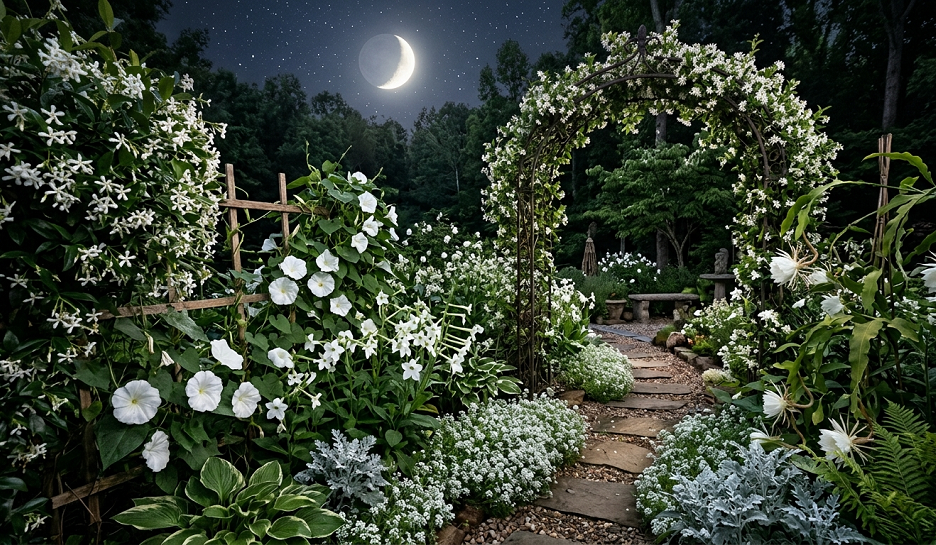
Here’s what separates a “garden with white flowers” from an actual moon garden: flowers that save their best performance for after dark. Some plants genuinely prefer the night. They open up, release fragrance, and put on a show specifically when the sun goes down. Planting these is one of the smartest things I’ve ever done.
Moonflower vine (Ipomoea alba) is the crown jewel. Each bloom is about four to six inches across, pure white, and it unfurls right at dusk in a slow spiral that is genuinely mesmerizing to watch. I’ve sat outside with guests specifically to watch a moonflower open. It’s that good. Grow it up a trellis, a fence post, or any structure near a seating area so you can actually witness the show.
Four o’clocks (Mirabilis jalapa) open in the late afternoon and stay open through the night, which is a long performance window by any standard. You can get them in white, and they’re wonderfully vigorous. Almost aggressively vigorous, honestly — the summer mine self-seeded everywhere, I found them growing through a crack in my patio stones. I didn’t even mind.
Evening primrose (Oenothera biennis) is another one that blooms at dusk. The soft yellow-white flowers open fast — fast enough to watch — and they attract hawk moths, which are incredible night pollinators that hover like hummingbirds. If you want to make your moon garden feel alive and wild at night, add evening primrose.
Casablanca lily (Lilium ‘Casa Blanca’) blooms during the day but its fragrance intensifies significantly at night. It’s not technically a night-bloomer, but it earns its spot in any moon garden discussion based on scent alone. Large, waxy, white, and almost aggressive in its perfume — it’s wonderful.
3. Use Silver and Gray Foliage Plants to Maximize the Glow Effect
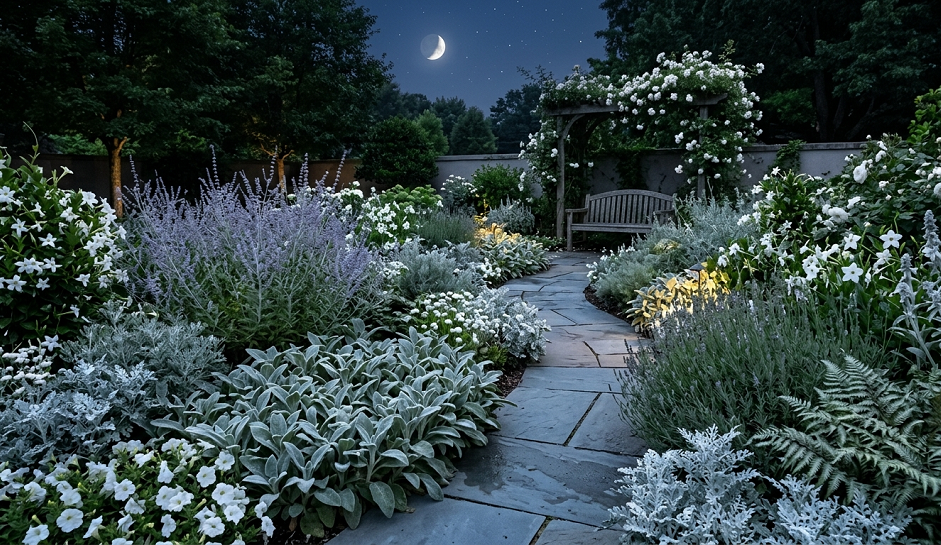
This is the moon garden trick most beginners skip, and it’s honestly half the secret. White flowers glow at night, but silver-leaved plants reflect light in a completely different way — they shimmer. They add dimension and movement even when the air is still.
Lamb’s ear (Stachys byzantina) is cheap, tough, spreads aggressively, and looks spectacular in moonlight. The fuzzy silver leaves catch dew and moonlight like tiny mirrors. I have it edging half my moon garden and it’s the first thing visitors comment on. One warning: it will spread into everything if you don’t divide it every couple of years. I’ve found it three feet into a neighboring bed on more than one occasion.
Dusty miller (Senecio cineraria) is another silver standby that works beautifully as a border plant or filler between larger white-blooming specimens. It’s usually grown as an annual in colder climates, but I’ve had it overwinter successfully in a sheltered spot in Zone 6, which was a delightful surprise.
For something more dramatic, try Russian sage (Perovskia atriplicifolia). Yes, it has lavender-blue flowers, which technically breaks the white-only rule — but the silver stems and foliage are so luminous at night that I’ve included it in my moon garden without a single regret. The fine-textured leaves catch light beautifully and the whole plant has an ethereal, misty quality.
Artemisia (wormwood/sage) in any of its silver cultivars — ‘Powis Castle,’ ‘Silver Mound,’ or ‘Silver King’ — gives you a reliable, drought-tolerant silver anchor. It’s the most foolproof choice in this category and I recommend it to every moon garden beginner.
4. Design a White Flower Border Along a Nighttime Garden Path
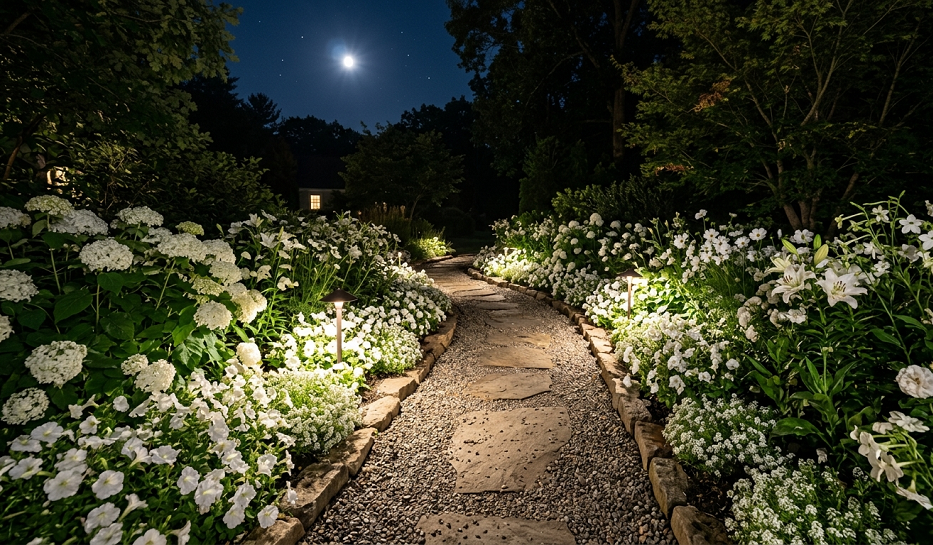
A moon garden path is one of those ideas that sounds fancy but is genuinely practical. When you’re walking outside at night — whether to let the dog out, sit on the patio, or stargaze — having a glowing ribbon of white flowers alongside the path means you don’t have to fumble with your phone flashlight. My kids started actually using the backyard at night once I put this in.
The best plants for a white flower border are ones that are low-maintenance, reliably white, and have some fragrance as a bonus.
Sweet alyssum (Lobularia maritima) is a ground-level border plant I genuinely love. It’s got tiny white flowers, a honey-like fragrance that gets stronger at night, and it’s so easy to grow from seed that it borders on embarrassing. Sprinkle seeds along the path edges in spring and by June you have a fluffy white carpet. It also self-seeds, so you’ll often get volunteers the following year without any effort at all.
White impatiens work beautifully in shaded path areas — under a tree canopy or along a fence — where almost nothing else will perform. They’re reliable, they bloom all season, and in low light they practically glow on their own. I know some gardeners turn up their noses at impatiens because they’re “ordinary,” but ordinary and luminous is exactly what you need for a path border.
For taller accents along the path, alternate in white salvia (Salvia farinacea ‘White Victory’) or white cosmos (Cosmos bipinnatus ‘Purity’). The cosmos in particular are incredible — their feathery foliage and large white blooms sway in the evening breeze and look genuinely romantic at night.
5. Add a Focal Point With a White Rose Climbing Trellis
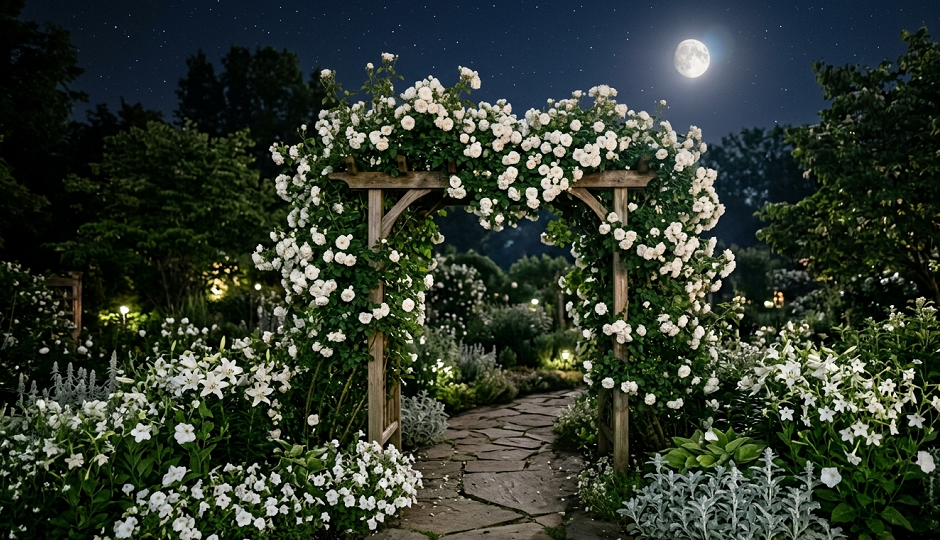
A climbing white rose on a trellis or arbor is the most classically romantic element you can add to a moon garden, and I will stand by that opinion forever. The first time I saw ‘Iceberg’ climbing rose in full bloom at night, under a half-moon, I genuinely felt like I was in a movie scene.
‘Iceberg’ climbing rose is my top pick — it’s disease-resistant (mostly), repeat-blooms from spring through frost, and the pure white flowers are produced in massive clusters. It’s not completely bulletproof; I did have a rough year with black spot when I ignored the watering schedule in a drought, but one season of attentiveness brought it right back.
‘New Dawn’ is a historic climbing rose with soft blush-white blooms and exceptional vigor. When I say exceptional vigor, I mean I planted it against a 6-foot fence and it was touching the roofline of my garage within three years. Plan your support structure accordingly. The fragrance is outstanding and those pale pink-white blooms are ethereal at night.
‘White Eden’ is a newer repeat-bloomer that’s more compact than New Dawn, which makes it better for smaller spaces. It has the classic cupped, old-rose bloom shape that photographs beautifully and performs even better in person.
Build your trellis or arbor near your primary seating area if possible. Sitting under a blooming white climbing rose on a summer evening with a glass of something cold is the entire point of having a garden.
6. Plant White Scented Flowers Specifically for Evening Fragrance
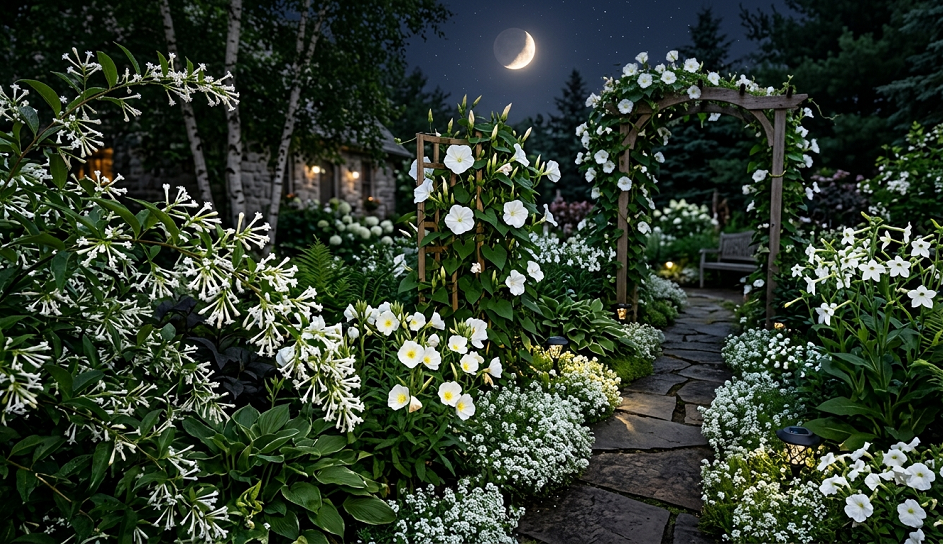
A moon garden that doesn’t smell good is half a moon garden. Fragrance is the invisible layer, and in the evening when the air is cooler and stiller, scents carry farther and last longer. This is actually science — volatile aromatic compounds evaporate slower in cool air. Your garden literally smells better at night.
Beyond the gardenias and moonflowers I’ve already mentioned, nicotiana (Nicotiana alata, the old-fashioned fragrant species, not the modern ornamental hybrids) is my most-recommended fragrant moon garden plant. The small white tubular flowers open at dusk, the fragrance is sweet and complex, and it blooms prolifically all summer. That cutting my neighbor gave me years ago? My nicotiana patch is now eight feet wide. I’ve given starts to probably thirty people.
White stock (Matthiola incana) is another fragrant powerhouse. It’s a cool-season annual, which means you plant it in early spring or fall — it doesn’t tolerate summer heat. But while it blooms, the clove-like fragrance is stunning. I plant it twice: once in spring and again in late summer for fall blooms.
Tuberose (Polianthes tuberosa) is about as close as you can get to liquid perfume in plant form. Rich, creamy, white, almost intoxicating. It’s a tropical bulb that needs to be dug up in cold climates, which is an extra step I consider completely worth it. It blooms in late summer when evenings are still warm enough to sit outside and actually enjoy it.
7. Create a White Moonflower Vine Screen for Privacy and Drama
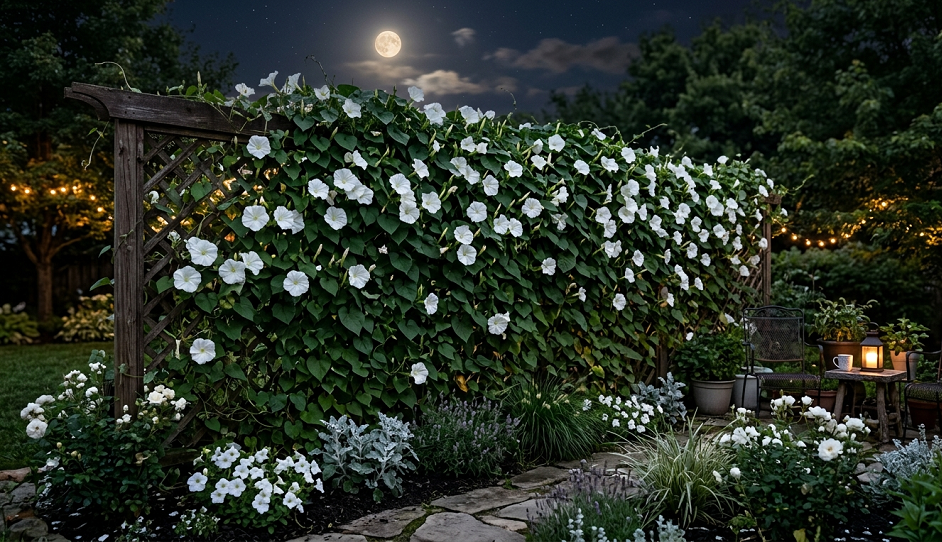
If you have a fence, a pergola, or any vertical structure you need to soften, a moonflower vine (or combination of vines) creates a living screen that doubles as a moon garden show-stopper. My backyard pergola went from sun-bleached sad lumber to a romantic outdoor room the summer I planted it out with moonflower and white mandevilla.
Moonflower (Ipomoea alba) grows fast — I’m talking 10 to 15 feet in a single season in warm climates. Give it something to climb and it will cover it enthusiastically. Nick the seeds before planting and soak them overnight for better germination; I skipped this step the first year and had terrible results.
White mandevilla (Mandevilla ‘White Delight’ or similar) is a tropical vine with glossy leaves and large, trumpet-shaped white flowers. It’s not cold-hardy above Zone 9, so I grow mine in pots and bring them in before frost. That’s extra work, but those glossy leaves and big blooms earn their keep.
For a perennial option in colder zones, sweet autumn clematis (Clematis terniflora) covers itself in tiny, star-shaped white flowers in late summer and fall. The fragrance is sweet and pleasant, and it’s the only fall-blooming clematis I’ve grown that actually delivered on its promise. Fair warning: it self-seeds aggressively. I found seedlings three gardens over. Deadhead rigorously.
8. Use Containers and Pots of White Annuals to Flex Your Moon Garden Design
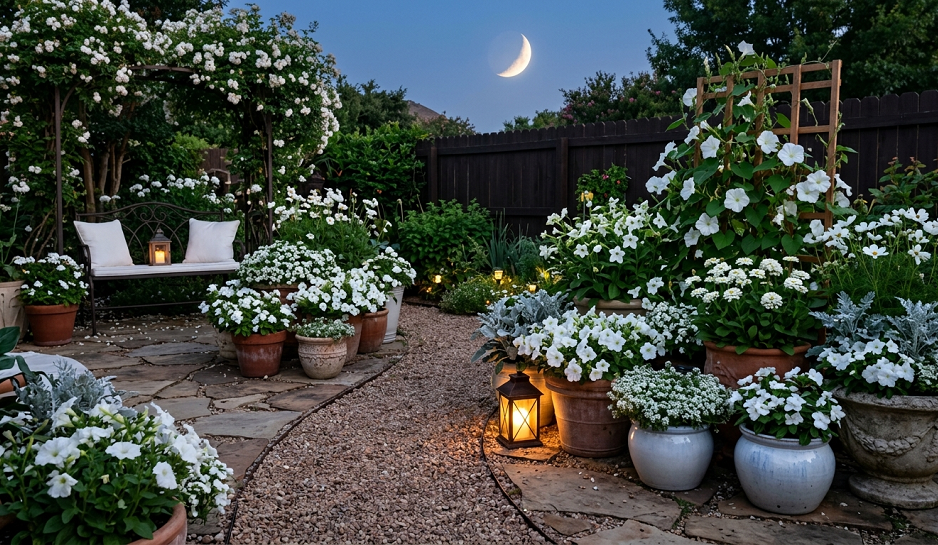
Container planting is the most underrated moon garden strategy there is. Pots let you move your white-flower magic wherever you need it — onto the patio, flanking a door, clustered near a seating area — and you can change the display each season without committing to permanent beds.
My favorite container combination for moon garden impact is white petunias + white bacopa + silver dichondra. The petunias give you volume and fragrance, the bacopa trails elegantly over the edge, and the silver dichondra cascades down in long silver curtains that look absolutely wild at night. Once you try this combo, you’ll plant it every summer.
White calibrachoa (million bells) in a hanging basket near your patio is a simple, foolproof choice. They bloom continuously from spring through frost without deadheading, cascade beautifully, and the small white flowers glow at night in a way that belies how inexpensive and low-maintenance they are.
One thing I’ve learned about container moon gardens: pot size matters more than people think. Underpotting is the most common container mistake. A moonflower vine in a two-gallon pot is going to be sad and stunted. Go big — minimum five gallons for vines and large annuals — and you’ll water less and get far better performance.
9. Install Low-Voltage Path Lighting to Enhance the Moon Garden Effect (Strategically)
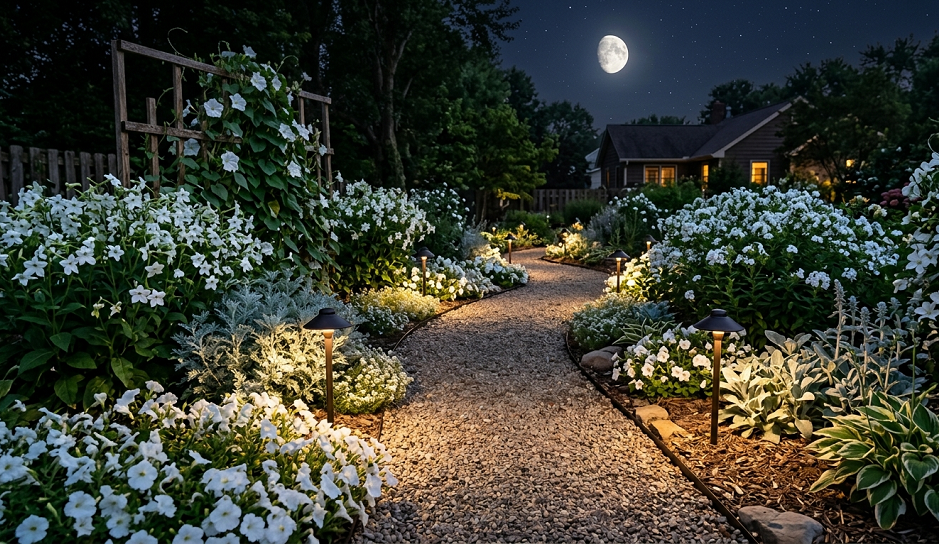
I know, I know — isn’t the whole point of a moon garden that it glows naturally? Yes. But a little well-placed lighting goes an enormous way, and I’ve become a convert to using it thoughtfully. The key word is thoughtfully. Blow-torching your garden with bright white LED spotlights defeats the entire point and ruins the ethereal effect you’ve worked so hard to create.
What you want is warm-toned, low-voltage uplighting positioned to graze across white flower clusters from below. When a beam of 2700K warm white light catches a stand of white hydrangeas from a low angle, the effect is honestly breathtaking. It enhances the natural glow rather than replacing it.
Solar path lights are fine for marking edges, but I’ve found that hardwired or plug-in 12-volt systems give you far more control over placement, brightness, and color temperature. A basic low-voltage transformer with a few adjustable spot fixtures runs about $80–$150 and will last years. The cheap solar stakes from big-box stores are, in my experience, garbage by the second season. I’ve bought and replaced them enough times to have funded a much better system years ago.
String lights — specifically the Edison-style warm bulbs on overhead wires — work beautifully above a seating area in a moon garden. They don’t illuminate the plants, but they create an ambient glow that lets you see and appreciate everything below. I hung mine from the pergola to a fence post and the effect on summer evenings is absolutely the reason I spend money on this garden.
10. Incorporate a White Garden Bench or Bistro Set as a Design Element
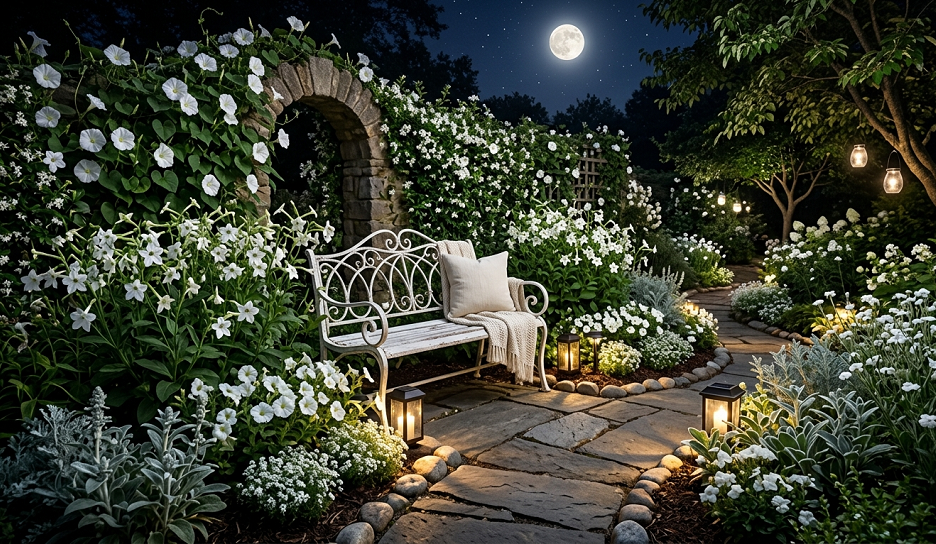
Your moon garden needs a place to sit, and that seating should be part of the design — not an afterthought. A white-painted bench or bistro set pulls double duty: it’s functional furniture and it’s also another glowing element in your nighttime garden palette.
A classic white wooden bench at the end of a garden path is one of those garden design choices that is genuinely timeless. I’ve had a painted teak bench in my moon garden for seven years. I repaint it every two to three seasons. It’s more work than a resin bench, but it looks infinitely better and I have zero regrets.
White metal bistro chairs and a small table near a cluster of fragrant white roses or a moonflower-covered trellis creates an outdoor room that genuinely feels like a destination. Throw a few pillar candles in lanterns on the table and you have one of the nicest evening spots imaginable.
If budget is a concern, a $30 thrifted wooden chair with a fresh coat of white exterior paint earns full moon garden credentials. The trick is consistency — keep the furniture light in tone so it reads as part of the glowing palette after dark.
11. Attract Pollinators With a White Pollinator-Friendly Moon Garden Corner
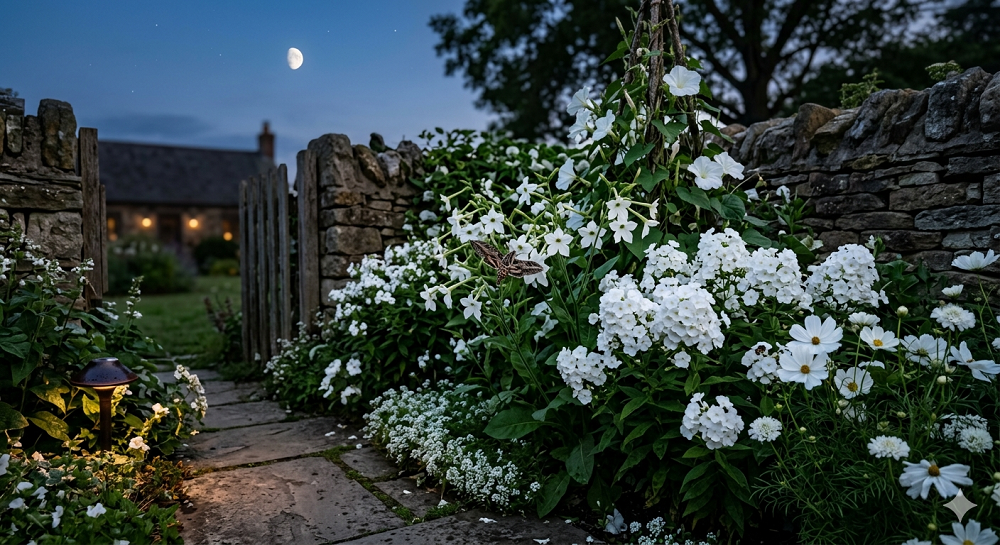
This one comes with a bonus ecological angle that I genuinely care about: many night-blooming and white-flowering plants are specifically evolved to attract moths, night-flying beetles, and bats as pollinators. A moon garden isn’t just beautiful — it’s a habitat.
Phlox (Phlox paniculata in white varieties like ‘David’) is a classic perennial that blooms heavily in midsummer and is incredibly attractive to hawk moths on summer evenings. The fragrance is sweet and carries well. ‘David’ is also one of the most mildew-resistant white phlox cultivars, which matters enormously — phlox is notorious for powdery mildew in humid conditions, and I’ve had entire plants look like they’d been frosted in gray by August.
White coneflowers (Echinacea purpurea ‘White Swan’ or ‘PowWow White’) attract daytime pollinators but also serve as excellent structural plants in the moon garden. They’re among the easiest perennials I’ve ever grown, drought-tolerant once established, and they leave behind seed heads that feed goldfinches through fall and winter.
Bonus tip: Add a shallow dish of water near your moon garden — a simple ceramic saucer or a small birdbath. Night-flying insects and moths need water sources, and the reflective surface of water at night adds another glowing, shimmering element to your garden without costing you anything but a refill every day or two.
Real Talk: What’s Not Worth the Effort (and What Can Go Sideways)
Let me be straight with you about a few things, because the moon garden content you’ll find on Pinterest is aggressively optimistic.
White roses can be a heartbreak. Many are disease magnets — black spot, aphids, rust — and keeping them looking pristine enough to actually contribute to a “dreamy aesthetic” takes real work. If you’re not prepared to spray preventively, deadhead religiously, and accept some imperfect foliage, choose something else. Repeat-blooming shrub roses labeled disease-resistant are your safest bet. Hybrid teas in white are beautiful and high-maintenance; don’t let anyone tell you otherwise.
All-white gardens can look sparse and boring mid-season. The dreamy moonlit effect depends on density and bloom succession. If you have three white plants with large gaps between them, it just looks like you haven’t finished planting. Plan for continuous bloom from spring to frost, use silver foliage to fill gaps, and don’t be afraid of density.
Deer will find your moon garden. Hostas, lilies, phlox — some of the best moon garden plants are also deer candy. If you have deer pressure, protect new plantings until established, and consider deer-resistant alternatives: white catmint, white baptisia, white-flowering ornamental grasses, agastache in white varieties.
White flowers show dirt, damage, and pests far more visibly than colored flowers do. Slug damage, thrips, browning edges — all of it is on full display in white blooms. Stay on top of pest monitoring and don’t skip it thinking the damage won’t show. It will show more than it would in any other garden style.
The Wrap-Up: One Parting Piece of Advice
Start small. I’m serious. Don’t rip out half your garden and go all-white overnight — you’ll panic by month two when something doesn’t work and you have no backup. Start with one dedicated bed, one container combination, or one section of a path. Get a feel for which white-flowering plants perform well in your specific conditions, soil, and climate. Then expand.
The moon garden is one of the most rewarding garden projects I’ve ever tackled precisely because it changes how you use your garden, not just how it looks. You stop being an 8-to-5 gardener and start staying outside long past sunset. Your patio stops being dead space after dark. Friends linger over dinner. Evenings get slower and better.
That’s what a good garden is supposed to do.
Now I want to hear from you: Do you already have a moon garden, or are you starting from scratch? Drop a question or share what you’re working with in the comments below — whether it’s a sunny suburban yard, a shady city courtyard, or a humid Southern climate, I’ve probably made a mistake there worth warning you about.

About Syprose Kiche
Syprose Kiche is the creator and writer behind My Besuited Home, a practical home and garden website covering DIY projects, gardening, lawn care, landscaping, home improvement, and outdoor living. She focuses on turning everyday homeowner questions into clear, practical guides backed by careful research and useful real-world considerations.