
My dog Biscuit once ate an entire pot of peace lilies I’d put on the patio. She was fine — but I was not, after three hours of panic-Googling and a vet call that cost me $120 just to hear “watch and wait.” That was the summer I got serious about turning my backyard into something that actually worked for my pets, not against them.
If you’ve been searching for DIY pet-friendly backyard ideas, dog-safe garden design, or ways to build a summer oasis your animals can enjoy without you hovering in a state of low-grade terror — you’ve landed in the right place. I’ve spent years ripping out plants, replacing mulch, patching fences, and rebuilding water features after getting it wrong the first (and sometimes second) time. What follows is the hard-won shortlist of ideas that actually deliver.
What Is “Barkitecture,” Exactly?
Barkitecture is exactly what it sounds like: architecture designed with your dog (or cat, or rabbit — no judgment) as the primary client. It’s the art of planning your outdoor space around animal behavior, safety, and enrichment rather than just aesthetics. And trust me, there’s a huge difference between a yard that looks pet-friendly on Pinterest and one that actually holds up to 60 pounds of chaos with muddy paws.
Good barkitecture hits three marks: it’s safe (no toxic plants, sharp edges, or escape routes), functional (shade, water, space to move), and durable (because dogs will test every single thing you build). The five ideas below check all three boxes — and I’ve built every single one of them myself.
1. The Shaded Dog Lounge: A DIY Pergola With Pet-Safe Climbing Plants
Why Your Dog Needs Dedicated Shade (and Why a Tarp Isn’t Enough)
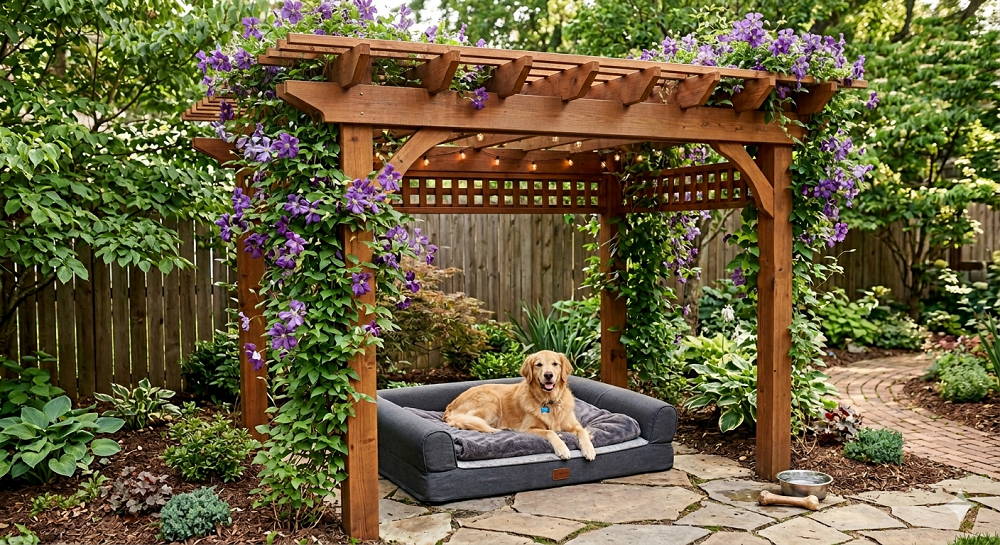
Every summer I see neighbors duct-taping a blue tarp to a fence and calling it a shade structure. I’ve done it myself. It’s ugly, it sags, and it does almost nothing to cool the ground underneath — which is where your dog is actually lying. A proper pergola, even a simple one, changes the entire dynamic of your yard.
Building a basic DIY pergola doesn’t require a contractor’s license or a second mortgage. A 10×10 freestanding pergola using pressure-treated 4×4 posts and 2×6 rafters runs about $400–$600 in materials, depending on your local lumber prices. I built mine over a weekend with a post-hole digger, a miter saw I borrowed from my brother-in-law, and about four hours of YouTube tutorials.
The real magic happens when you add climbing plants — but this is where a lot of pet owners go completely wrong. Wisteria is gorgeous and absolutely toxic to dogs. Morning glory? Also toxic. Trumpet vine? Toxic. I’ve ripped out more “pretty” plants than I care to admit after realizing they had no business being near my animals.
Stick to these pet-safe climbing plants instead:
- Climbing roses (thornless varieties like ‘Zephirine Drouhin’ for bonus safety)
- Passionflower (Passiflora incarnata — the native variety, not all species)
- Scarlet runner beans (edible for humans, safe for dogs, and they grow fast)
- Hops — wait, actually skip hops. They’re toxic to dogs even dried. I made that mistake in year three of my garden. Don’t repeat it.
Once your pergola is up and your safe climbers are established, lay decomposed granite or pea gravel underneath to keep the ground cool. Concrete and black rubber mats absorb and radiate heat like a griddle. I’ve measured the surface temp difference between concrete and decomposed granite on a 90°F afternoon: sometimes 20+ degrees. That matters for paw pads.
One more thing: anchor those posts properly. Biscuit once ran full-speed into one of my pergola posts chasing a squirrel. If I’d used surface-mount post bases instead of setting them 24 inches into the ground, the whole thing would have come down on her.
2. The Dog-Safe Water Feature: DIY Splash Zone and Cooling Station
How to Build a Pet Water Zone That Doesn’t Breed Mosquitoes or Algae
Dogs in summer need to cool down, and most of them will find their own solution — usually your sprinkler system or the kiddie pool you bought for your actual kid. Giving them a dedicated splash zone is one of the best quality-of-life upgrades I’ve made in my yard, and it’s cheaper than you think.
The simplest version is a sunken stock tank splash pad. Buy a 100-gallon galvanized stock tank (roughly $80–$120 at a farm supply store), dig a hole so the rim sits flush with your lawn or patio level, and drill a 1-inch drainage hole near the bottom with a rubber stopper you can pull when you need to empty it. Dogs can wade in without the “climbing in and tipping it over” chaos that comes with above-ground tubs.
The issue most people skip over: stagnant water in the summer sun turns into a mosquito nursery and an algae soup within days. I added a small submersible fountain pump (about $25 on Amazon) to keep the water circulating. It runs off a standard outdoor outlet, the movement prevents mosquito larvae from taking hold, and my dogs think the bubbling is the greatest thing that’s ever happened to them.
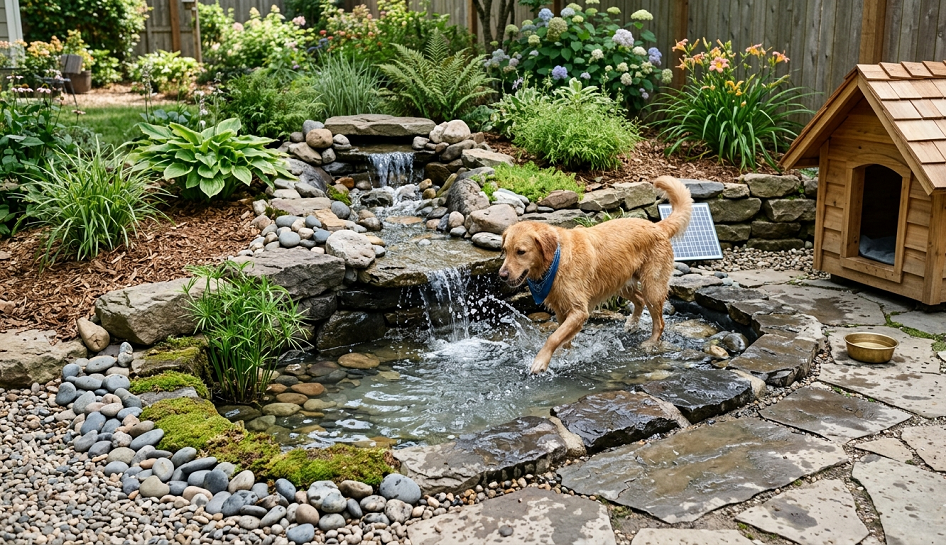
For a slightly more ambitious build, consider a shallow splash pad made from flagstone set in a slight depression, with a simple recirculating pump and a ground-level spray head. The water film stays thin — half an inch or less — so there’s no drowning risk for small dogs, and the stone stays cooler than any synthetic surface. I spent one Saturday afternoon on mine and $180 in materials. It’s been the centerpiece of my backyard for three summers.
A few safety notes I learned the hard way:
- Never use copper algaecides or blue dye treatments in pet water features. Some are acutely toxic to dogs. Plain white vinegar (a splash per week) keeps algae manageable without the risk.
- Check your water feature daily in summer heat. A small, still pool can reach dangerous temperatures for drinking.
- Add a rough-textured ramp or exit point to any water feature deeper than 8 inches. Dogs panic when they can’t find footing on a smooth wall. (Ask me how I know.)
3. The Digging Zone: Give Your Dog a Legal Place to Excavate
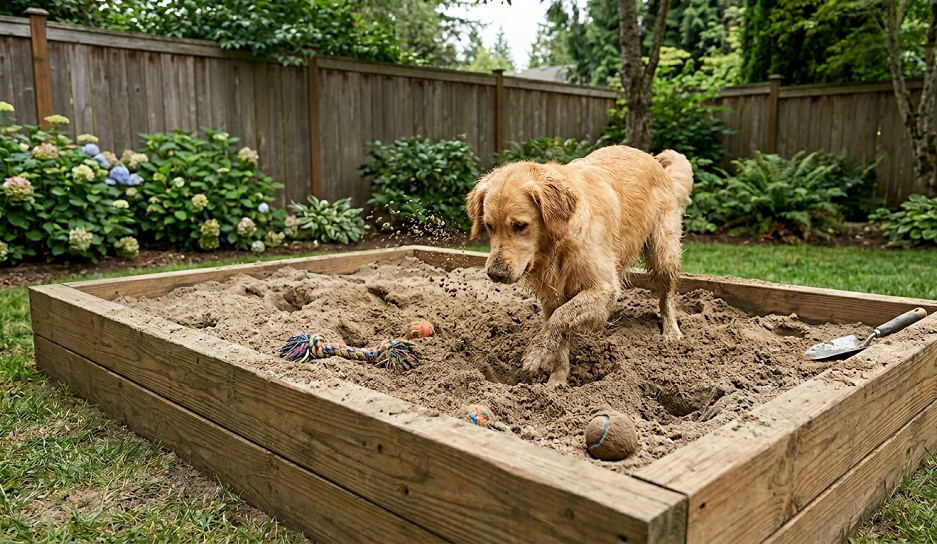
How to Stop Dog Digging Destruction by Working With Their Instincts
Here’s an opinion I’ll stand behind: trying to train a terrier out of digging is like trying to train yourself out of breathing. Some dogs dig. It’s hardwired. The single most effective thing I’ve ever done for my yard wasn’t a training technique or a deterrent spray — it was giving Biscuit her own legal digging pit, and the destruction in the rest of my yard dropped by about 90%.
A dedicated digging zone is shockingly easy to build. Frame a 4×6 or 4×8 area with untreated cedar landscape timbers (cedar is naturally rot-resistant and safe for pets — skip pressure-treated wood here, as older formulations contain copper compounds that can irritate paws and be ingested during digging). Fill the area 12–18 inches deep with a mix of play sand and topsoil at roughly a 60/40 ratio.
The trick to getting your dog to actually use it — rather than walking past it to destroy your vegetable bed — is to bury things in it. I started by hiding Biscuit’s favorite toys and some dog treats just below the surface. Within a week she was choosing the pit on her own. Within a month, she’d defended her pit against a squirrel, which I consider a full adoption.
Ground rules for your digging zone:
- Location matters. Put it in partial shade. A digging pit in full afternoon sun becomes hot, dry, and unpleasant — and a bored dog will go find cooler, wetter dirt elsewhere (like your raised beds).
- Keep the pit moist. Dry, packed sand isn’t satisfying to dig. Give it a light watering every couple of days in dry weather.
- Check for pests. Moist sand can attract earwigs, pill bugs, and sometimes ants. I do a quick visual check when I water and refresh the hide-and-seek buried items.
- Refresh the “treasure.” Once a dog finds everything in the pit a hundred times, the pit loses its appeal. I rotate in new toys, bully sticks sealed in biodegradable bags, and the occasional frozen marrow bone.
4. A Dog-Safe Herb and Sensory Garden: Plants That Enrich (Not Endanger) Your Pet
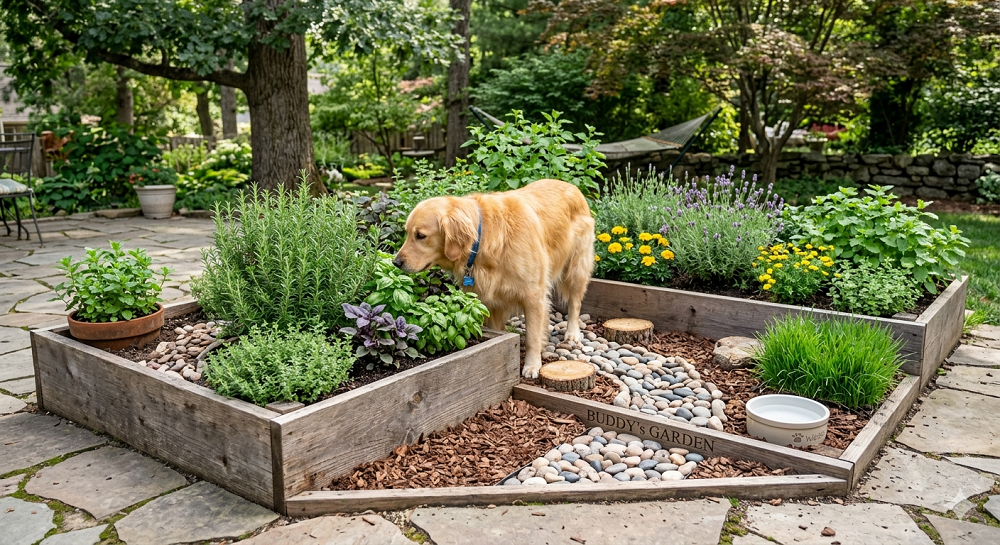
Which Garden Plants Are Safe for Dogs — and Which SEO Results Lie to You About It
Every “pet-safe garden” list I’ve found online seems to have been written by someone who has never actually checked the ASPCA toxicity database. I’ve caught outright errors on major gardening websites. So let me be direct about what I’ve actually grown and verified.
The concept of a sensory garden for dogs is brilliant in theory — herbs and plants with strong scents engage a dog’s primary sense, providing mental enrichment alongside physical space. In practice, you have to vet every single plant. Here’s what I grow in mine without worry:
Genuinely dog-safe herbs and plants:
- Rosemary — Dogs sniff it obsessively. It’s safe, drought-tolerant, and doubles as a pest deterrent.
- Basil — Safe for dogs, and mine like to walk through it and smell like a pizza, which is charming.
- Dill — Safe and attractive to pollinators.
- Catnip — Yes, some dogs respond to catnip. Mine rolls in it. It’s completely safe.
- Echinacea (coneflower) — Safe for dogs, beautiful, and native to North America.
- Marigolds — Safe AND a natural nematode deterrent for your vegetable beds. Double win.
- Lemon balm — Mildly calming, safe, and smells amazing when a dog inevitably flattens it.
What I ripped out because I was wrong:
- Lavender — I know. I know. I loved my lavender border. But lavender contains linalool, which is toxic to dogs in concentrated form. Occasional sniffing is probably fine; having a dog who eats your lavender plants (looking at you, Biscuit) is a different story. I pulled it and replaced with rosemary. No regrets.
- Aloe vera — Often listed as safe or “mildly toxic” on lazy websites. The ASPCA lists it as toxic. I removed mine immediately.
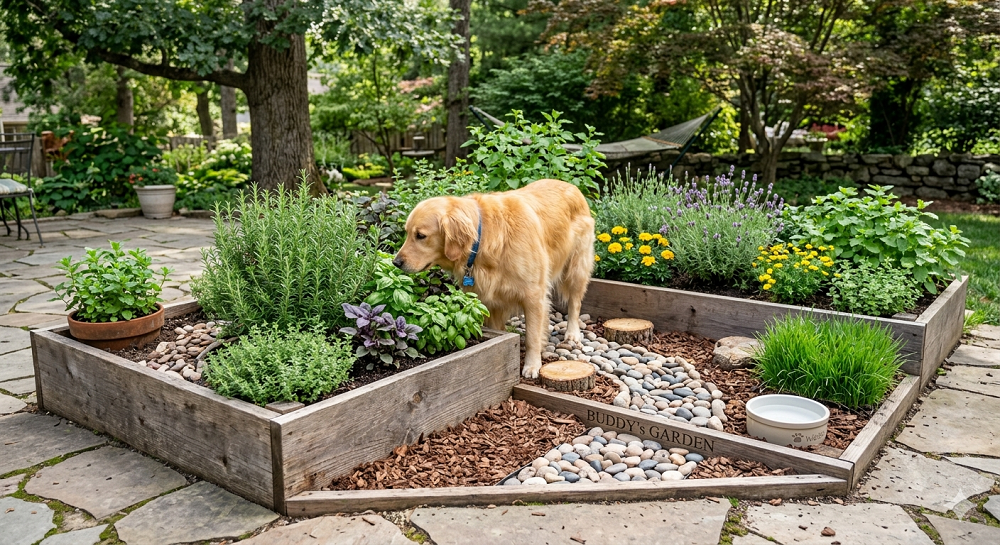
Build your sensory garden in a raised bed or defined border with low edging so your dog knows where the “interesting zone” is. I use rough-cut cedar boards set about 6 inches high — enough to define the space without being a barrier. Dogs respect boundaries better than most people give them credit for, as long as the boundary is physical and consistent.
One bonus tip: Plant a sacrificial patch of dog grass (Dactylis glomerata) or wheatgrass somewhere in your yard. Dogs eat grass — usually to settle upset stomachs — and if you give them a clean, pesticide-free patch to graze, they’re far less likely to strip your lawn or eat something questionable.
5. The Pet-Safe Perimeter: Fencing, Ground Cover, and Escape-Proof Borders
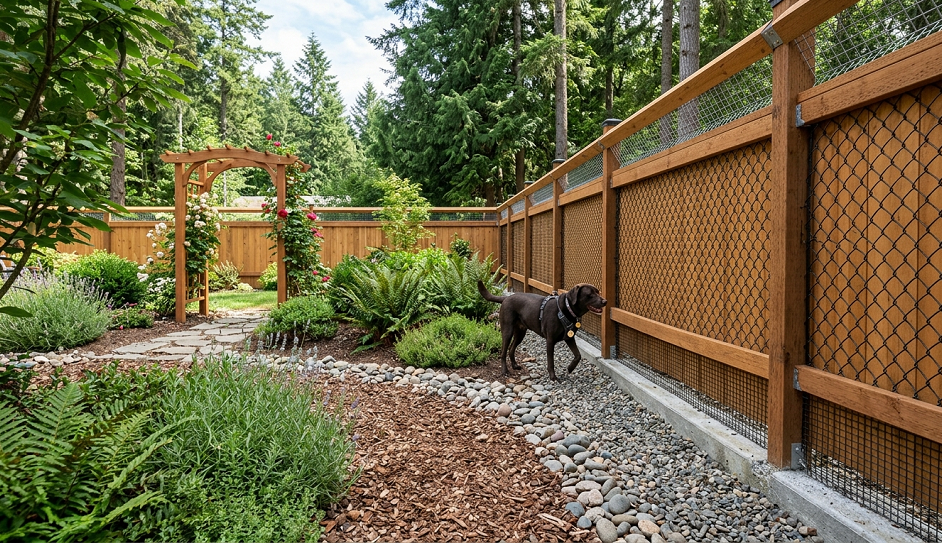
How to Fence a Yard for Dogs Without It Looking Like a Prison Compound
A yard your dog can escape is not a summer oasis. It’s a liability and a source of constant anxiety. I’ve chased Biscuit down three different streets over the years, and every single time it was because I had underestimated either her athleticism or her motivation.
The fencing conversation starts with one question: Is your dog a jumper, a digger, a squeezer, or a combination? Because each type requires a different solution, and a 6-foot privacy fence means absolutely nothing to a determined digger who goes under rather than over.
For jumpers: The most effective solution I’ve used isn’t height — it’s coyote rollers (PVC pipe mounted along the top of fence rails that spin when a dog tries to get purchase) or an inward-angled fence extension. Adding 18 inches of outward lean at the top of an existing 5-foot fence stops most dogs better than adding 2 feet of straight height.
For diggers: Bury a hardware cloth apron (1×1 inch galvanized wire mesh) horizontally, extending 18–24 inches outward from the base of your fence, about 6 inches underground. Dogs dig down and out — the moment they hit wire underground and follow it, they lose the mental thread of what they were doing. This single fix stopped Biscuit’s great tunnel project of last summer.
For squeezers and small dogs: Check every gap in your fence after any rainstorm or freeze-thaw cycle. Gaps that didn’t exist in spring appear by summer. I do a fence walk every March and every June, poking at boards and checking post bases.
On ground cover: This is where I’ll be blunt — cocoa mulch is a total waste of money for pet owners, even though it’s everywhere at garden centers and looks beautiful. Cocoa mulch contains theobromine, the same compound in chocolate that’s toxic to dogs. The risk depends on the dog’s size and how much they ingest, but I won’t have it anywhere near my yard. I use cedar mulch in planted beds (natural insect deterrent, safe for pets) and pea gravel in high-traffic zones where mulch just gets kicked around anyway.
A well-designed perimeter also means no toxic plants along the fence line, no standing water pooling near fence posts (attracts mosquitoes and rots wood), and no gaps between fence and gate hardware where a dog can get a leg or jaw stuck. I’ve seen that injury in person. It’s bad.
Real Talk: What’s Not Worth the Effort (And What Can Go Seriously Wrong)
Honest Warnings From Someone Who Has Made Every Single Mistake
Let me save you some money and some panic.
Artificial turf is not the pet paradise it’s marketed as. Every ad makes it look like the solution to muddy paws and brown spots. The reality: artificial turf gets extremely hot in direct sunlight — surface temperatures can exceed 150°F on a 90°F day, which will burn paw pads on contact. Cheap infill materials (crumb rubber especially) are suspected carcinogens and get tracked into your house. And urine doesn’t just disappear — it pools in the infill and creates an ammonia smell that only gets worse. If you want turf, budget for a premium product with good drainage, apply infill rated for pet use, and plan for regular enzyme-treatment cleaning. The “low maintenance” promise is a lie.
Misting systems sound amazing until you realize you’ve created a waterlogged mud zone. I installed one. I removed it two seasons later. Unless your mister is in a paved area with proper drainage, you end up with a swamp that smells like wet dog and breeds fungus gnats.
Not all “pet-safe” plant labels are trustworthy. Nurseries and garden centers use that label loosely. Some mean “non-toxic if eaten in small quantities.” Some just mean “not immediately fatal.” Always cross-reference with the ASPCA Animal Poison Control database (aspca.org/pet-care/animal-poison-control/toxic-and-non-toxic-plants) before planting anything new in a yard your animals access.
DIY dog pools can become drowning risks. Any water deeper than about 10–12 inches needs a ramp or exit point. Even strong swimmers panic when they’re tired and can’t find a foothold. I’ve reinforced this point above, but it bears repeating here.
Wrapping Up: Your Yard Can Be Both Beautiful and Safe
A backyard that works for your dog doesn’t have to look like a dog run. The best barkitecture I’ve seen — and built — is stuff that a human guest wouldn’t even notice was specifically designed for animals. The pergola looks like a pergola. The sensory garden looks like a garden. The splash pad looks intentional and pretty. The difference is just in the decisions made at the plant nursery, the hardware store, and the fence line.
My parting wisdom: start with safety, build for behavior, and add beauty last. Every single bad experience I’ve had in my pet-friendly yard happened when I reversed that order — when I bought the pretty plant first and checked the toxicity database second, or when I built the aesthetic water feature before thinking about how a 60-pound dog actually interacts with water.
Biscuit is nine now. She has a shaded lounge, a digging pit she considers sacred territory, a splash pad she visits every afternoon, and a fence she has not escaped in two years. That is the real measure of good barkitecture.
What’s the biggest challenge you’ve run into designing an outdoor space for your pets? Have a DIY trick that’s worked brilliantly — or a disaster story that saved someone else from the same fate? Drop it in the comments below. I read every single one, and I genuinely love hearing what’s worked (and what spectacularly hasn’t) in other people’s yards.

About Syprose Kiche
Syprose Kiche is the creator and writer behind My Besuited Home, a practical home and garden website covering DIY projects, gardening, lawn care, landscaping, home improvement, and outdoor living. She focuses on turning everyday homeowner questions into clear, practical guides backed by careful research and useful real-world considerations.