
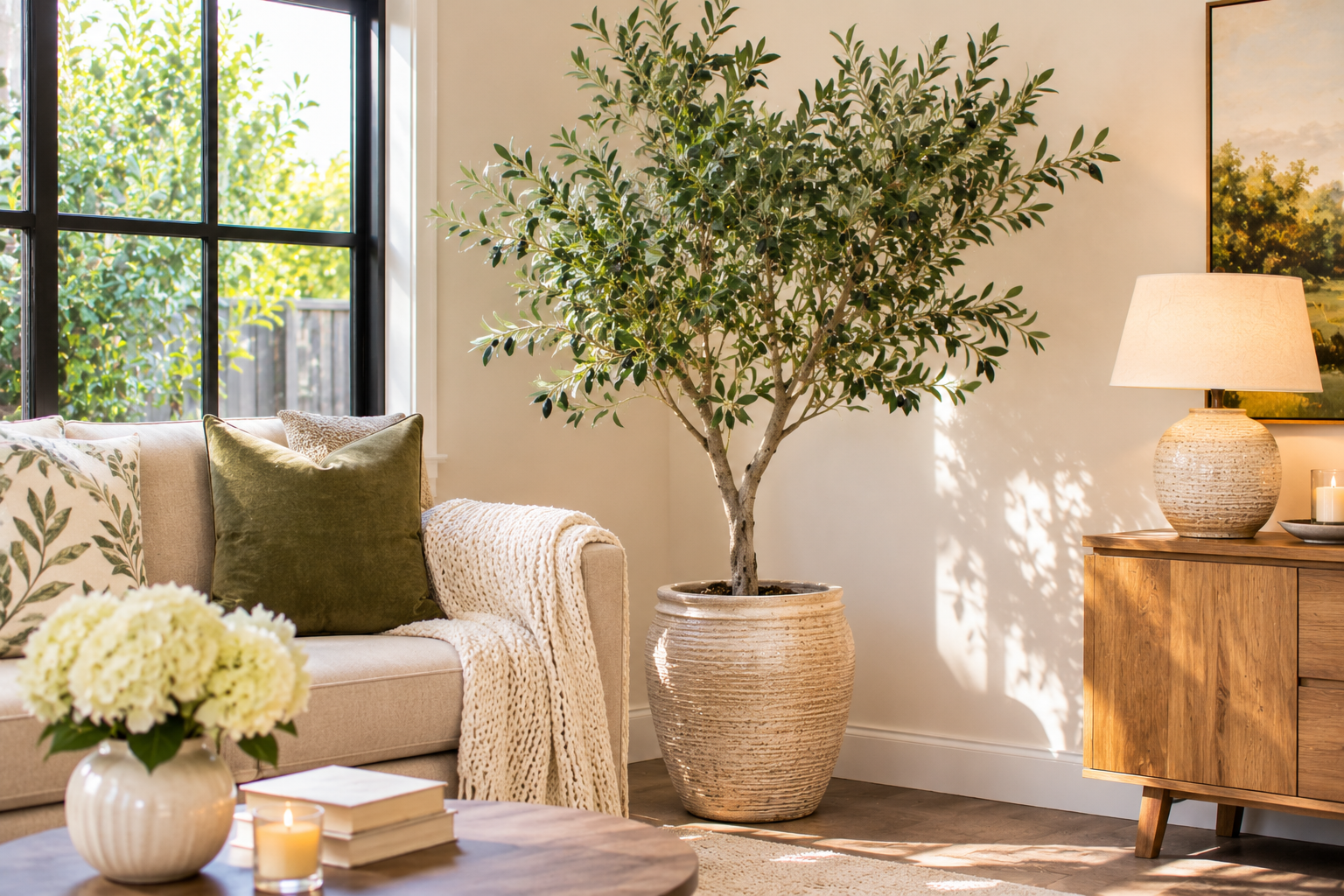
The spot where an olive tree looks best in a room is rarely the spot where it can survive. A silvery tree tucked into a shadowy corner beside the sofa is the picture most people save, but olive trees (Olea europaea) evolved in hot, bright, dry Mediterranean climates. A dim corner gives them neither the light nor the dry soil they depend on. The usual outcome is predictable: a handsome tree arrives, drops leaves over a few weeks, and ends up as a bare stick in an expensive pot.
The ideas below are built around that problem instead of ignoring it. Each one works with how olives behave, and a few sidestep the issue entirely by using cut branches or a faux tree where the light is too poor for a living plant. Read the short section on light and water first. It decides which ideas are realistic in your home and which ones need a workaround.
What an Indoor Olive Tree Needs Before You Decorate Around It
Every styling choice in this article depends on four things: light, water, drainage, and airflow. Get those wrong and no pot or arrangement will save the tree.
Light is the deciding factor
Olives want as much direct sun as a window can give them. A common recommendation is six or more hours of direct light a day, which in the Northern Hemisphere usually means a south-facing window, with a west-facing one as the second choice. An east window can work for a smaller tree if nothing blocks it. A north-facing window, or any spot more than a few feet back from the glass, is where leaves start to thin and drop.
A useful rule: if you can’t comfortably read a book at that spot at noon without turning on a lamp, a living olive will struggle there. A full-spectrum LED grow light on a timer, running roughly 12 hours a day, can fill the gap in a dim room. Follow the manufacturer’s guidance on distance, because a fixture placed too close can scorch foliage and one placed too far does very little.
Water less often than you think
Overwatering kills more indoor olives than drought does. These trees tolerate dry soil far better than constantly damp soil, which invites root rot. Wait until the top two inches of soil are dry before watering, then water thoroughly until it drains from the bottom, and empty the saucer afterward. In winter, when growth slows and light is weaker, the interval stretches considerably. Check the soil with a finger or a wooden skewer rather than following a calendar.
Drainage is not optional
This matters for decor because many beautiful containers have no drainage hole. A pot without one is fine only as a decorative outer sleeve (a cachepot) around a plain nursery pot that does have holes. Use a gritty, fast-draining mix such as a cactus and succulent blend with extra perlite or coarse sand mixed in, rather than standard moisture-retentive potting soil.
Airflow, heat, and humidity
Olives like dry air with some movement. Steamy bathrooms and stagnant corners are poor choices. Keep them away from heating vents, which blast hot, dry air onto the leaves, and away from drafty doors, which cause sudden temperature swings. Moving the tree from place to place also tends to trigger leaf drop, so pick a spot and stay with it.
Pets and children
The ASPCA’s plant database lists olive (Olea europaea) as non-toxic to cats and dogs, though chewing on any plant can upset a stomach. Confirm the current listing before relying on it, and remember that decorative extras like small stones, fairy-light wires, and ribbon are their own hazards for curious pets and toddlers.
Placement Ideas That Match Real Light Conditions
1. A Sunroom or Bright Window Corner as the Showpiece
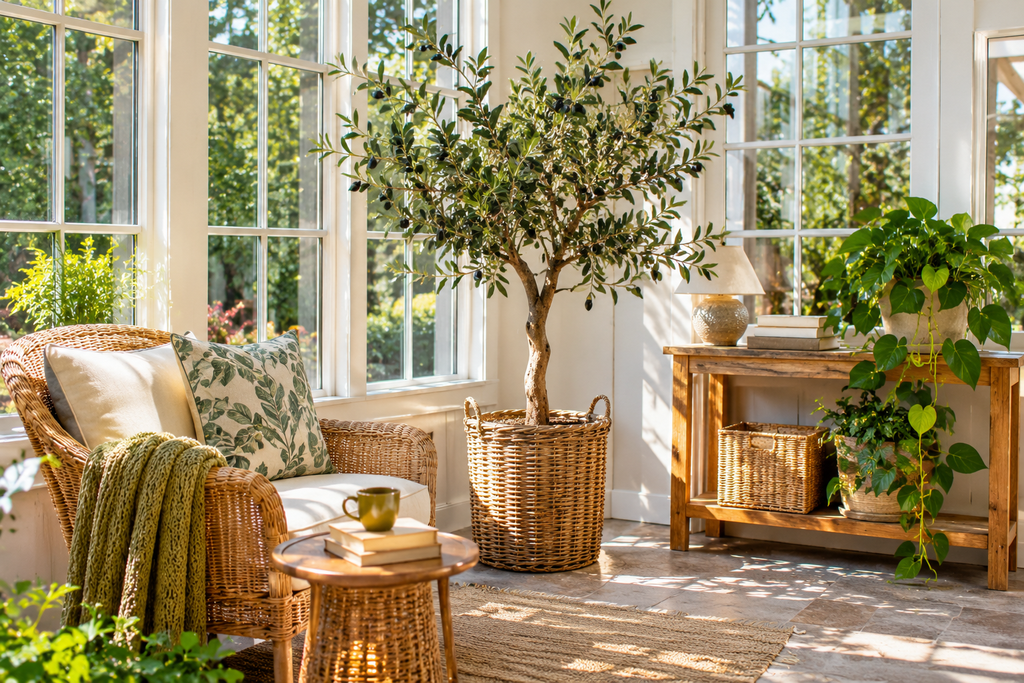
The most successful olive displays are also the simplest. Set a tall tree, around four to six feet, in the brightest corner of the room and let the window do the work. A sunroom gives it the closest thing to Mediterranean conditions most homes can offer. Leave some open floor around the pot so the canopy reads as a sculpture, and add little else. A wicker chair and a small side table are plenty.
If the window gets hot afternoon sun through single-pane glass, check the leaves in summer for brown, crisp patches. Pulling the tree back a foot or using a sheer curtain during the hottest hours prevents that.
2. Beside the Front Door, If There’s a Window
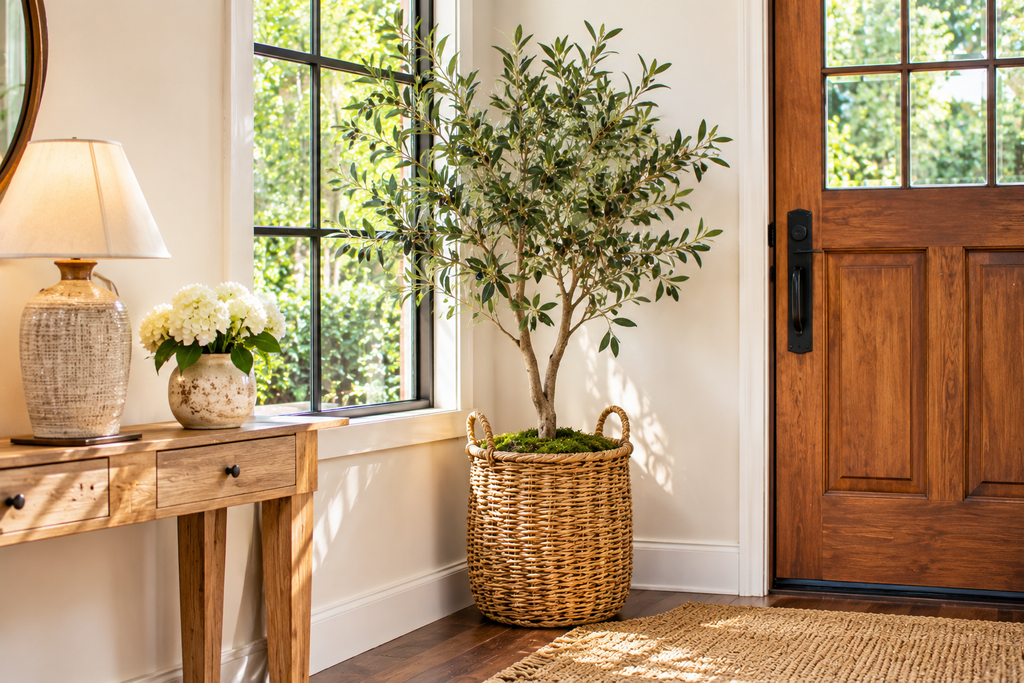
Entryways tend to be dark, which makes them risky. Where a door has sidelights or a large transom, though, an olive tree beside it makes a welcoming first impression. A single slim tree in a tall planter works better than a wide, bushy one in a narrow hallway, since the canopy won’t brush past people’s shoulders.
If the entry is windowless, skip the living tree. A faux one (see idea 21) or a vase of cut branches handles that spot better.
3. A Floor Tree in the Living Room Corner
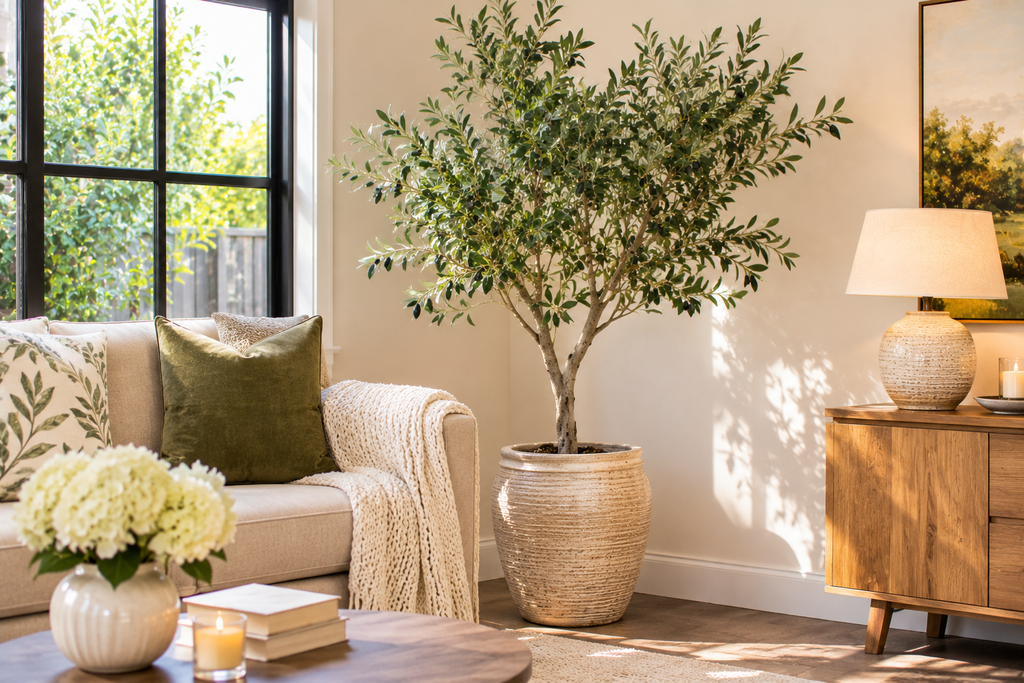
A large floor tree softens the hard angle where two walls meet, and olive foliage is a good neutral backdrop for almost any color scheme. The gray-green leaves pair well with warm whites, tan leather, rust, and charcoal. Place it where a window is close enough to supply real light, and angle the sofa or a lamp toward it so it feels intentional rather than shoved into leftover space.
Rotate the pot a quarter turn every week or two. Plants lean toward light, and without rotation one side thins out while the other stretches.
4. Flanking a Fireplace, With Distance
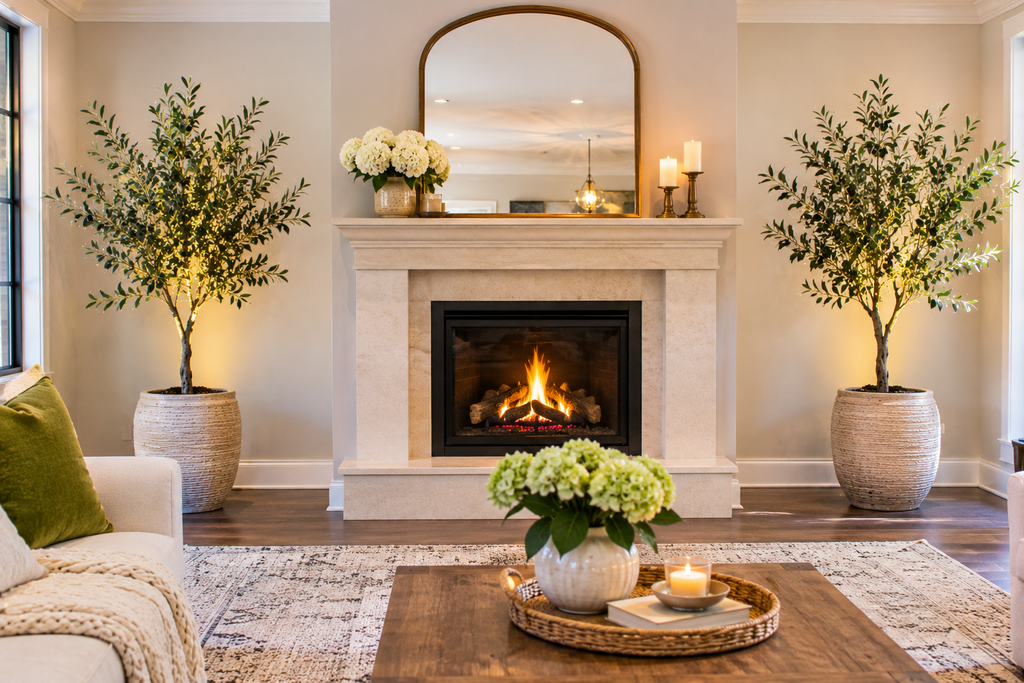
Two matching trees on either side of a fireplace give a room formality. They also sit right where heat is a problem. Radiant heat from a working fireplace, and the dry air near it, can brown leaves and dry the soil quickly. Keep the trees at least a few feet from the firebox, and never place them where sparks or a dangling branch could reach an open flame. If the fireplace is decorative or rarely used, this arrangement is easier and safer.
5. On a Dining Room Sideboard or Console

A small olive, around two feet tall, in a ceramic pot makes a handsome sideboard accent, but only if the room has decent daylight. A dining room with a south or west window can support it. Otherwise, treat the sideboard as a place for a rotating cast: keep the tree on a sunnier windowsill most of the week and bring it to the table for a dinner or a few days at a time.
Protect wood surfaces with a deep saucer or a cork-backed tray. Dark rings on a sideboard are easier to prevent than to repair.
6. A Mini Olive on the Kitchen Windowsill
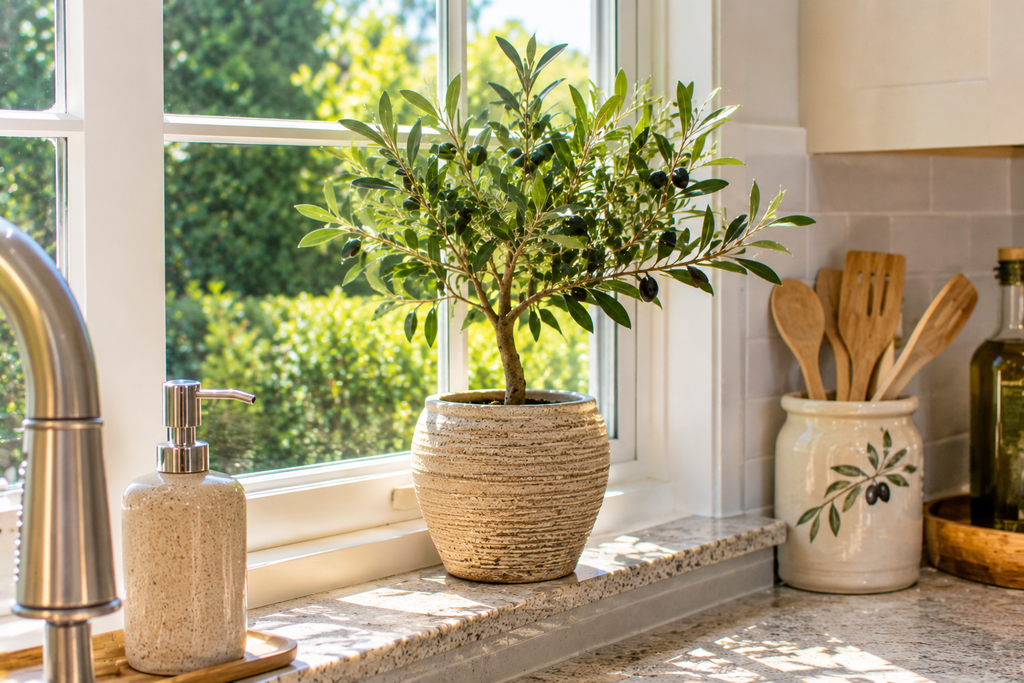
Small potted olives, often sold under cultivar names like ‘Arbequina’ or compact types marketed as dwarf, suit a sunny kitchen sill well. They stay low enough to fit under cabinets, and the kitchen’s bright window is often the best light in the house. Pair one with a small dish of olive oil bottles or a wooden cutting board propped nearby, and the whole corner reads as a Mediterranean kitchen without any extra effort.
Keep it away from the range and out of the splash zone of the sink. Grease in the air coats leaves and blocks light, so wipe them every few weeks with a damp cloth.
7. A Bedroom Reading Nook
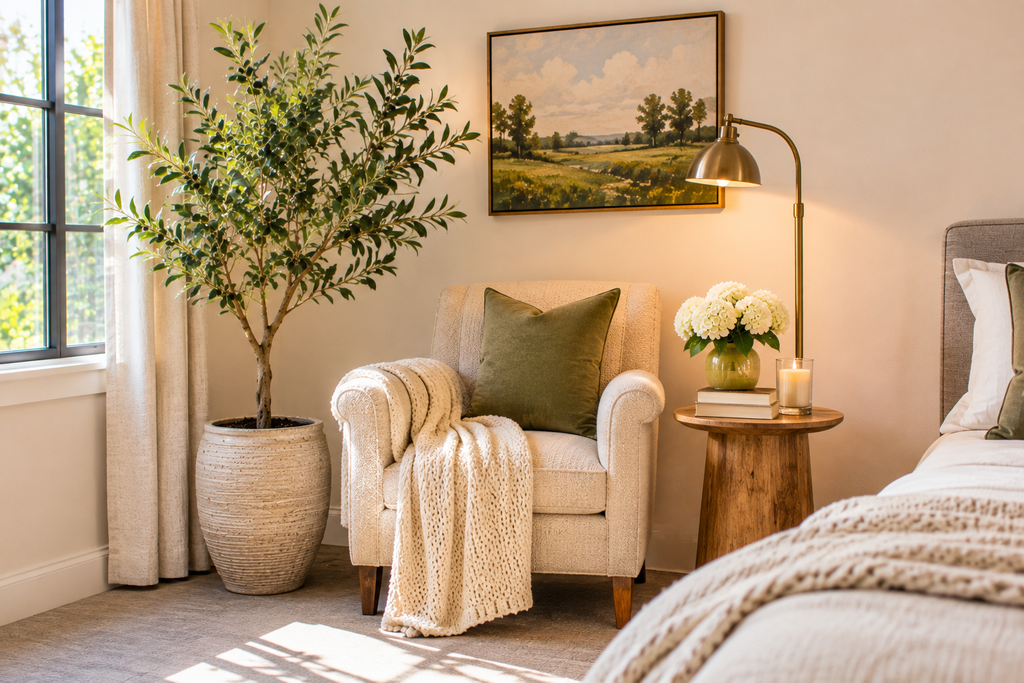
If a bedroom has a bright window, an olive tree beside an armchair creates a calm, slightly European corner. The tree’s open, airy canopy won’t crowd a small space the way a dense fiddle-leaf fig can. Choose a pot in a soft, matte finish, add a linen throw on the chair, and keep the lighting warm.
The caution here is bedroom humidity and closed doors, which reduce air movement. Crack a window on mild days if you can.
8. A Home Office With a Grow Light
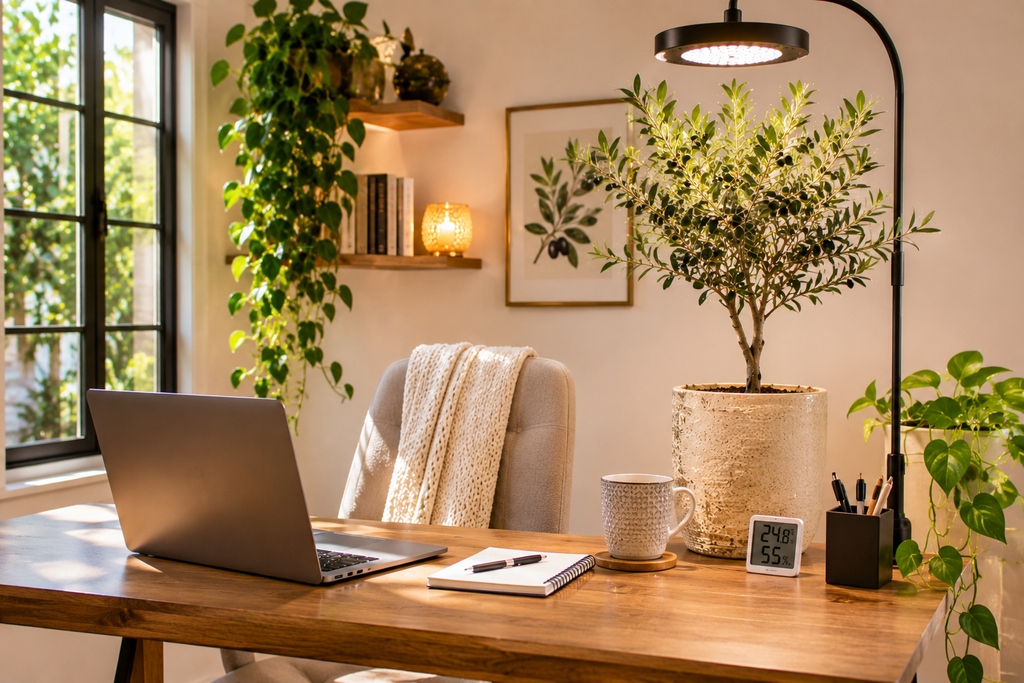
This is the one place a grow light earns its keep as a design element. A slim LED fixture on a stand, or a clip-on arm over a desk, lets an olive live beside a monitor, and the soft green of the foliage is easy on the eyes during long workdays. Put the light on an outlet timer so the schedule stays consistent. Position the tree so the light covers the whole canopy, not just the top, and rotate it regularly.
Pots, Baskets, and Planters That Carry the Look
9. Classic Terracotta
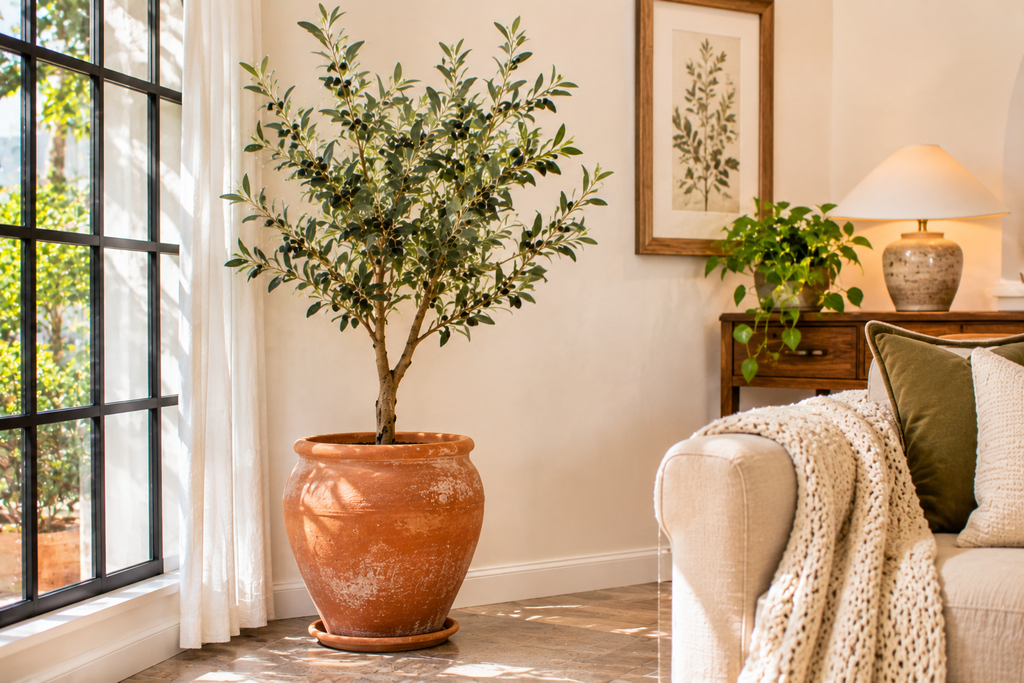
Terracotta is the most practical choice for an olive. The clay is porous, so it wicks moisture from the soil and helps prevent the soggy roots olives hate. The warm orange-brown tone against silvery foliage is also the quintessential Mediterranean pairing. A plain, aged-looking pot looks more convincing than a heavily glazed or ornate one.
The tradeoff: terracotta dries quickly, so you’ll water slightly more often than with glazed pots, and the pot can leave mineral marks on a floor. A saucer or plant caddy solves the second problem.
10. A Woven Basket as a Cachepot
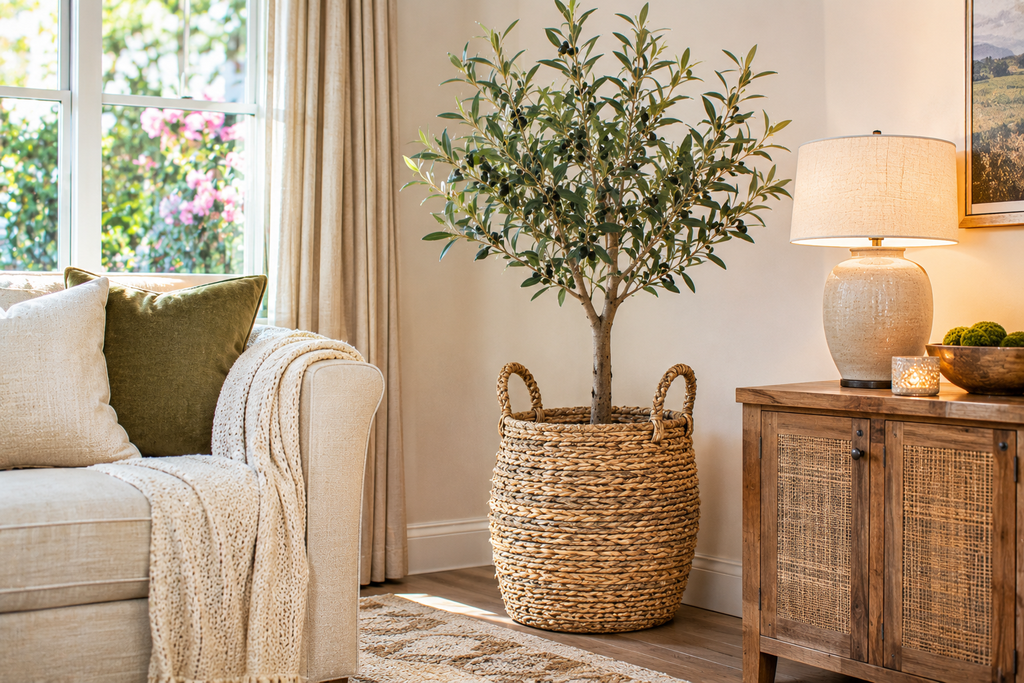
Baskets add texture and make a tree feel cozy rather than showroom-perfect. The key is to never plant directly into the basket. Keep the olive in its nursery pot, set that on a plastic saucer or tray inside the basket, and lift it out to water. Seagrass, rattan, and jute all work. Choose a basket a couple of inches wider than the pot so air can circulate and the plastic stays out of sight.
A damp basket can mold, so let it dry fully if it ever gets wet, and don’t leave water standing in the bottom.
11. Glazed Ceramic in Warm Neutrals

Cream, oatmeal, soft gray, or a muted olive green glaze lets the tree stand out instead of competing with it. Glazed ceramic holds moisture longer than terracotta, which suits households where watering is irregular, but it also makes overwatering easier. Only use ceramic with a drainage hole or as a sleeve around a nursery pot, and lift the inner pot out after watering to let it drain fully.
12. Cement or Stone-Look Planters for a Modern Room

A concrete or cement-composite planter pairs a more architectural look with the tree’s soft canopy. The contrast works especially well in minimalist or industrial rooms. These planters are heavy, so decide the location before planting, not after. A large tree in a big concrete pot with wet soil can easily weigh well over 50 pounds, which matters if you plan to move it, or if the floor is old or the pot sits on a second story.
13. Vintage Crocks, Galvanized Tubs, and Copper
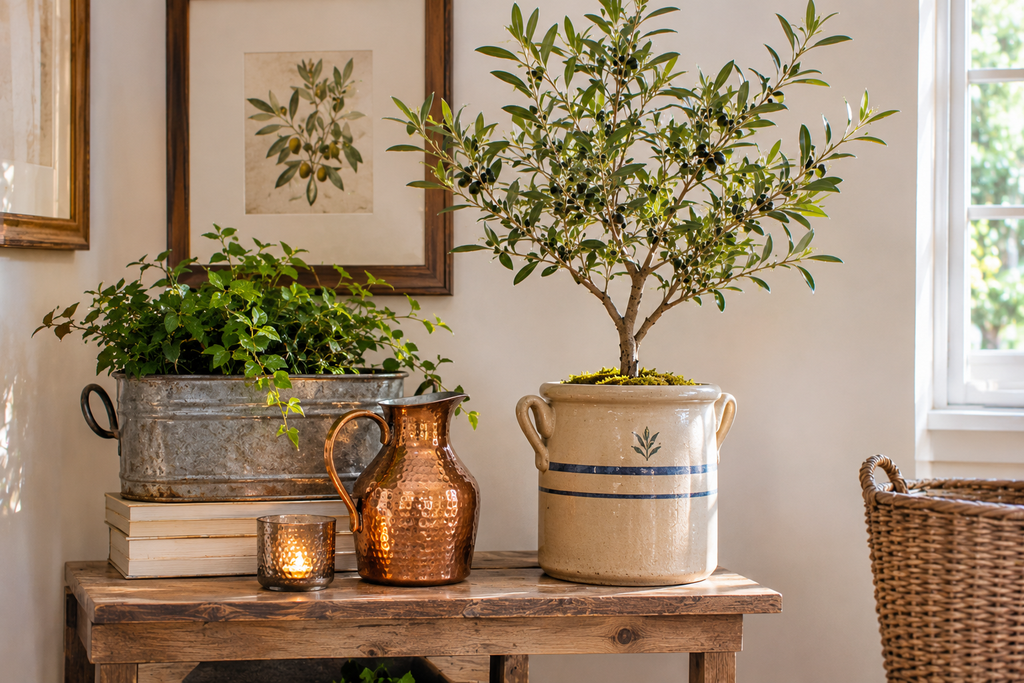
Secondhand containers give an olive tree character that new pots can’t. An old stoneware crock, a galvanized bucket, or a copper boiler all suit the tree’s rustic Mediterranean roots. Most have no drainage, so use them as outer sleeves, and put a layer of stones or a riser under the inner pot so it never sits in drained water. Check older metal and glazed pieces for rust or flaking finish that could stain floors.
14. A Plant Stand to Add Height
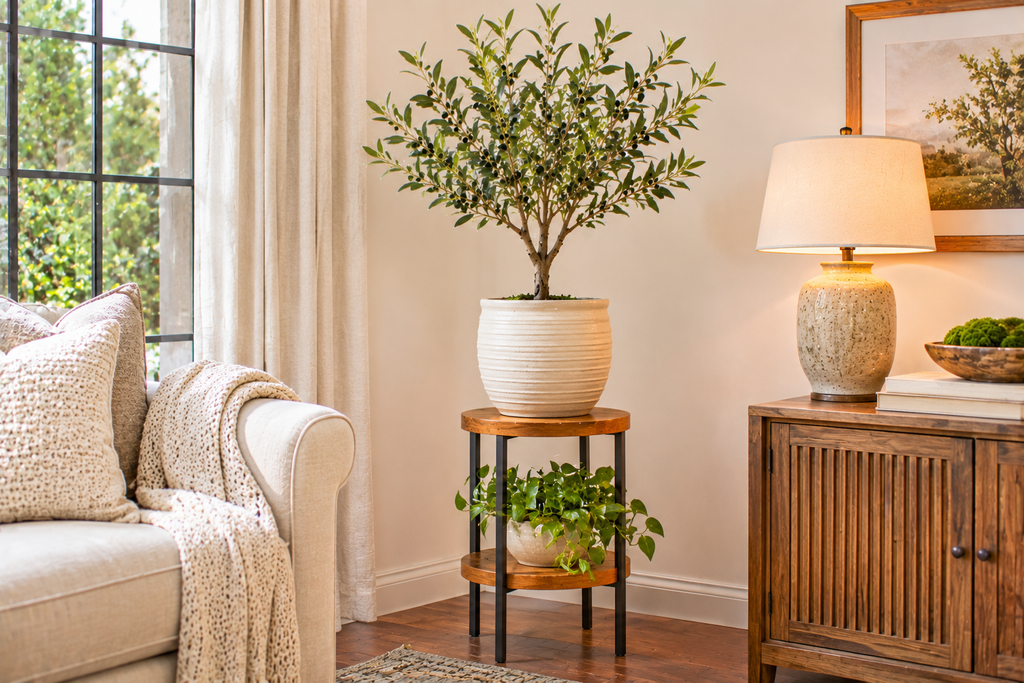
Small olives disappear on the floor. A mid-century-style plant stand or a stack of old books under a pot lifts the canopy to eye level and gets it closer to a window, which helps with light. Make sure the stand is rated for the weight of the pot and wet soil, and that the base is wide enough not to tip if someone bumps it. A tall, narrow stand is a poor match for a top-heavy tree.
Styling Ideas That Make an Olive Tree Feel Cozy
15. A Matching Pair for Symmetry
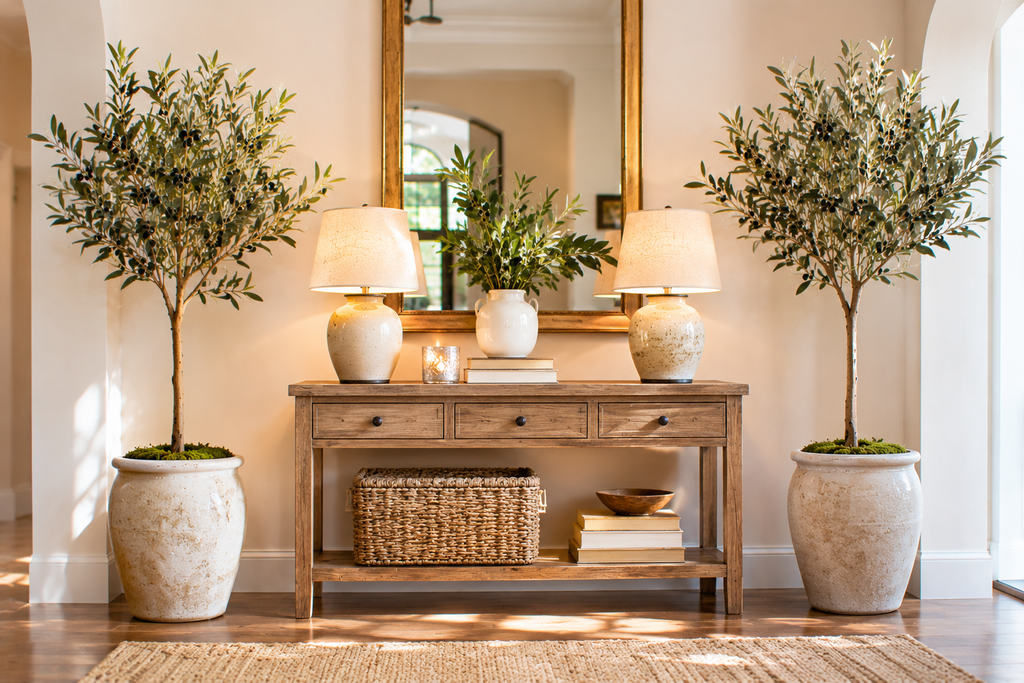
Two trees of similar size flanking a doorway, sofa, bed, or window have an immediate, polished effect. Buy them at the same time and from the same source so the foliage color and shape match. If one grows faster than the other, trim the larger one lightly in spring to keep the pair balanced.
16. A Standard-Form Olive (the “Lollipop”)

Some nurseries sell olives trained as standards: a single bare trunk topped with a rounded canopy. The shape is tidy and formal, and it takes up less floor space than a bushy tree because the lower half is open. That open trunk leaves room to tuck a low basket or a stack of books beneath it. Keep in mind that the trunk is bare partly because a pruner shaped it that way. If you cut or remove the canopy heavily, regrowth can be slow, so ask the seller how it was trained before buying.
17. A Decorative Stone Top Dressing
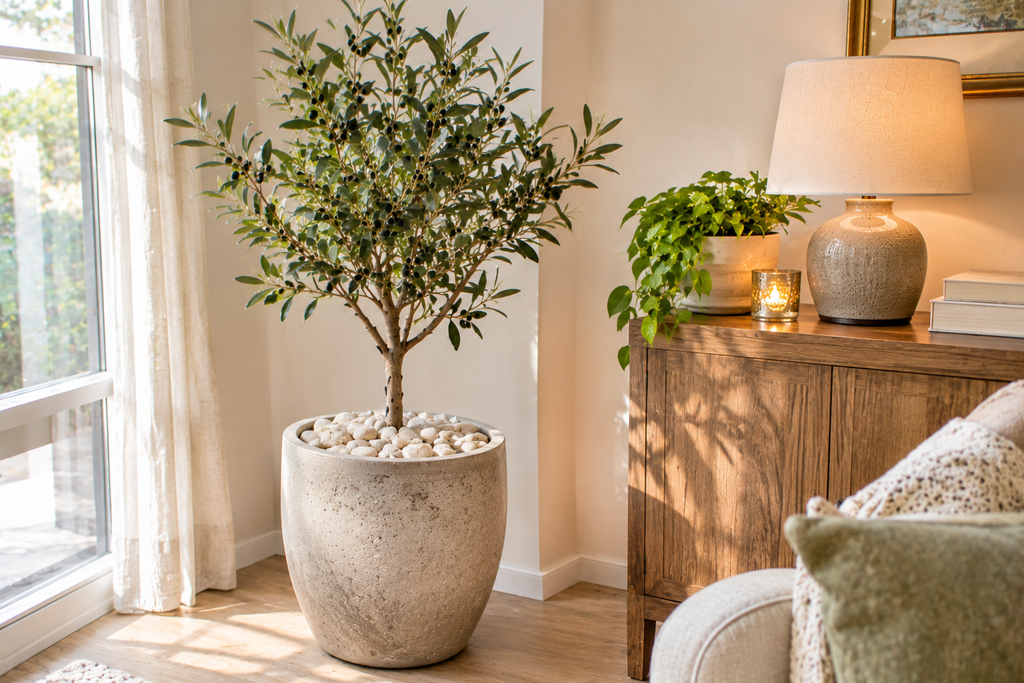
A layer of smooth river stones, light gravel, or pebbles over the soil hides the dirt and gives the pot a finished look. It also suits the Mediterranean theme. A thin layer, about an inch, is enough. Don’t pile stones against the trunk, and pull them aside when checking moisture so you can see the real soil surface. In homes with cats, a layer of stone also discourages digging.
18. A Mediterranean Vignette Around the Tree
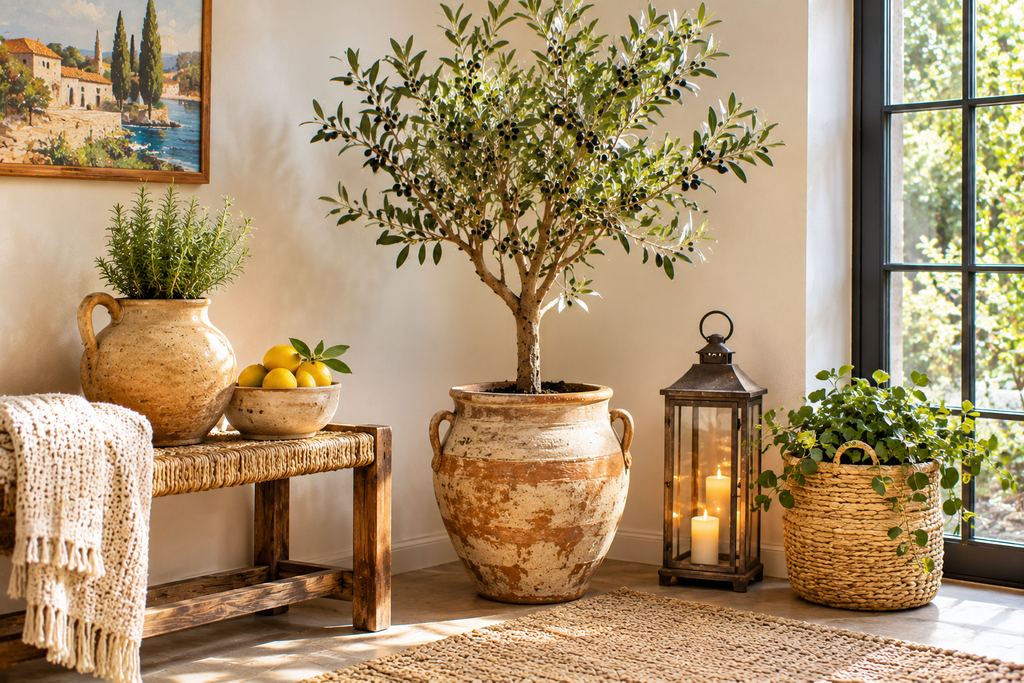
Build a small scene at the base: a wooden stool holding a stack of linen napkins, a ceramic bowl, a few olive oil bottles, a cutting board leaning against the wall. Keep the grouping within a single color family, such as cream, tan, and sage, so it reads as a collected corner instead of clutter. Keep the pot itself clear enough to water and rotate, and avoid placing anything directly against the foliage where it blocks light.
19. Warm Lights for Winter Evenings
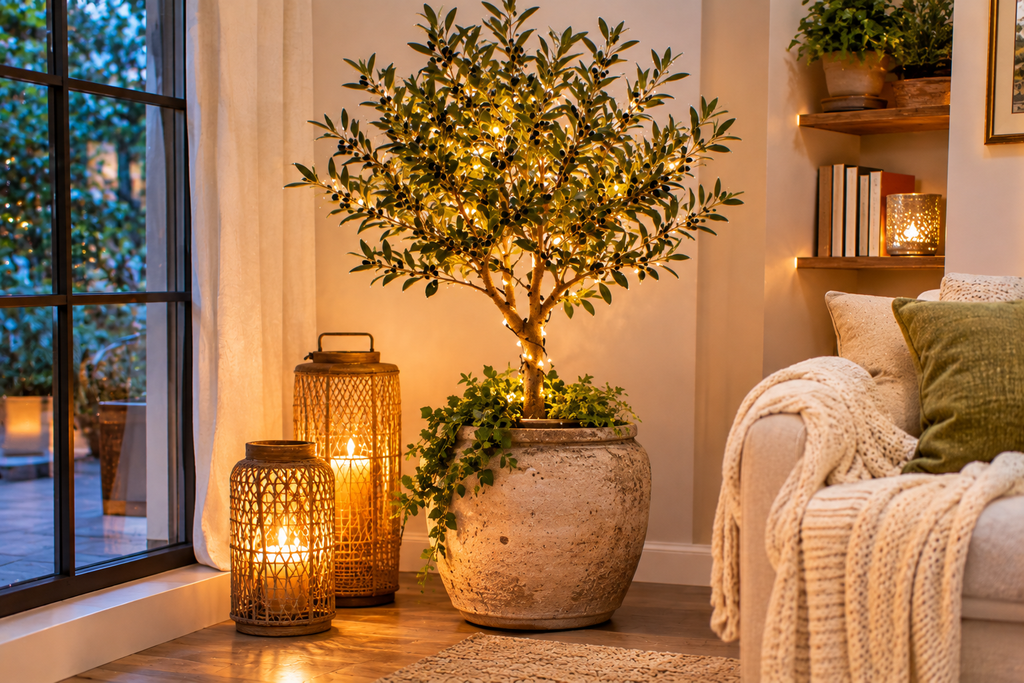
Olives hold small lights well, because the leaves are narrow and the canopy is open. Use LED mini string lights in warm white, which produce little heat compared with older incandescent strings, and check that they’re rated for indoor use. Drape them loosely rather than wrapping tightly, and unplug them when you leave the house or go to sleep. Pulling the lights off when the season ends is easier than trying to untangle them from branches that have grown around the wire.
For a holiday version, tie a few ribbon bows or hang lightweight ornaments from the thinner branches. Heavy ornaments bend the slender twigs.
20. A Cut Branch Arrangement in a Tall Vase
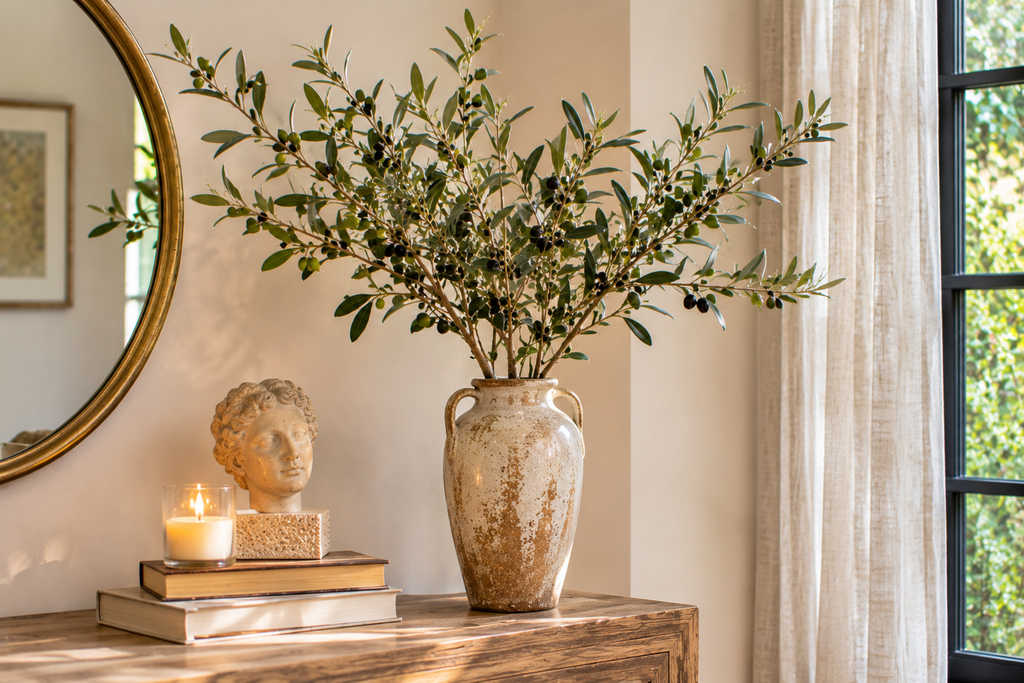
When the light is too poor for a living tree, cut branches are the best substitute. Florists and some garden centers sell fresh olive branches, and they hold up for a couple of weeks in water. A few long stems in a tall ceramic or glass vase, placed in a hallway or on a mantel, give much of the same look with none of the care. Trim the base of each stem on a slant and change the water every few days.
Preserved or dried olive branches last for months without water. They shed more easily, so don’t put them near open flames, candles, or heat sources.
When a Living Tree Won’t Work
21. Choosing a Faux Olive Tree That Doesn’t Look Fake

For windowless entries, dim hallways, and basement rooms, a good faux olive tree is a legitimate design choice. Three details separate a convincing one from an obvious one:
- Leaf color. Real olive leaves are gray-green on top and paler silver underneath. Trees with flat, glossy, uniformly dark green leaves look artificial from across the room.
- Trunk. A real olive trunk is gnarled, uneven, and often twisted. A smooth, perfectly straight trunk is a giveaway.
- Canopy shape. Real trees are slightly irregular. Spend a few minutes bending and fluffing the branches so the shape isn’t symmetrical.
Hide the base with moss, stones, or a basket, and dust the leaves regularly, since faux foliage collects dust and looks dull fast. Don’t place a faux tree where its mix of plastic and wire might be a chewing hazard for pets.
22. A Wreath or Garland of Olive Branches
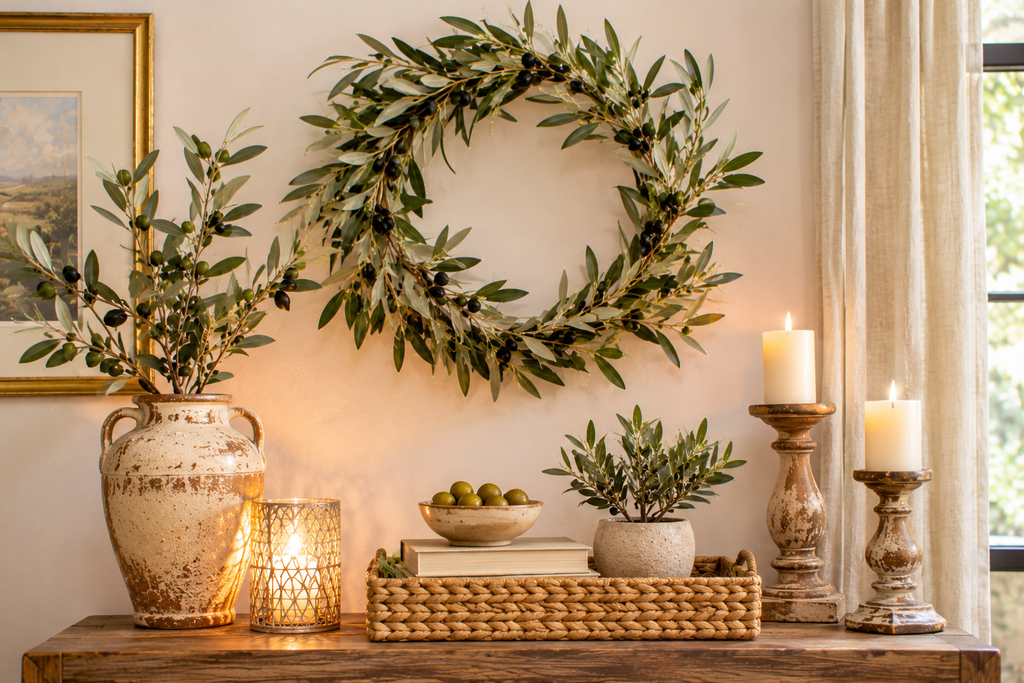
Olive foliage works beautifully in wreaths and garlands because the leaves are narrow and silvery, and they pair well with white and cream ribbon. A faux or preserved garland draped along a mantel, a bookshelf, or a dining table gives the olive look to rooms that can’t hold a tree at all. A real fresh garland will dry out within days indoors, so decide early whether you want something temporary or something that lasts.
Why Indoor Olive Trees Fail, and How to Spot It Early
The signs of trouble show up in the leaves before the tree is in serious danger:
- Leaves dropping steadily, especially from the inside of the canopy. Often a light problem. The tree can’t support as many leaves as it can photosynthesize. Move it brighter or add a grow light.
- Yellowing leaves with soil that stays wet. Likely overwatering. Let the soil dry deeper before watering again, and confirm that the pot drains. If the roots smell sour or look brown and mushy when you slide the tree out, trim the damaged roots and repot into dry, gritty mix.
- Crisp brown leaf edges or tips. Can point to underwatering, heat from a vent, or sun scorch. Check the soil first, then the surroundings.
- Sticky leaves or fine webbing. Scale insects and spider mites both show up on stressed indoor plants. Wipe the leaves, isolate the tree, and treat it according to the label of an indoor-rated product.
Summer outdoors can help a tree recover, but move it gradually. Start in shade for several days, then increase sun over one to two weeks. A tree that spent months in a dim room can sunburn in a single afternoon.
Questions Readers Often Ask
Will an indoor olive tree produce olives?
Unlikely, and don’t count on it. Olives generally need strong light and a cool winter rest period to set flower buds, and most homes provide neither. Treat any fruit as a bonus rather than a goal. Even if olives form, they usually aren’t ready to eat without curing, because raw olives are intensely bitter.
How big will an indoor olive tree get?
It depends on the cultivar, pot size, and how much you prune. In the ground, olives grow into large trees. In a container, growth is restrained, and many hobbyists keep them in the range of three to eight feet. Pruning in spring keeps the size manageable. Check the specific cultivar’s mature height, because dwarf types are bred to stay small.
How often should I repot?
Every two to three years is a general guide, ideally in spring. Move up only one or two inches in pot diameter at a time, since an oversized pot holds extra wet soil around the roots. A tree that is already in a large pot and healthy can instead get a top-dressing of fresh soil.
Can I use my olive tree as a Christmas tree?
A small one can work as a lighter-weight alternative. Use cool-running LED lights, keep ornaments light, and don’t hang anything that stresses the branches. Return the tree to its regular spot after the holidays, and remove lights and decorations promptly.
Final Thoughts
Pick the light first, then the look. If a room has a south or west window, a living olive tree is a realistic centerpiece, and almost every container and styling idea here will work. If the room is dim, choose between a grow light, a cut-branch arrangement, or a well-chosen faux tree, and save the real tree for a brighter spot.
Before you buy: confirm the pot drains or can sit inside a cachepot, plan where the tree will live for months rather than weeks, and leave room to water it without lifting a heavy planter across the house. Those three decisions do more for the tree’s survival than any decorative detail.

About Syprose Kiche
Syprose Kiche is the creator and writer behind My Besuited Home, a practical home and garden website covering DIY projects, gardening, lawn care, landscaping, home improvement, and outdoor living. She focuses on turning everyday homeowner questions into clear, practical guides backed by careful research and useful real-world considerations.