
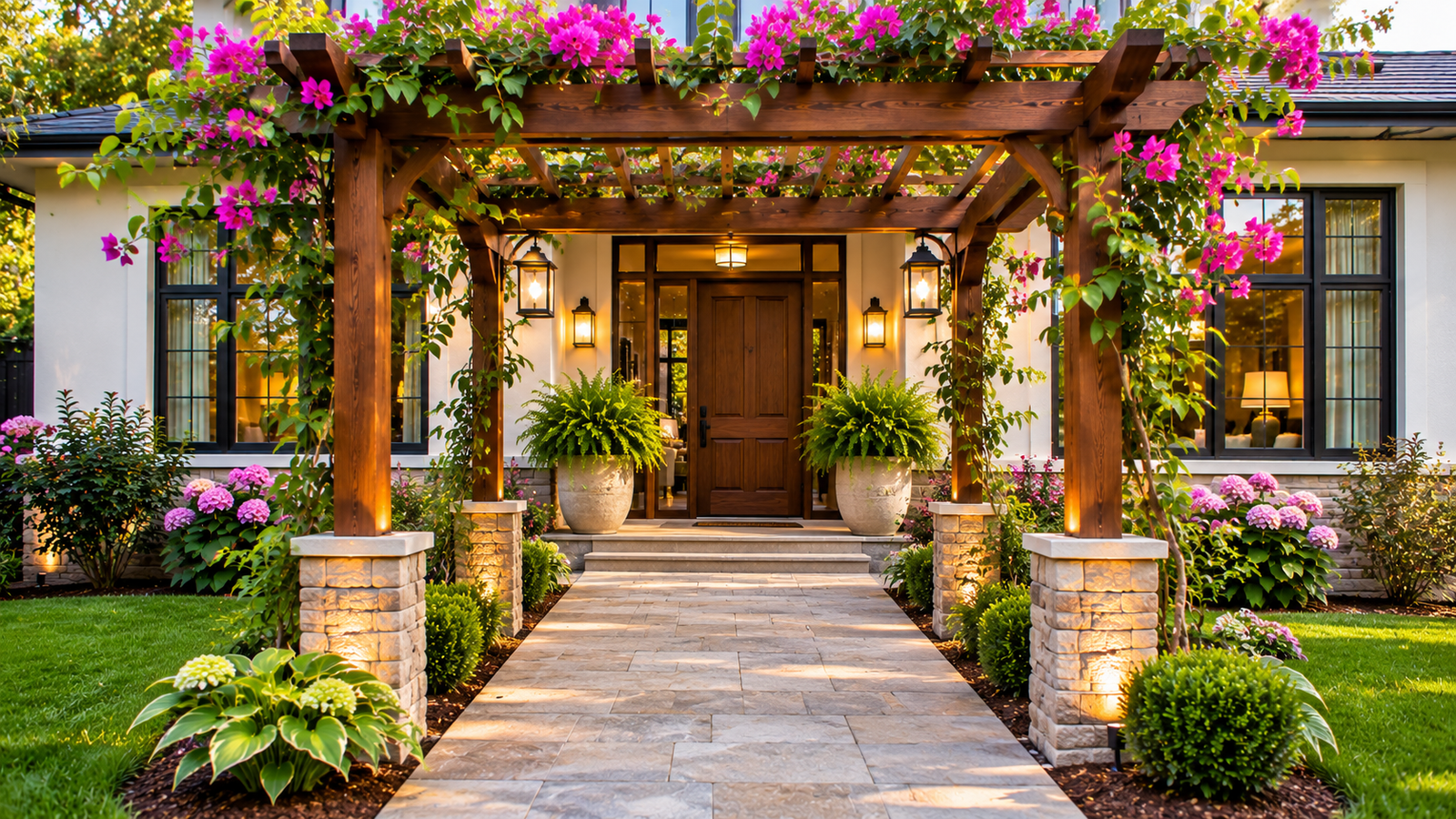
A front yard gets judged from the street in about three seconds. In that time, the eye registers the shape of the lawn, whether the house has a clear entrance, and whether the plantings look planned or accidental. Individual flowers barely register. What people see is structure: lines, layers, and proportions.
That is why so many front yards with plenty of plants still look unfinished. A row of shrubs hugging the foundation, a lawn that runs right up to the walls, and a path that wanders nowhere in particular can all hold a yard back, however healthy the plants are. The ideas below are organized around fixing those structural problems first, then adding the plant and decor details that make a yard feel complete. Most can be done in stages, and several cost very little.
Start With the Problems a Yard Needs Solved
Before choosing any idea, it helps to name what’s wrong. Most underperforming front yards have one or two of these issues:
- The front door is hard to find. Visitors have to hunt for the entrance, usually because plantings or a garage dominate the view.
- The yard is flat. Everything sits at the same height, so nothing draws the eye anywhere.
- The foundation planting is outgrown. Shrubs installed small have swallowed windows and cover the lower wall.
- The edges are undefined. Lawn bleeds into beds, beds bleed into the driveway, and the whole thing looks soft and unkept.
- Nothing happens in winter. The yard looks good for a few weeks and bare the rest of the year.
Match your problem to the sections below instead of working through the list in order. A yard with an undefined entrance needs ideas 1 through 4 far more than it needs a pollinator border.
Ideas That Make the Entrance the Focus
1. Widen and Straighten the Front Walk
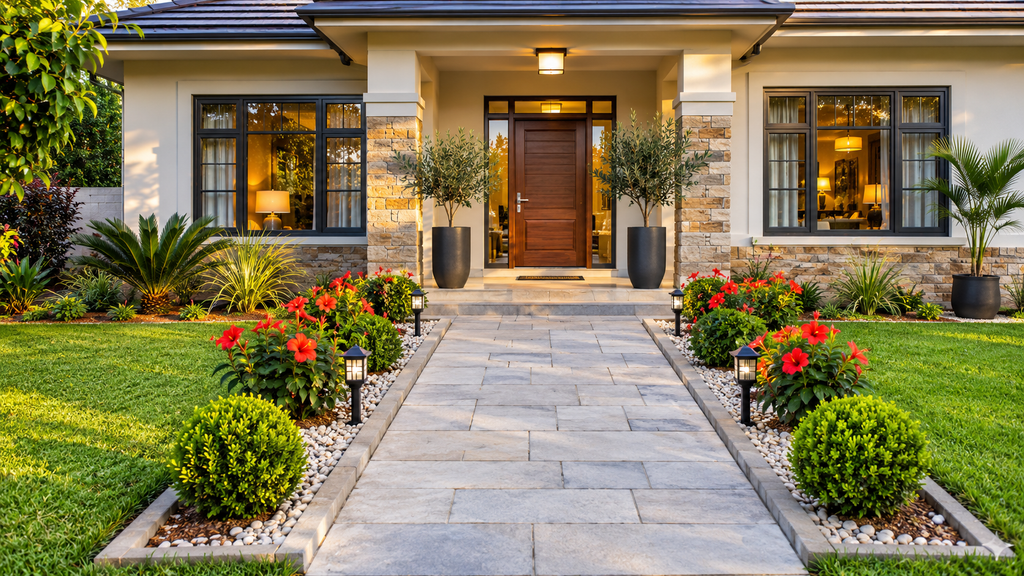
A walkway is often the most functional element in the yard and the most neglected. A common recommendation among landscape designers is a front walk wide enough for two people to walk side by side, which usually means about 4 to 5 feet. Many builders install 3-foot paths that force people into single file and look pinched. Widening the path is more work than planting a bed, but it changes how the whole yard reads.
If the existing path is straight and runs perpendicular to the street, resist the urge to bend it just for interest. A curve needs a reason, such as a tree, a slope, or a bed the path must go around. A curve with no obstacle looks arbitrary. A straight path with good edging and plantings can look more intentional than a meandering one.
2. Choose Path Material for How the Yard Is Used

Path material affects both appearance and maintenance:
- Poured concrete is durable and clean-lined, and it can be stamped or stained to look like stone. It cracks over time in freeze-thaw climates.
- Natural stone pavers (bluestone, slate, flagstone) look rich but cost more, and irregular flagstone can be a trip hazard if set badly.
- Brick suits traditional and colonial homes. It needs a well-compacted base to prevent heaving.
- Gravel is the budget option and drains well, but it migrates into the lawn and is difficult to walk on with a stroller or wheelchair. It needs solid edging.
- Concrete pavers are modular and easy to repair, and come in many shapes and colors.
Match the material to the house when you can. A brick path to a brick house usually feels cohesive. A mix of unrelated materials in one small yard usually looks busy.
3. Frame the Door With Symmetrical Planting
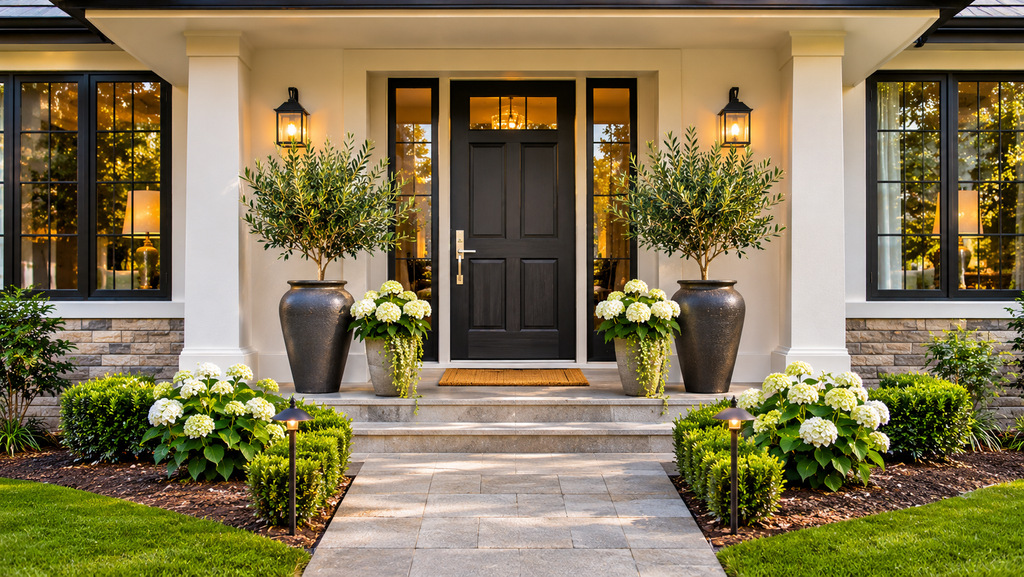
If the entry is the starting point, symmetry is the simplest way to emphasize it. Two matching planters, two identical evergreen shrubs, or a matched pair of small trees flanking the steps all signal “this is the entrance.” Formal symmetry works especially well on houses with a centered door.
Pots are the easiest version. Large containers, at least 18 to 24 inches wide, hold up better than small ones, which dry out quickly and look undersized next to a front door. Small pots can look like an afterthought.
4. Add an Arbor or Pergola Over the Walkway
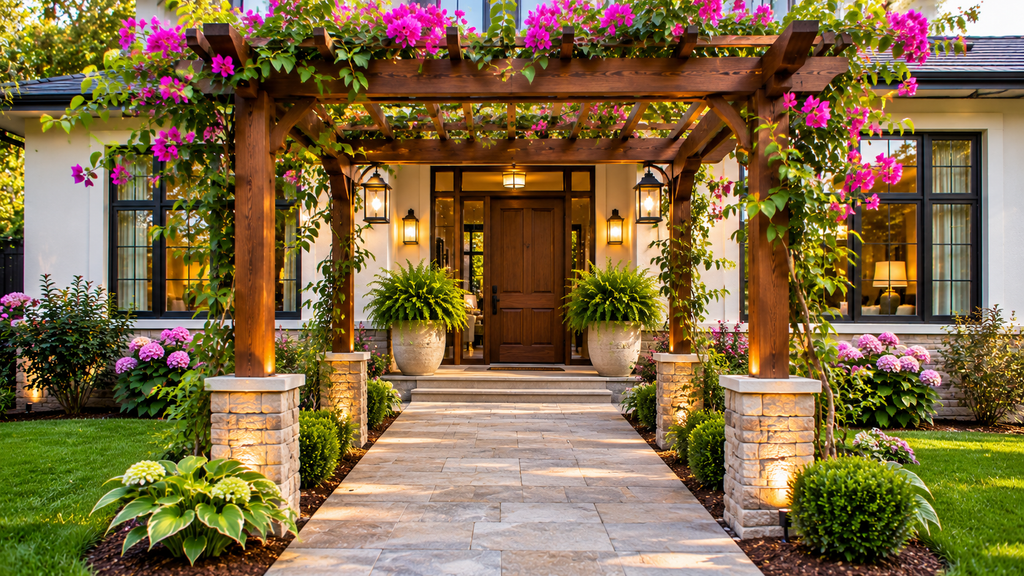
A simple arbor over the path creates a threshold. It gives the eye a frame and the plants a support. Climbing roses, clematis, or wisteria are classic choices, but note that wisteria is aggressive and needs a sturdy structure and regular pruning. A modest arbor in cedar or powder-coated metal is a more realistic project for most homeowners than a full pergola. Check local rules before building: some municipalities and homeowners’ associations restrict structures in front yards or require permits.
5. Light the Path Without Overdoing It

Low-voltage landscape lighting makes a front yard usable and safe after dark, and it improves the evening appearance. The most common mistake is placing lights in a regimented row like an airport runway. Lights spaced irregularly and in pairs of two or three, with some lighting the plantings rather than the path, look more natural. Warm white bulbs generally look better than cool white against foliage and brick. Solar lights are easy to install but are often dimmer and less reliable through winter, so they work best as accents, not primary lighting.
Low-voltage systems (typically 12 volts) are considered much safer for DIY installation than line-voltage systems, but any work connecting to your home’s main power should be done or checked by a licensed electrician.
Ideas That Rework the Foundation Planting
6. Replace Outgrown Foundation Shrubs
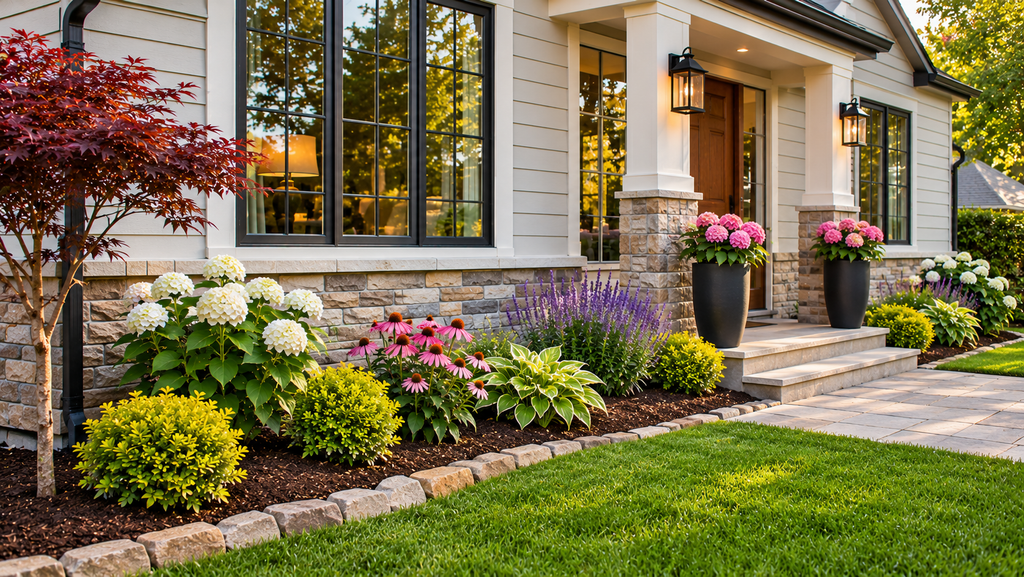
Foundation shrubs are often planted when the house is new and left until they swallow the windows. If you find yourself pruning the same shrub two or three times a year to keep it below a sill, it’s probably the wrong plant for the spot. Pruning something to half its natural size repeatedly produces an ugly, shaped lump and constant work.
Before buying replacements, check the mature height and width on the plant tag or a reliable source such as a university extension plant database. Choose varieties whose mature size matches the space. Dwarf cultivars of boxwood, holly, juniper, and spirea exist for this reason.
7. Plant Away From the Wall
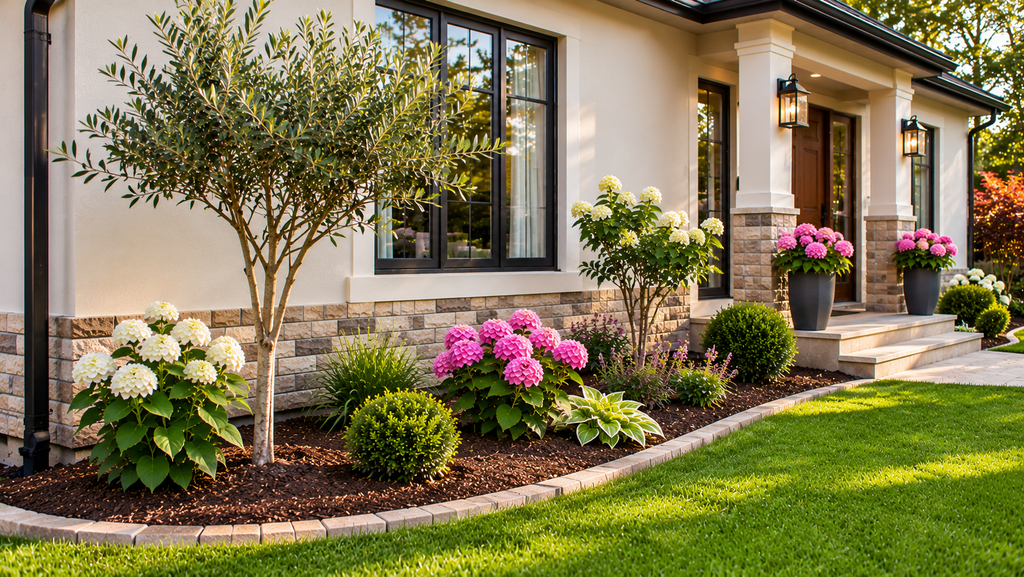
Plants set too close to the house cause real problems: trapped moisture against siding, blocked airflow, hidden pest access, and roots near the foundation. A general rule is to plant at least half the shrub’s mature width away from the wall, and more for larger shrubs. A shrub that will reach 4 feet wide should sit at least 2 feet from the house.
8. Layer Heights Instead of a Single Row
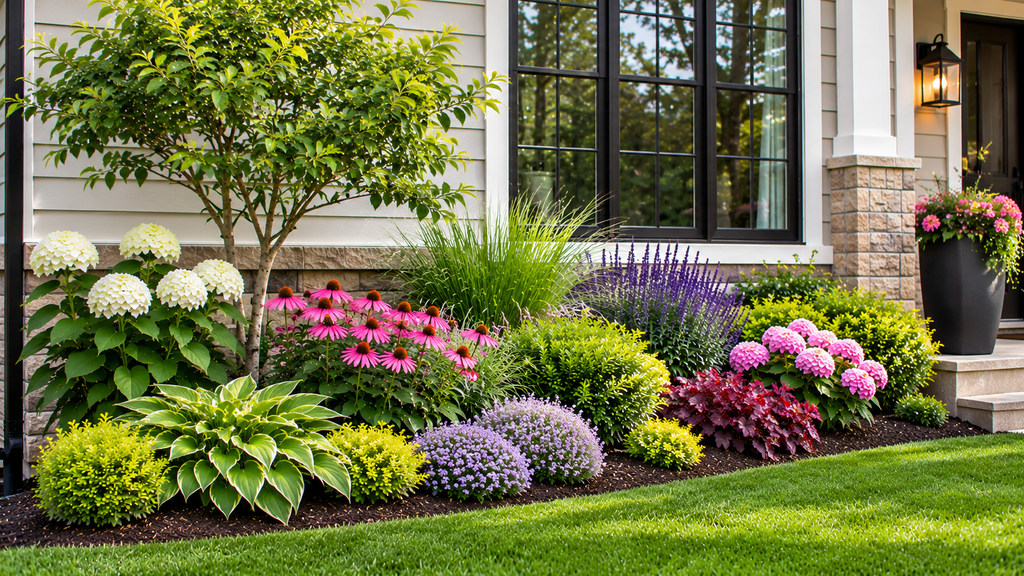
The classic builder’s planting is a single line of the same shrub. A layered bed looks fuller and more intentional. A simple formula: taller structure in the back (or at the corners), medium shrubs and grasses in the middle, low perennials or groundcovers at the front. The tallest plants should stay below window sills where possible, and layering should leave room for a bed depth of at least 4 to 6 feet, which is the minimum for a three-layer design. Shallower beds only support a single row of plants.
9. Break Up the Straight Line With Corner Anchors

The corners of a house are good places for something vertical: a small ornamental tree, a tall columnar evergreen, or a grouping of ornamental grasses. This visually anchors the house to the ground and softens hard corners. Pick plants that won’t overwhelm the roofline at mature height.
Ideas That Define Edges and Shape the Lawn
10. Cut a Crisp Bed Edge

If a yard feels messy, there’s a good chance it’s the edge. A clean, defined line between lawn and bed makes plantings look cared for, even if the plants themselves are casual. You can create one with a sharp spade, with steel or aluminum edging, with stone or brick borders, or with a simple trench edge cut 3 to 4 inches deep. Plastic edging is cheap but tends to heave and show over time.
Trench edging needs recutting a couple of times each growing season. Hard edging in stone or metal costs more upfront but needs less ongoing effort.
11. Reshape the Lawn With Gentle Curves

Lawn edges that follow gentle, sweeping curves are easier to mow than tight scallops. A good test: if you can’t mow a curve in one pass without backing up, it’s too tight. Use a garden hose laid on the lawn to preview the shape before cutting any sod. Look at it from the street and from the front door, since those are the views that matter.
12. Shrink the Lawn Where Grass Struggles
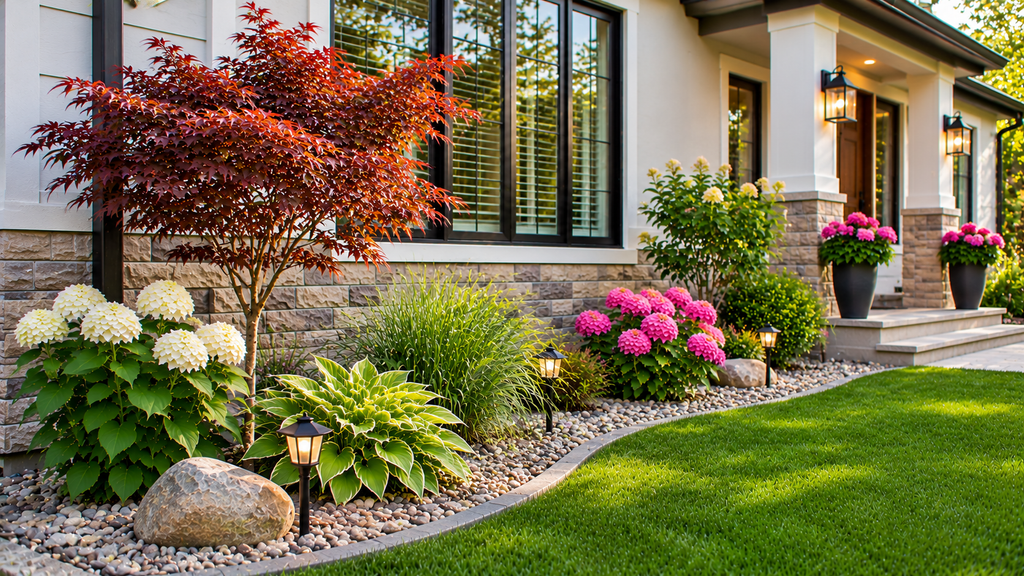
Grass is a practical choice for areas that get foot traffic and sun. It’s less sensible where it struggles: deep shade under trees, steep slopes that are hard to mow, narrow strips between the driveway and the walk, or hot, dry spots along the street. Replacing those areas with groundcovers, mulched beds, or low-maintenance plantings reduces mowing and watering and often looks better. Take the opportunity to check local water restrictions and any HOA lawn requirements before removing turf.
13. Use a Lawn Alternative in Low-Traffic Zones
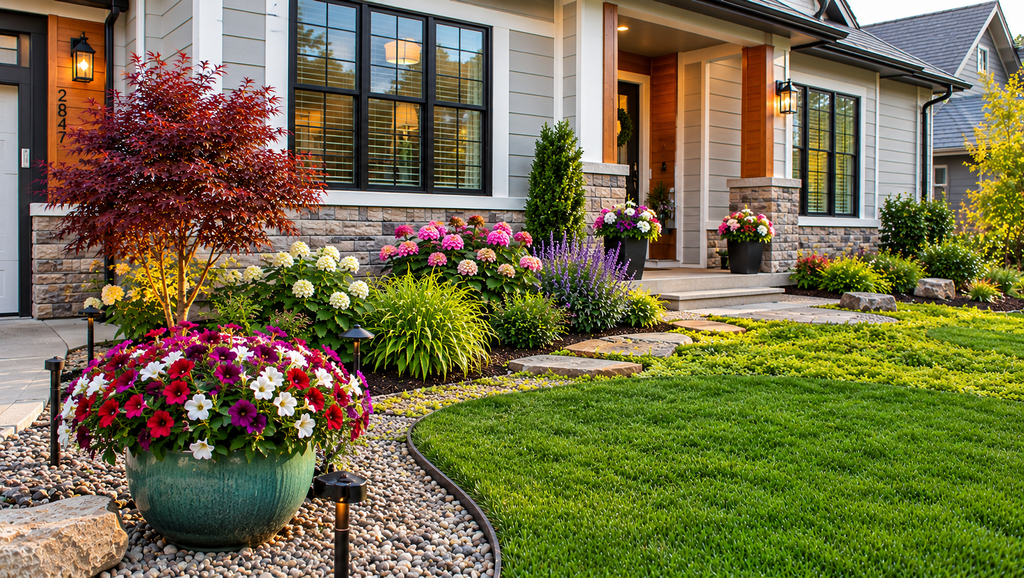
Several groundcovers can substitute for turf where there’s little foot traffic. Creeping thyme, sedum, clover, and sedges suit different conditions. Thyme and sedum like sun and drainage. Many sedges tolerate shade. Clover is soft and drought tolerant but can stain clothing and will attract bees when it flowers, which matters if children or allergies are a concern. None of these tolerates heavy traffic the way a turf lawn does, so keep them away from main paths.
14. Add a Clear Border Along the Driveway

A strip of low plants along the driveway softens a large hard surface and keeps the lawn from creeping onto it. Keep plants low enough that drivers can see around them when backing out, and avoid anything thorny close to car doors. Ornamental grasses, low junipers, or lavender (in sun and dry soil) work well.
Ideas That Add Height, Texture, and Shape
15. Plant One Good Specimen Tree
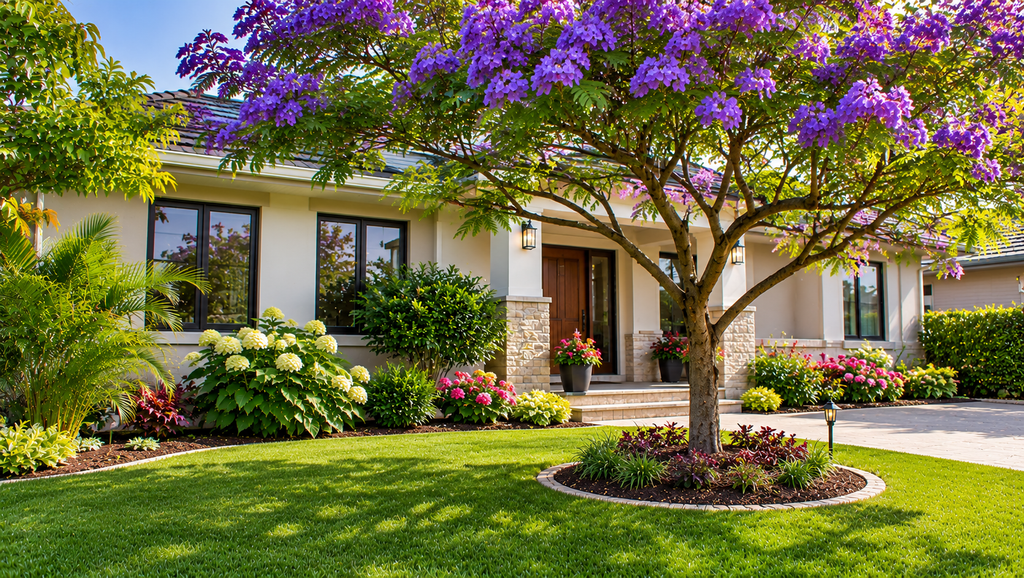
Many front yards have lots of shrubs and no focal point. A single well-chosen small tree can anchor the yard: a Japanese maple, a serviceberry, a dogwood, a crabapple, or a crape myrtle, depending on region. Check the mature size before buying so it doesn’t crowd the house, power lines, or sidewalk. Keep the root zone away from sewer lines, septic systems, and foundations, and call 811 (the national “call before you dig” number in the US) before digging any large hole.
16. Build in Evergreen Structure for Winter
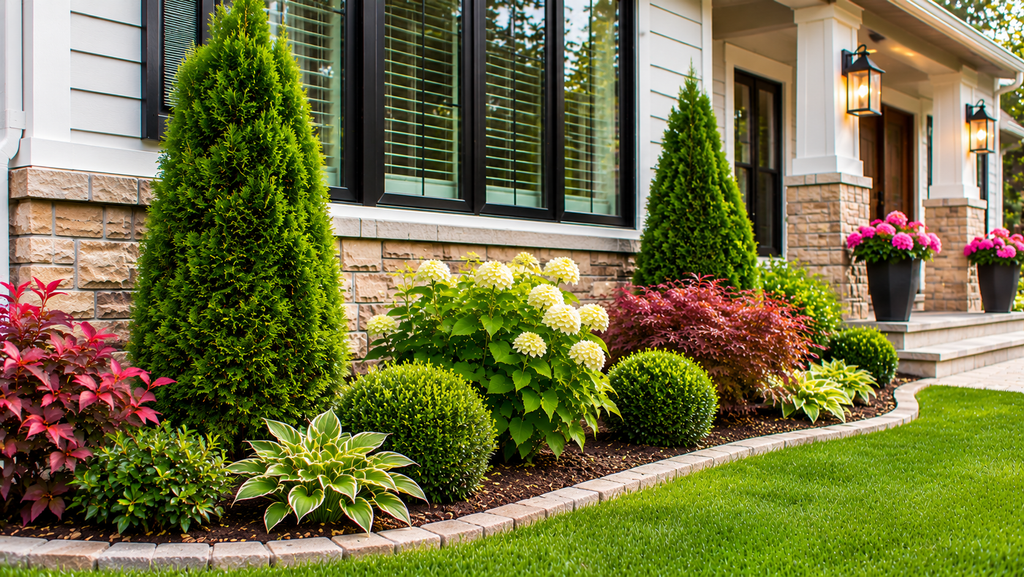
Deciduous plants vanish in winter, and a yard of perennials can look empty for months. Evergreens, including boxwood, holly, yew, dwarf spruce, or evergreen azaleas depending on the climate zone, give the yard a skeleton year-round. A good guideline is to make at least a third of the planting evergreen, though that can be adjusted to taste and climate. Plants that hold up in your hardiness zone matter more than any rule of thumb, and the USDA Plant Hardiness Zone Map is the standard reference.
17. Use Ornamental Grasses for Movement
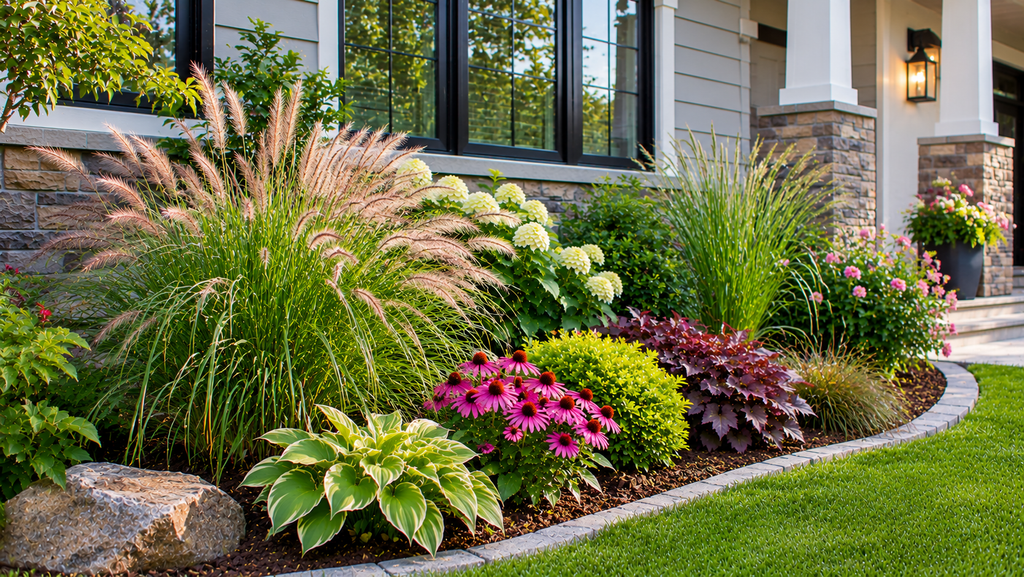
Grasses add texture and sound, and many look good from late summer through winter. Feather reed grass, little bluestem, switchgrass, and fountain grass are common picks. Check each species for invasive tendencies in your region: some, like miscanthus in certain areas, can spread aggressively from seed. Most grasses are cut back in late winter, before new growth starts.
18. Use Repetition to Calm a Busy Bed
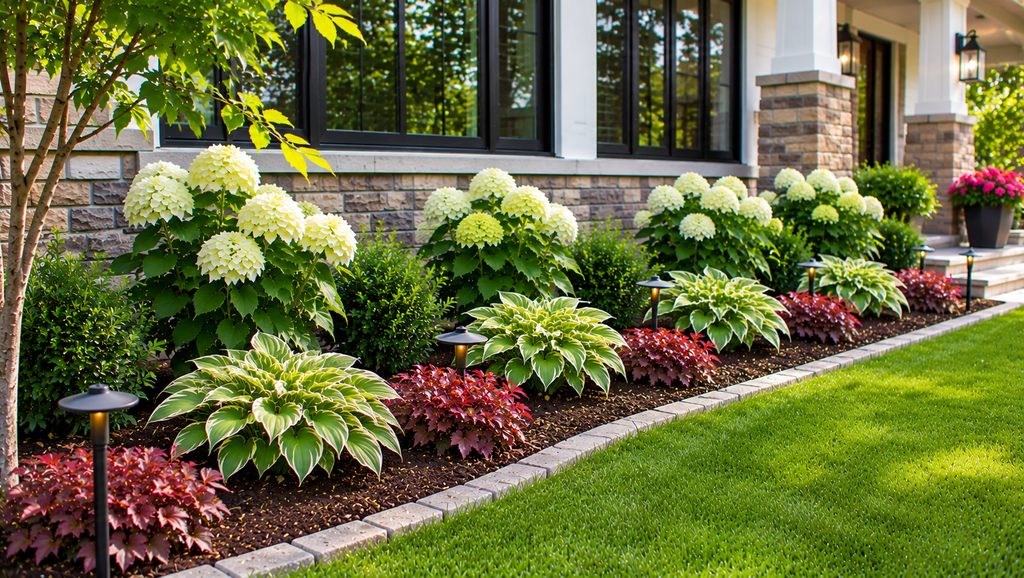
Beds that include one of everything look chaotic. Repeating a few plants in groups of three or five, and repeating those groups along the bed, creates rhythm. The same principle applies to color: pick two or three main colors and keep them consistent. Odd numbers tend to look more natural than even ones.
19. Add Vertical Elements

Obelisks, trellises, tall planters, and upright plants like columnar junipers bring height to a yard that would otherwise sit low. A trellis against a blank garage wall, for example, can support climbers and break up a large flat surface.
Ideas That Add Color and Seasonal Interest
20. Plan Bloom in Sequence
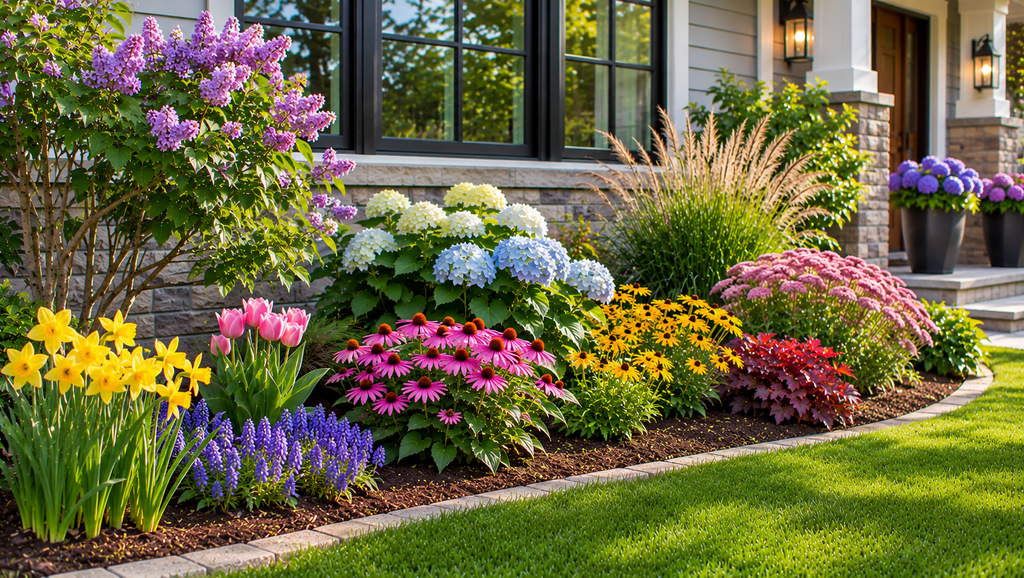
A front yard that blooms all at once in May and does nothing else leaves months of dull appearance. Plan for something in each season: spring bulbs and flowering shrubs, summer perennials, late-season sedum and asters, and fall color or berries. Perennials with long bloom times, such as coneflower, catmint, salvia, and coreopsis, fill the middle of the year with less effort than constantly replacing annuals.
21. Choose a Restrained Color Palette
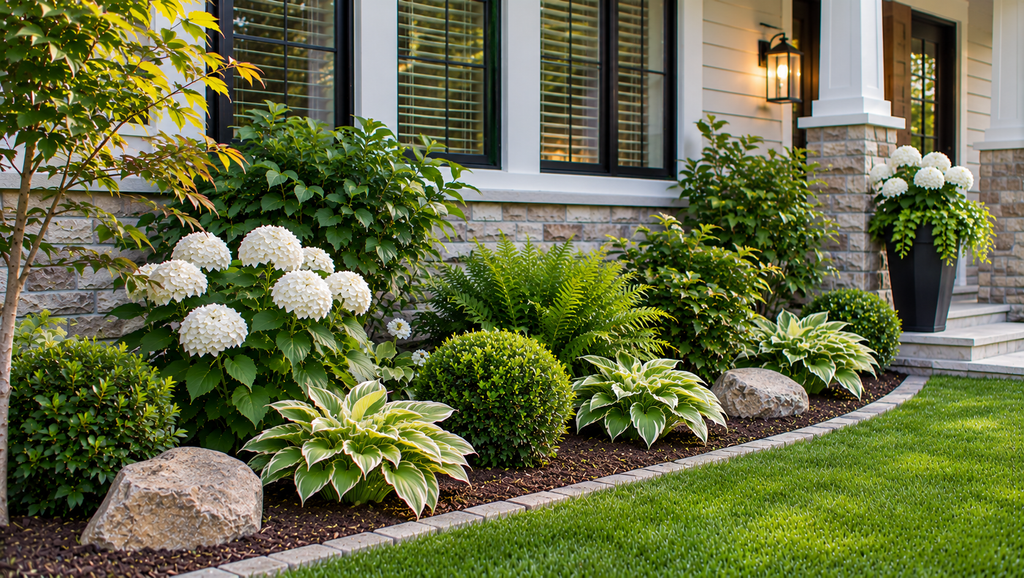
A yard with every color in the rainbow can look scattered. Limiting the palette makes it look planned. Common approaches include a single-color scheme with different textures, a two-color pairing such as purple and yellow, or a mostly green yard with white accents. White and pale flowers show up well at dusk.
22. Add Seasonal Containers

Containers let you change the yard’s look without replanting beds. A pot by the door can hold spring pansies and bulbs, summer annuals, fall mums and ornamental kale, and winter evergreen branches. Containers need drainage holes, quality potting mix (not garden soil), and regular watering in summer, since pots dry out faster than beds. Frost-prone climates require frost-resistant pots or emptying them before winter, as some ceramic and terra cotta pots crack when water freezes inside.
23. Include Pollinator-Friendly Plants

Native perennials such as coneflower, milkweed, bee balm, and asters support bees and butterflies and often need less care once established. Native plants vary a lot by region, so a local native plant society or cooperative extension office is the best source for a list suited to your area. Pollinator plants also attract insects, so keep them away from doorways if anyone in the household has bee-sting allergies.
Details That Finish the Picture
24. Give the Mailbox and House Numbers Attention
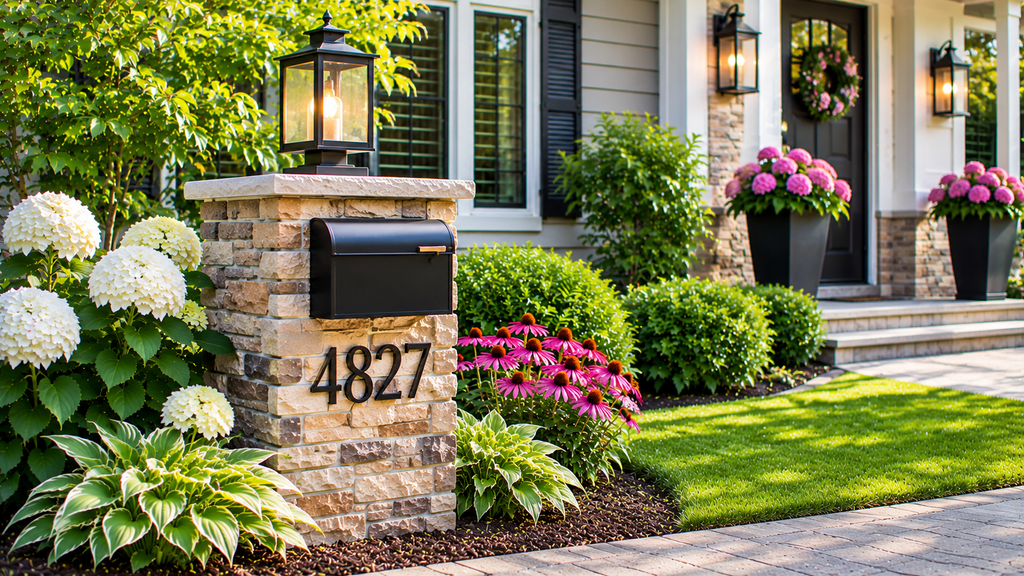
These small elements sit in the most visible spot and are often neglected. A clean mailbox, a matching post, house numbers large enough to read from the street, and a small planting at the base make the property look cared for. Check postal service rules before replacing a mailbox, since standards govern size and placement.
25. Use Mulch Correctly

Mulch makes a bed look finished and suppresses weeds, and it helps retain soil moisture. The usual recommendation is 2 to 3 inches deep, kept a few inches away from stems and trunks. Piling mulch against tree trunks, sometimes called “volcano mulching,” can encourage rot and pests. Fresh dark mulch also makes plantings look sharper.
26. Hide the Utility Equipment
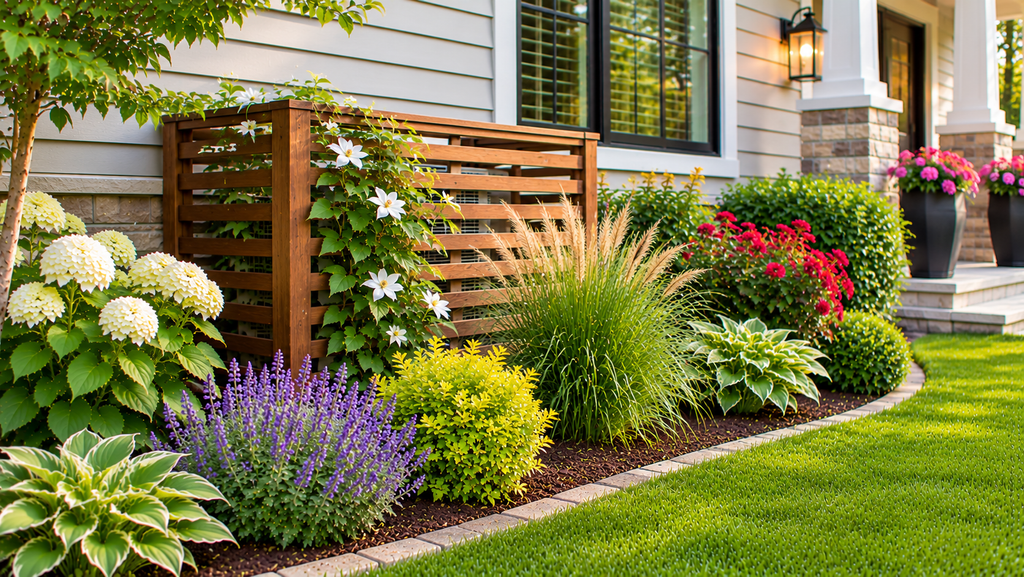
Air conditioning units, meters, and trash bins undercut an otherwise nice yard. A low screen of shrubs or a simple lattice panel can hide them. Leave clearance around equipment as required by the utility company or manufacturer, since blocked airflow reduces efficiency and meters must stay accessible. Never plant against gas meters or utility boxes without confirming local clearance requirements.
27. Add One Decorative Feature
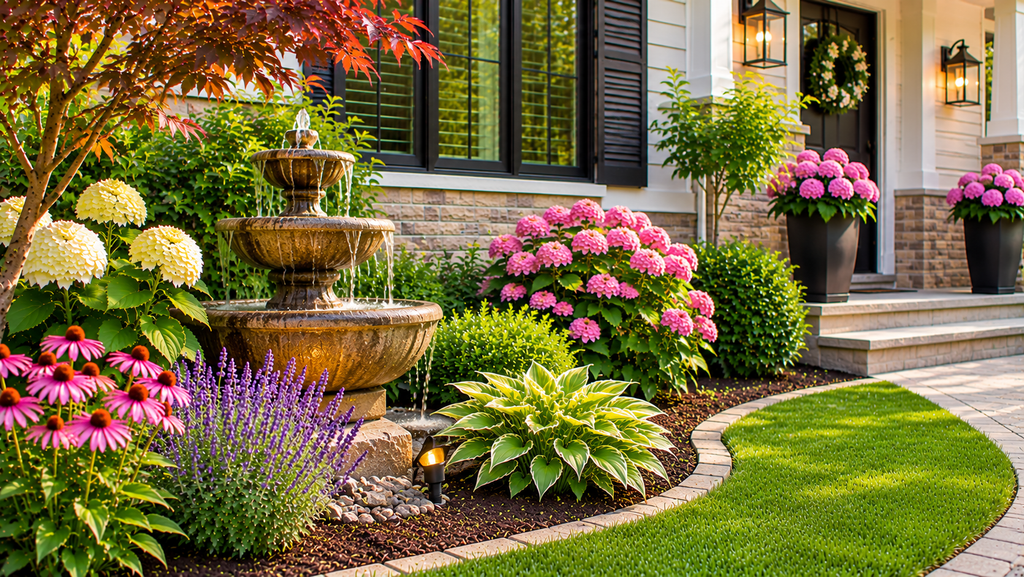
A birdbath, a sundial, a bench, or a sculptural piece can serve as a focal point. One well-placed item generally looks better than several competing ones. Keep scale in mind: tiny ornaments get lost in a front yard and are best used in a courtyard or small bed.
Planning Before You Plant
Check What’s Underground and Allowed
Call 811 before any digging. Check HOA covenants and local zoning for height limits on fences and hedges, restrictions on certain plants, and rules about front yard structures. Some areas restrict vegetable gardens or turf removal in front yards, while others encourage it.
Look at the Yard From the Street
Photograph the house from the curb and from across the street, then print or sketch over the photo. This reveals proportion problems that are hard to spot from inside the yard. It also helps prioritize: you can see immediately whether the problem is the entry, the foundation, or the lawn.
Work in Phases
A full front yard redo can cost thousands of dollars, but it doesn’t have to happen at once. A reasonable sequence is structure first (paths, edging, big plants), then foundation and layers, then perennials and containers, then decor. Starting with decor is the usual mistake, because it can’t make up for weak structure.
Know When to Hire Help
Hire a licensed professional for anything involving grading and drainage changes, retaining walls over a few feet high, electrical work, large tree removal, or structural pergolas. A landscape designer can also be worth a one-time consultation fee even if you do the work yourself, since the plan is the most valuable part.
Common Questions
How much should I spend on front yard landscaping? Costs vary widely by region, materials, and scope, so any single figure would be unreliable. Getting two or three local quotes for the parts you won’t do yourself gives a realistic range for your area. A commonly cited rule of thumb among real estate professionals is that landscaping investment tends to pay back through added appeal, but returns vary and should not be treated as guaranteed.
What’s the best time of year to plant? In most of the US, fall and early spring are better than midsummer for trees and shrubs, because cooler weather and rain reduce stress on new roots. Exact timing depends on your climate zone and local frost dates.
Can I do a low-maintenance front yard that still looks good? Yes. Use fewer plant varieties in larger groups, choose plants suited to your site’s sun and soil, mulch well, and install clean edging. Low maintenance usually means the right plant in the right spot, not no plants.
What if my front yard faces north or is mostly shade? Shade changes the plant list and gives you lush foliage options: hostas, ferns, hellebores, astilbe, hydrangeas (for part shade), and Japanese forest grass. Flower color is more limited, so texture and leaf contrast do more of the work.
Final Thoughts
Curb appeal rests on a few structural decisions. Make the entrance obvious, give the house plantings it won’t outgrow, define clean edges, add height at a focal point, and make sure something is interesting in every season. Color and decor come after that and work best on a sound base.
If the budget is tight, start with the front walk, the edging, and the foundation planting. They produce the most visible change per dollar. Before buying anything, confirm mature plant sizes, check your hardiness zone, and call 811 before digging.

About Syprose Kiche
Syprose Kiche is the creator and writer behind My Besuited Home, a practical home and garden website covering DIY projects, gardening, lawn care, landscaping, home improvement, and outdoor living. She focuses on turning everyday homeowner questions into clear, practical guides backed by careful research and useful real-world considerations.