
My backyard used to look like a confused meadow before I discovered the magic of boxwoods. I spent three years trying to make “wild and free” work, but it just looked like I’d given up on life. If you’re tired of your front yard looking like a messy afterthought, boxwoods are the “reset button” you’ve been looking for. They are the duct tape of the gardening world—they fix almost every structural mistake you’ve made.
I’ve spent over a decade lugging bags of mulch and killing more shrubs than I care to admit. I once planted a row of “bargain” boxwoods too close to my driveway, and by year three, I couldn’t get my car door open without pruning the hedge first. I’ve learned the hard way which ideas actually work and which ones are just a recipe for a weekend of back-breaking regret.
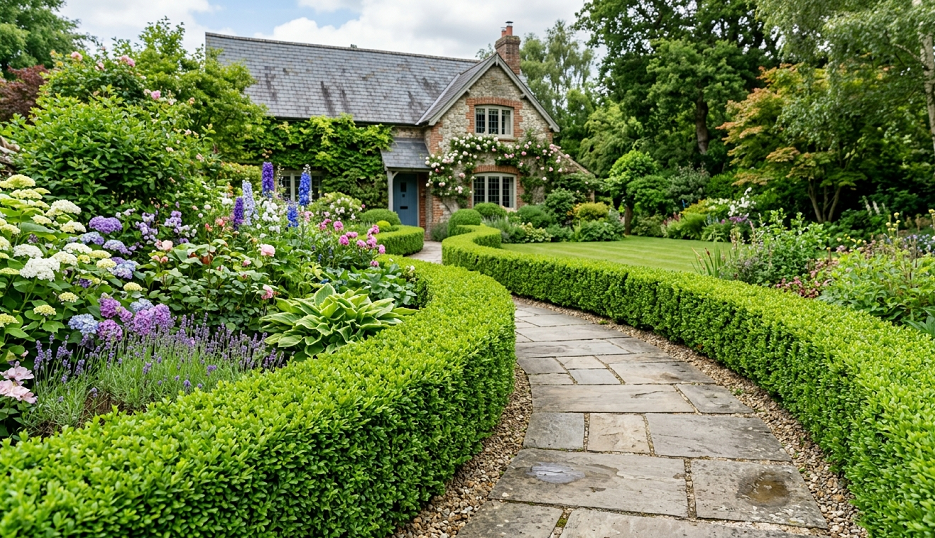
1. Low Boxwood Hedges for Classic Pathway Edging
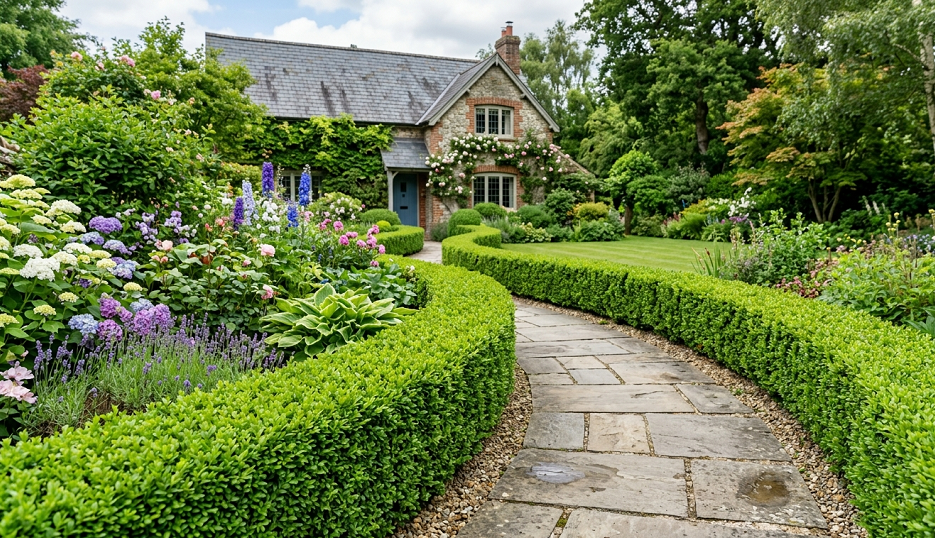
There’s something about a crisp, green line that makes even a gravel path look like it belongs at a French estate. I’m a huge fan of using Buxus microphylla ‘Winter Gem’ for this because it stays relatively compact. When I first started out, I thought I could just “eye-ball” the line. Big mistake. My first path looked like a snake trying to find its way home after a long night at the pub.
To get that professional, SEO-worthy look, you need to use stakes and a string line. Don’t skip this. If your line is off by even two inches, you’ll see it every single time you pull into the driveway. I prefer keeping these hedges around 12 to 15 inches tall. It’s high enough to define the space but low enough that you don’t feel like you’re walking through a green canyon.
Maintenance is where most people trip up. You can’t just prune these once a year and expect them to look like a magazine cover. I hit mine with a light trim in late spring and again in mid-August. If you wait too long into the fall to trim, the new growth won’t harden off before the first frost, and you’ll end up with ugly brown tips all winter. I learned that the year I got “ambitious” in October and turned my hedge into a graveyard of toasted leaves.
For spacing, don’t listen to the tag that says “plant 3 feet apart.” If you want a solid hedge in your lifetime, plant them about 15 to 18 inches apart. Yes, it costs more upfront, but you won’t be looking at individual lumpy balls for five years while you wait for them to grow together. It’s the difference between a finished project and a “work in progress” that never actually finishes.
2. Creating Formal Boxwood Parterres in Small Front Yards
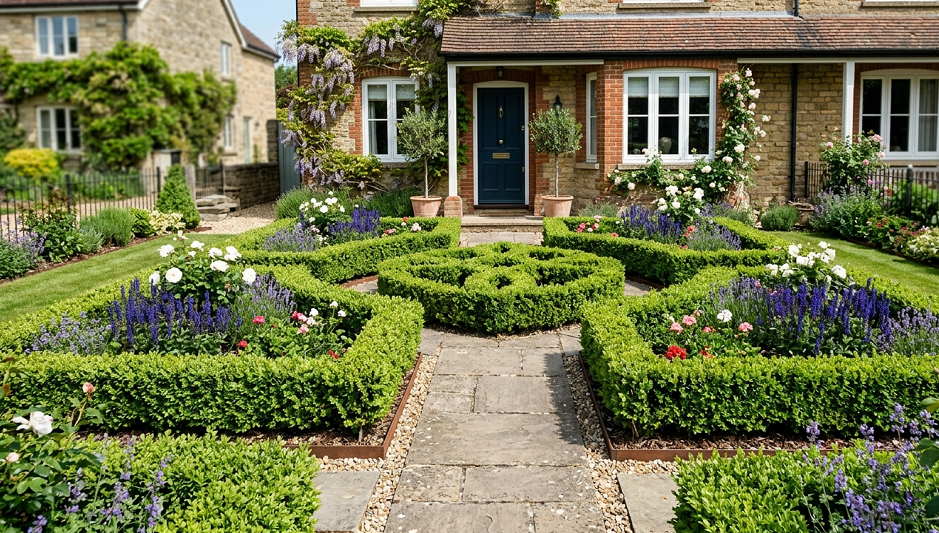
If you have a tiny front yard and you’re struggling with “curb appeal,” a parterre is your best friend. This is basically just a fancy word for geometric patterns made of hedges. I’ve found that a simple “X” pattern or a square-within-a-square adds so much visual weight that you don’t even need expensive flowers to make the house look good.
The trick here is symmetry. If one side is bigger than the other, it’ll drive you crazy. I once built a diamond-shaped parterre under my kitchen window and realized halfway through that I’d centered it on the vent pipe instead of the window. I had to dig up twelve shrubs in the pouring rain just so I could sleep at night. Measure twice, dig once—that’s my motto.
Inside the boxes of your parterre, you can go nuts with seasonal color. I like to swap out red tulips in the spring for white begonias in the summer. But honestly? Sometimes I just fill them with dark hardwood mulch and call it a day. The green of the boxwood pops so hard against dark mulch that it looks intentional and high-end even when you’re being lazy.
Don’t go for the giant varieties here. Look for ‘English Boxwood’ (Buxus sempervirens ‘Suffruticosa’). It grows slowly, which is exactly what you want. You don’t want to be out there every weekend with shears trying to maintain a complex geometric shape. Slow growth means less work, and I am all about finding ways to spend more time in my lawn chair and less time on my knees.
3. Using Boxwood Topiary Cones for Modern Entryway Accents
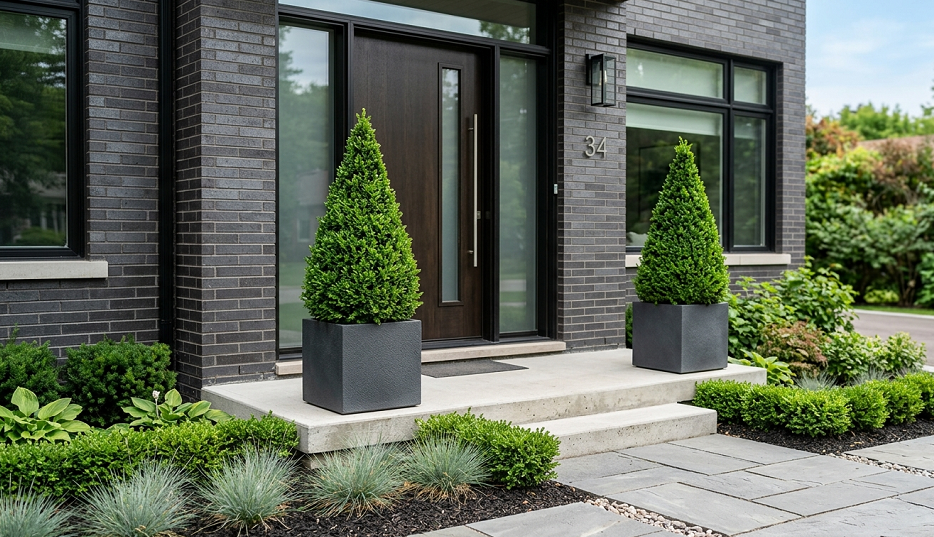
I used to think topiaries were only for people with mansions and full-time staff, but then I realized a pair of potted boxwood cones can hide a multitude of architectural sins. If your front door feels “flat” or boring, stick two cones in oversized black planters on either side. It’s instant class. I did this for a neighbor who was trying to sell her house, and she got an offer three days later.
Buying pre-shaped cones is expensive. If you’ve got more time than money, buy a standard upright boxwood like ‘Dee Runk’ or ‘Fastigiata’ and shape it yourself. It’s not as scary as it sounds. I use a simple bamboo tripod as a guide. Tie three stakes together at the top, spread the bottoms out around the plant, and snip everything that pokes outside the stakes. It’s like a haircut for your garden.
The biggest mistake I see with potted boxwoods is drainage. Boxwoods hate “wet feet.” If they sit in water, they will turn yellow and die faster than a New Year’s resolution. I always drill extra holes in the bottom of my pots and use a high-quality potting mix with plenty of perlite. I once lost a pair of $80 topiaries because I forgot to check if the “decorative” pot actually had a hole in the bottom. It didn’t. They drowned in two weeks.
During the winter, potted boxwoods need a bit of extra love. In my neck of the woods, the wind can dry them out even when it’s freezing. I spray mine with an anti-desiccant in December. It’s like putting lip balm on your plants. It keeps the moisture in the leaves so they don’t turn that sickly orange color by February.
4. Layering Boxwoods with Ornamental Grasses for Texture
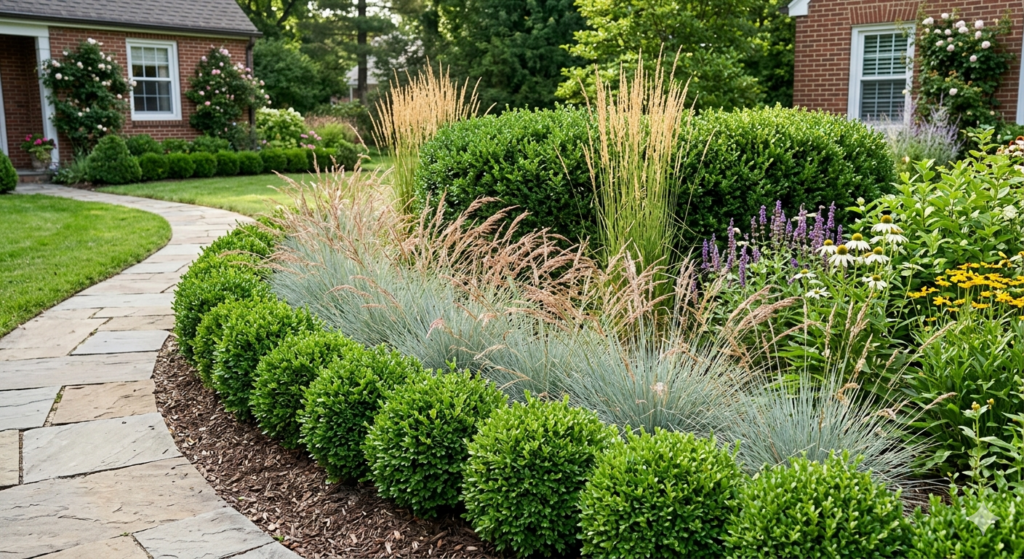
This is my secret weapon for a low-maintenance backyard. I love the “odd couple” vibe of a structured, clipped boxwood sitting right next to a wild, flowy ornamental grass like Pennisetum (Fountain Grass) or Miscanthus. The boxwood provides the “bones,” and the grass provides the movement. It’s the perfect balance of “I have my life together” and “I’m still fun at parties.”
I usually plant the boxwoods in a tight row or a cluster of three spheres in the front, with the taller grasses behind them. The contrast is killer. In the fall, when the grasses turn golden and the boxwoods stay deep green, your garden will look better than the local park. One year, I tried putting the grasses in front, but they just covered the boxwoods and made the whole bed look like a messy haystack. Keep your “anchors” visible.
Another reason I love this combo is that it’s nearly bulletproof. Deer hate boxwoods (they taste like bitter soap to them), and most ornamental grasses are equally unappealing to the local wildlife. After the summer my hostas were eaten down to the nubs by a family of deer, I pivoted hard to this combination. Now the deer just walk past my yard with a look of disappointment.
For the boxwoods in this setup, I don’t go for perfect squares. I like “clouds” or rounded spheres of different sizes. It feels more organic. I use ‘Green Velvet’ because it naturally wants to be a round ball anyway. You barely have to touch it with the shears to keep that shape, which leaves you more time to enjoy a cold drink while watching the grass blow in the breeze.
5. Defensive Planting: Boxwood as a Living Privacy Screen
If you’ve got a neighbor who likes to stare while you’re grilling, you need a living wall. Forget those ugly vinyl fences. A tall boxwood screen is elegant and permanent. You’ll want the ‘American Boxwood’ (Buxus sempervirens) for this because it can actually get some height—up to 10 or 12 feet if you let it.
The key to a good privacy screen is patience. Don’t let them grow straight up without trimming the tops, or they’ll get leggy and thin at the bottom. You want a “dense” wall, not a “see-through” one. I learned this the hard way with a row of Hicks Yews that looked like a row of skinny pencils for five years. With boxwoods, I prune the tops every year to encourage the plant to push growth out to the sides.
When planting a long screen, the cost can be staggering. My tip? Buy the smaller 3-gallon pots and be okay with waiting three years for total privacy. The larger 7-gallon or 10-gallon plants are huge and heavy, and they often suffer more transplant shock. Plus, if you’re digging 20 holes, your back will thank you for choosing the smaller pots. I once tried to plant fifteen 10-gallon boxwoods in one weekend and I couldn’t stand up straight for a week.
One thing to watch out for is “Boxwood Blight.” If you’re planting a massive row, you’re creating a monoculture. If one gets sick, they all get sick. I make sure to space them enough for air to circulate and I always water at the base of the plant, never the leaves. Wet leaves are a playground for fungus, and once blight hits your 10-foot screen, it’s game over.
6. Integrating Boxwood Spheres into Perennial Borders
I think every perennial bed needs at least three boxwood balls. Why? Because without them, your garden looks like a pile of sticks for six months of the year. When the peonies die back and the coneflowers turn to mush, the boxwood spheres stand there like soldiers, keeping the garden looking intentional through the winter.
I like to use different sizes—maybe a large 24-inch ball, a medium 18-inch one, and a tiny 10-inch one tucked near the front. This “group of three” rule is a classic design trick that works every single time. I once planted a single boxwood in the middle of a flower bed and it looked like a stray bowling ball that someone forgot to pick up. Grouping them makes it look like design.
These spheres also serve as a great “shoulder” for floppier plants. If you have catmint or lavender that tends to flop over after a heavy rain, plant a boxwood sphere right next to it. The stiff branches of the boxwood will hold up the flowers, saving you from having to use those ugly green plastic stakes. It’s functional art.
For these, ‘Green Mountain’ is a solid choice because it’s easy to shape. But here’s a pro-tip: don’t use electric shears for small spheres. You’ll take off too much and end up with a flat spot that takes a year to grow back. Use hand shears. It’s slower, sure, but it’s meditative, and you have way more control. I find it’s the best way to clear my head after a long day.
7. The Boxwood “Cloud” Garden for a Zen Aesthetic
If you’re into that Japanese-inspired, minimalist look, “cloud pruning” (or Niwaki) is the way to go. This involves taking a group of boxwoods and pruning them into a series of overlapping, soft mounds of different heights. It looks like a rolling green fog. It’s incredibly soothing to look at, and it’s a great way to handle a slope where nothing else wants to grow.
I started a cloud garden on the little hill by my mailbox three years ago. At first, the mailman thought I’d lost my mind because I was out there with a level and a pair of scissors. But now that it’s filled in, people actually stop their cars to take pictures. It’s much more interesting than a standard hedge.
To pull this off, you need to be okay with imperfection. It’s not about perfect circles; it’s about soft, organic humps. I suggest using a mix of ‘Green Velvet’ and ‘Winter Gem’ to get slightly different shades of green, which adds to the “depth” of the clouds. It makes the whole area look like a 3D landscape painting.
A quick side note: cloud pruning requires a bit more maintenance. Since you have so many “surfaces,” you have to be diligent about removing dead leaves that get trapped in the crothes of the branches. If you let old leaves sit in there, you’re asking for rot. Once a month, I just go through and give the “clouds” a good shake to clear out the debris.
8. Defining Vegetable Garden Beds with Boxwood Borders
This is the ultimate “cottage garden” move. If you have raised beds for veggies, surround the base with a low boxwood hedge. It makes the whole garden look like a formal “potager” instead of just a patch of dirt where you grow zucchini. It also acts as a physical barrier that keeps creeping weeds (and my neighbor’s annoying dog) out of my lettuce.
I used ‘Justin Brouwers’ boxwoods for my veggie garden border because they are naturally mounded and very slow-growing. I only have to prune them once a year. The best part? In the winter, when my vegetable beds are just empty boxes of brown dirt, the boxwood border keeps the area looking tidy. It keeps the “winter blues” away when I look out the kitchen window.
One thing to keep in mind is root competition. Boxwoods have shallow, fibrous roots. If you plant them too close to your tomatoes, they’re going to fight for water. I keep my boxwoods about 12 inches away from the actual wooden frames of my raised beds. This gives both the shrubs and the veggies enough “breathing room” to thrive without a underground turf war.
I also find that the boxwoods provide a little bit of a windbreak for my younger seedlings in the spring. Those first few weeks of March can be brutal, and having a 10-inch thick green wall around the beds keeps the soil just a tiny bit warmer and the wind from snapping my pepper plants. It’s a win-win for aesthetics and biology.
9. Creating a “Step” Hedge with Multiple Boxwood Varieties
If you have a long driveway or a large expanse of wall, a single row of boxwoods can be boring. Try “stepping” them. This means planting a tall row in the back (like ‘American’), a medium row in the middle (‘Green Mountain’), and a short, clipped row in the front (‘English’). It creates a tiered, stadium-seating effect that looks incredibly expensive.
I did this along the side of my garage to hide the ugly concrete foundation. It took a lot of digging—I won’t lie—but the result is a lush wall of green that changes texture as your eyes move down. It’s much more effective at “grounding” a building than a single line of shrubs. It makes the house look like it grew out of the earth.
When you do this, make sure you leave enough space between the rows. You need to be able to walk between them (or at least lean over) to prune the back ones. I didn’t do this the first time and ended up having to balance on a ladder like a circus performer just to reach a stray branch in the back. Give yourself 18 to 24 inches of “service space” between the tiers.
For color, I like to use varieties that have slightly different hues. ‘Green Mountain’ has a bit of a brighter, lime-green tint in the spring, while ‘American’ stays a deeper, forest green. That subtle shift in color makes the “steps” stand out even more. It’s a masterclass in monochromatic design that will make your neighbors jealous.
10. Using Boxwoods to “Anchor” Large Boulders or Rocks
If you have a rock garden or a large feature boulder, it often looks “stuck on” rather than part of the landscape. I love tucking two or three boxwood spheres right against the base of a large rock. It “softens” the hard edges of the stone and makes it look like the rock has been there for a hundred years.
I have a massive piece of granite in my backyard that the builders left behind. For years, it just looked like a giant gray tooth sticking out of the grass. I planted three ‘Green Velvet’ boxwoods around it in a cluster, and now it’s my favorite spot in the yard. The way the soft green leaves spill over the hard gray stone is just “chef’s kiss” levels of contrast.
Don’t plant them all the way around the rock. You want to leave some of the stone visible so you get that “emerging” look. I usually plant them on one “shoulder” of the rock and leave the other side open with maybe some low-growing thyme or moss. It feels more natural, like something you’d see on a hike in the mountains.
Quick side note: Rocks hold heat. In the summer, that boulder is going to act like a radiator. You’ll need to check the soil moisture more often for boxwoods planted against stone. I lost one during a heatwave in 2024 because the rock literally cooked the roots. Now, I give those specific plants an extra drink of water when the thermometer hits 90 degrees.
11. Bonus: The “Floating” Boxwood Sphere in a Sea of Groundcover
This is a fun one if you want something a bit more modern. Plant a single, perfectly manicured boxwood sphere in the middle of a large bed of a uniform groundcover like Pachysandra or Vinca Minor. It looks like a green island floating in a sea of leaves. It’s a bold, graphic statement that works amazingly well under large shade trees where grass won’t grow.
I have a huge Oak tree that kills everything beneath it. I gave up on grass and planted a carpet of Asian Jasmine, then “dropped” a large 30-inch boxwood ball right in the center. It looks like a piece of living sculpture. Because the groundcover stays low (about 3-4 inches), the boxwood really stands out as a focal point.
To keep this look clean, you have to be a bit of a “neat freak.” You can’t let the groundcover climb up into the boxwood, or it’ll ruin the “floating” illusion. Every spring, I take my hand shears and cut a clear 2-inch “moat” around the base of the boxwood so the groundcover doesn’t touch it. It takes five minutes, but it makes the design look a thousand times more professional.
Real Talk: What No One Tells You About Boxwoods
Look, I love boxwoods, but let’s get real: they aren’t perfect. If you’re expecting a “set it and forget it” plant, you’re in for a rude awakening. First off, they can smell like cat pee. Specifically, the ‘English’ variety (Buxus sempervirens ‘Suffruticosa’) has a very distinct odor, especially on hot, humid days. I actually like the smell—it reminds me of old-world gardens—but my wife thinks a stray cat has moved into the hedges. Test a branch at the nursery before you buy fifty of them.
Second, “Boxwood Blight” is real and it’s a nightmare. It’s a fungus that can turn your expensive hedge into a pile of dead sticks in weeks. I’ve seen people lose $5,000 worth of landscaping in a single season. My advice? Don’t buy your boxwoods from a big-box store parking lot. Go to a reputable local nursery that can vouch for their growers. It’s worth the extra few bucks for “Blight Resistant” varieties like the ‘NewGen’ series.
Also, don’t over-mulch! I see people piling mulch up against the trunk like a “mulch volcano.” This is a death sentence. It traps moisture against the bark and invites rot and insects. Keep the mulch a few inches away from the main stem. I’ve spent more time digging mulch away from drowning boxwoods than I care to admit.
Finally, they are slow. If you want an instant 6-foot wall today, boxwoods are going to break your heart and your bank account. You have to be okay with the “long game.” If you try to force them to grow faster with too much nitrogen fertilizer, you’ll get “floppy” growth that breaks under snow. Slow and steady wins the race with these guys.
I’ve made every mistake you can make with these green beauties, but I still wouldn’t trade them for anything. They are the backbone of a good garden. Whether you’re going for a formal estate look or just trying to hide an ugly foundation, there’s a boxwood idea that’ll fit. Just remember to keep your shears sharp and your string lines straight.
Do you have a favorite boxwood variety that has survived your “black thumb,” or did you learn the hard way about the “cat pee” smell like I did? Drop a comment below and let’s talk dirt! I’m happy to answer any questions about spacing or pruning if you’re stuck.