
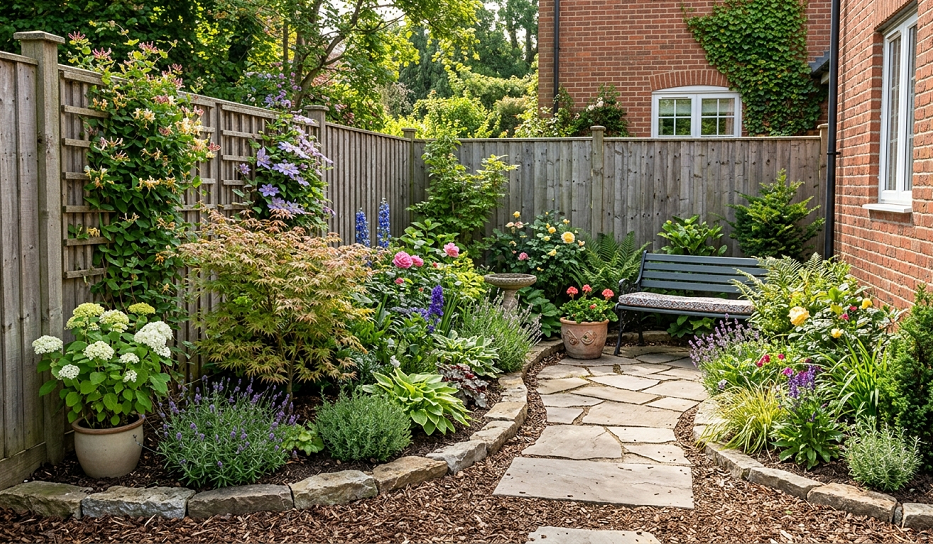

That dead corner in your yard is taunting you. You know the one — the awkward triangle of compacted dirt where the fence meets the neighbor’s fence, where nothing grows but weeds and old regret. Maybe it’s where the lawnmower goes to die. Maybe you’ve been “planning” something for it since you moved in six years ago.
I’ve been there. I am that person. My back-left corner sat empty for three full growing seasons while I convinced myself I’d “figure it out eventually.” Then I finally got my hands dirty, made about a dozen mistakes, and turned it into the most talked-about spot in my entire garden. Now every neighbor who walks by stops to ask what I did.
Corner spaces are actually gifts. The structure is already built in. You have two solid walls or fences creating natural backdrop and support. You have a focal point waiting to happen. You just need a plan — and a few hard-won ideas from someone who’s tried most of them.
Here are 17 corner garden ideas that actually work, ranked in no particular order, with a few honest opinions thrown in about what’s not worth your time.
1. Build a Tiered Raised Bed Corner Garden for Maximum Planting Space
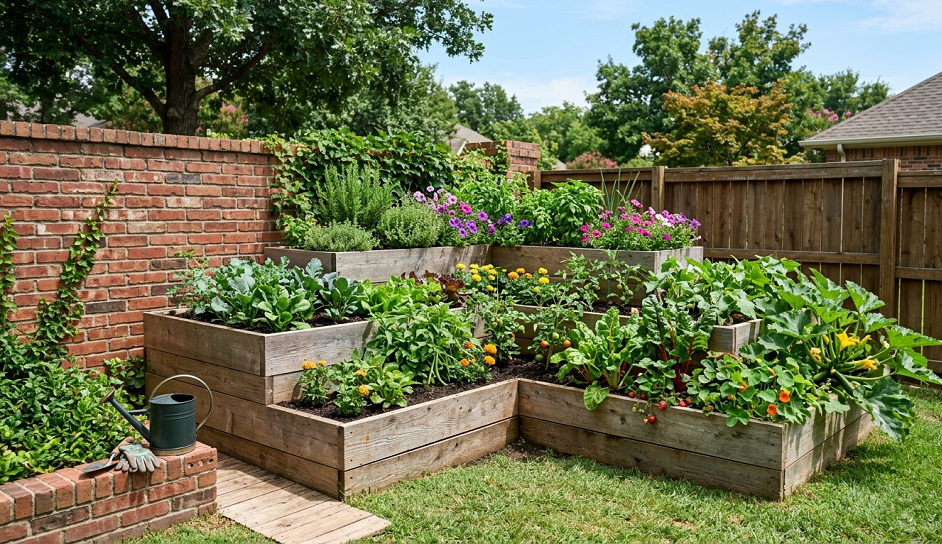
Tiered raised beds are my number one recommendation for corners, full stop. The geometry is perfect — you can build a staircase effect going from tall in the back corner to low at the front, and suddenly a neglected triangle becomes a lush, layered planting display.
I built my first tiered corner bed with rough cedar planks and a bag of deck screws one rainy Saturday afternoon. It wasn’t pretty, but it worked. The three-tier design gave me roughly three times the planting surface of a flat bed in the same footprint. I grew tomatoes on the top tier, herbs in the middle, and trailing nasturtiums along the front — and people thought I’d hired a landscaper.
The key is making your tallest tier genuinely tall — at least 18 inches — so you get real depth for root vegetables and deep-rooted perennials. Short raised beds are a waste of good lumber. Fill them with a quality mix of topsoil, compost, and perlite, not whatever clay nightmare is already in the ground.
For corners specifically, build your tiers in a rough L-shape or right-triangle shape to hug the fence lines. Anchor the back boards directly against the fence (with a small gap for airflow) and you’ve got a structure that feels intentional and permanent from day one.
2. Install a Vertical Trellis Wall for Climbing Plants
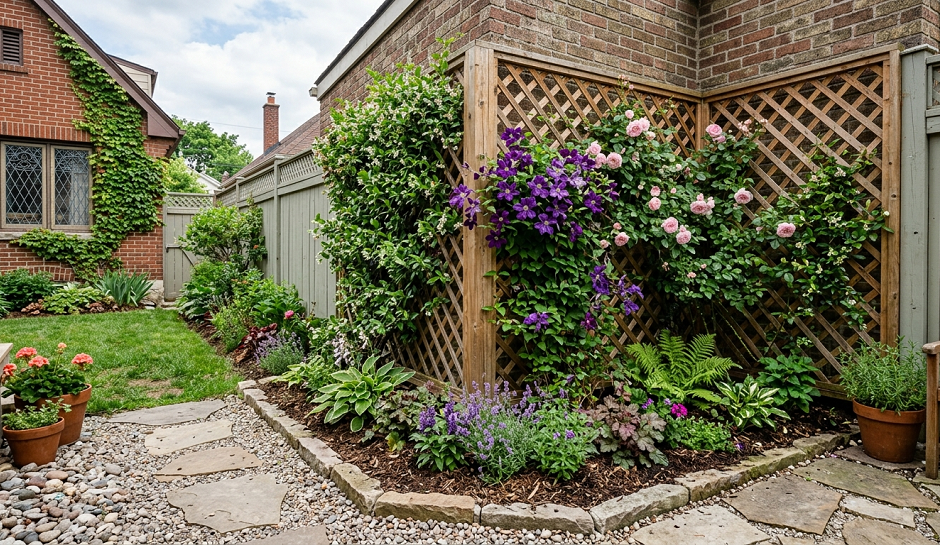
A corner trellis is probably the single most dramatic transformation you can make for the least amount of money. Two fence panels meeting at a corner already form a natural theater backdrop. All you’re doing is giving plants a reason to perform on it.
I’ve tried fancy cedar lattice, welded wire panels, and those flimsy plastic grid trellises from the big box stores. My honest take: the plastic ones are a total waste of money, even if they look fine on Pinterest. They bow, they break, and after one season of supporting a mature climbing rose, they fail spectacularly. Go with a sturdy wire grid or build a simple wooden trellis from pressure-treated lumber and galvanized wire.
For the plants, you can’t beat climbing roses, jasmine, clematis, or a vigorous cucumber vine if you want edible drama. The corner location means your trellis gets viewed from multiple angles as you walk through the garden — so choose plants with visual interest at multiple heights. Clematis blooms from the middle up; plant a low perennial at its feet to cover the bare ankles.
One thing most people skip: install your trellis at least four inches away from the fence surface. Airflow behind the plants prevents mildew, and you’ll thank yourself when you need to repaint the fence in five years without hacking through a decade of climbing stems.
3. Create a Cozy Corner Seating Nook Surrounded by Plants
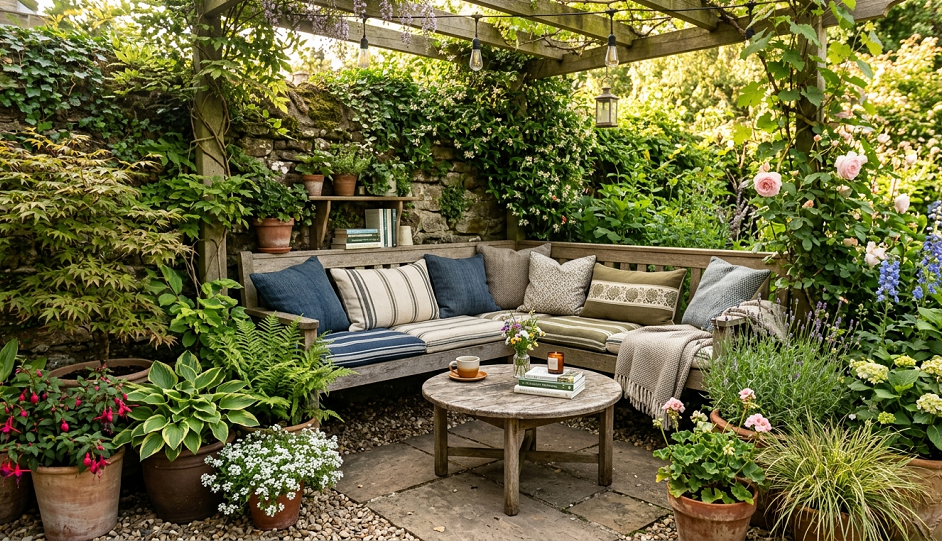
The best gardens have a place to sit inside them, not just a patio to look out from them. A corner is the perfect place to tuck a small bench, a pair of Adirondack chairs, or even a simple tree stump with a flat top.
The trick is to plant around the seating, not just behind it. Frame the entrance to your corner nook with two matching plants — a pair of ornamental grasses, two columnar shrubs, or even two oversized container plants that act as living gateposts. This creates the psychological sense of “entering” a space, and it makes even a basic bench feel like a secret garden hideaway.
The summer I finally did this with my corner space, I planted a curved row of tall ornamental grasses on one side and a sprawling lavender hedge on the other. By July, the bench was completely enclosed in soft movement and fragrance. My kids called it “the thinking spot.” I called it “the place I go when I need five minutes of silence.”
For materials, I’d skip the cheap resin furniture and invest in teak or cedar. Teak especially is almost indestructible outdoors and ages into a beautiful silver-grey if you don’t oil it. Your back will also thank you if you choose a bench with an actual backrest rather than those decorative flat-slab numbers that look great in photos and feel terrible after twenty minutes.
4. Plant a Corner Butterfly and Pollinator Garden
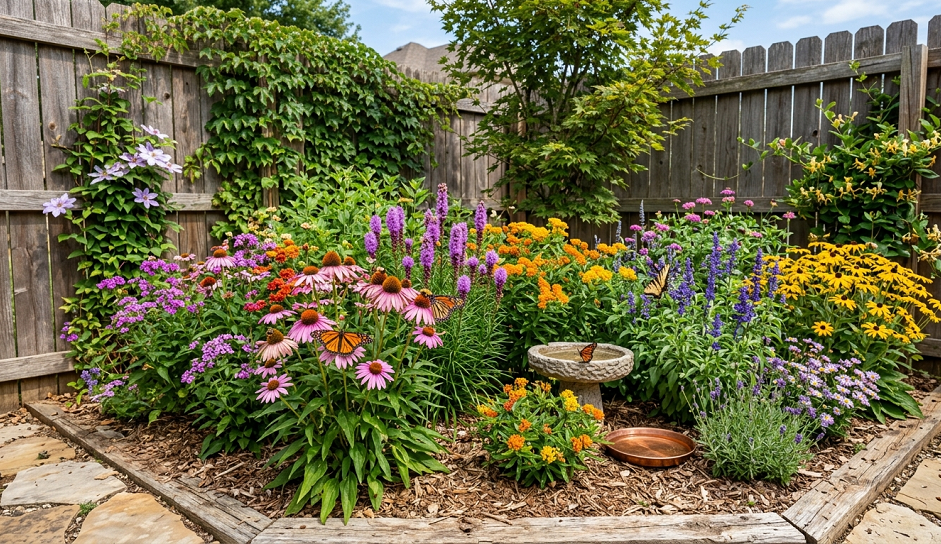
Pollinator gardens are genuinely one of the most rewarding things you can do with an awkward corner. You’re not fighting the space — you’re filling it with a controlled wildness that actually gets better as it grows more chaotic.
The basic principle is to layer plants at three heights: low groundcover, mid-height perennials, and tall statement plants at the back of the corner. Echinacea, black-eyed Susans, and lavender are my go-to middle-layer workhorses. Joe-Pye weed or native tall grasses anchor the back. Creeping thyme or alyssum fills the edges.
I made the mistake my first year of buying a pre-packaged “pollinator mix” seed blend and scattering it over the corner. What grew was mostly weeds with a confused scattering of cosmos. Plant actual established transplants or start your own seedlings, and be intentional about bloom succession so something is flowering from early spring through hard frost.
The payoff is real and fast. Within one season my corner was buzzing with bees, hovering with butterflies, and occasionally visited by hummingbirds. My neighbor, who had complained about my “messy garden,” was over asking for cuttings by August. That felt good.
5. Use a Corner Focal Point: Ornamental Trees and Large Shrubs
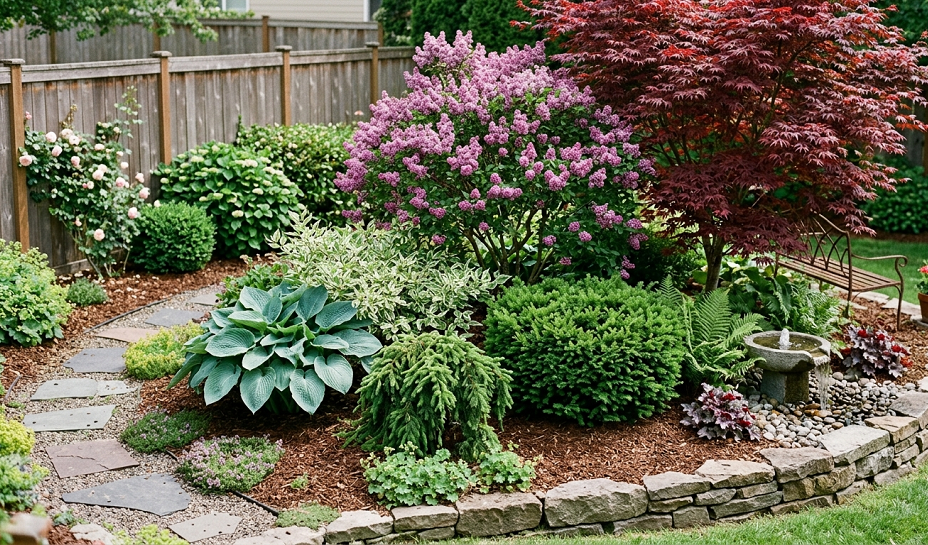
Every garden needs a focal point, and a corner is the natural home for one. A single well-chosen ornamental tree or large architectural shrub transforms the entire feel of your outdoor space.
My favorites for corner focal points are Japanese maples, which give you stunning color, interesting form, and four-season interest. They’re slow-growing enough not to get out of hand, and they work in both large and small corners. Crape myrtles are another excellent choice if you’re in a warmer climate — they bloom for months and don’t require babying.
Do not, under any circumstances, plant a fast-growing screening tree in your corner and expect it to stay manageable. I watched a neighbor plant a Leyland cypress “just to fill the space quickly” — ten years later it was blocking light from three surrounding properties and required a crane to remove. Slow and right beats fast and wrong every time.
For smaller corners, a multi-stem serviceberry or a weeping cherry gives you height and drama without the footprint of a full tree. Underplant with spring bulbs that pop before the tree leafs out, and you’ve created a full-season display in about six square feet of real estate.
6. Build a Corner Herb Spiral for a Productive Kitchen Garden
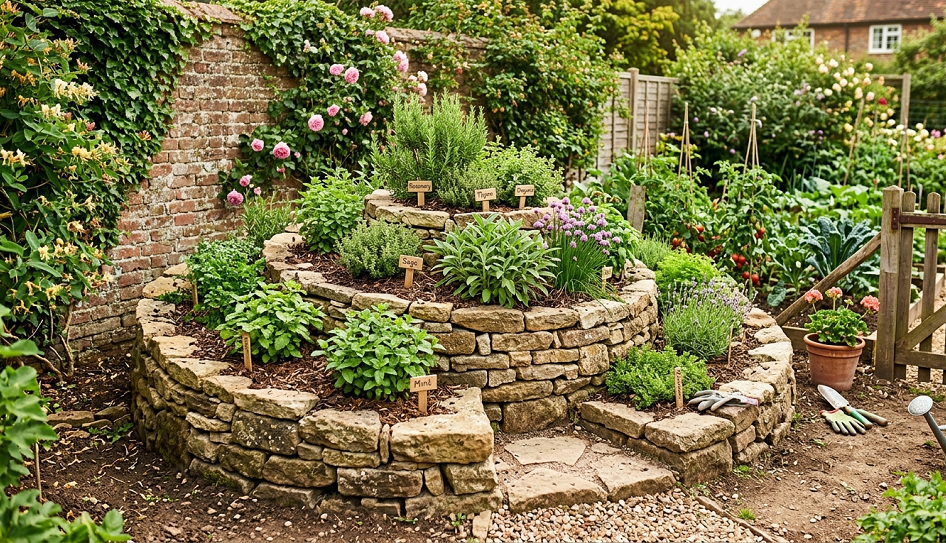
An herb spiral is one of those ideas that sounds like a landscaping gimmick until you actually build one — and then you wonder how you ever gardened without it. The basic concept is a raised spiral mound that creates multiple microclimates in a small footprint: the top is hot and dry (perfect for Mediterranean herbs like rosemary and thyme), the sides are moderate (basil, oregano), and the base is cooler and moister (parsley, cilantro, mint).
A corner location is ideal because you can build the spiral freestanding and view it from multiple angles. Use stones, bricks, or reclaimed pavers to create the spiral wall — you don’t need mortar for a small structure. Aim for about four to five feet in diameter and two to three feet at the peak.
I built mine using salvaged fieldstone from an old stone wall I dismantled, and it cost me almost nothing. It looks like it belongs in a magazine. The only thing I’d do differently: I planted mint directly in the soil at the base instead of keeping it in a buried pot. Mint is a thug. It had colonized a three-foot radius within one growing season. Always — and I mean always — contain your mint.
Fill your spiral with quality free-draining potting mix rather than garden soil. Herbs hate wet feet, and garden soil compacts in raised structures. One bag of good-quality herb potting mix costs a few dollars and will make the difference between thriving plants and sulky ones.
7. Design a Corner Water Feature with Surrounding Plantings
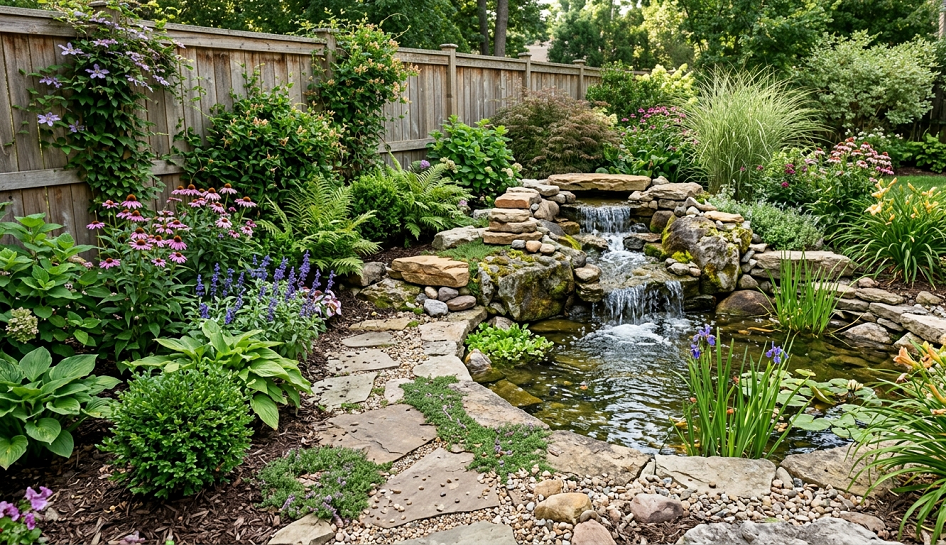
A small water feature in a corner turns a dead space into a sensory destination. You don’t need a full pond or a complicated installation. A half-barrel water garden, a simple recirculating fountain, or even a preformed liner sunk into the ground can create that calming sound and visual interest that makes a garden feel complete.
The corner placement is smart for a water feature because the fence walls buffer wind (which disturbs water surface and blows fountain spray onto adjacent plants) and create a naturally sheltered microclimate. Plants also look stunning reflected in still water, and a corner backdrop gives you a contained, framed view.
For surrounding plants, I love combining tall ornamental grasses behind the feature for movement, moisture-loving astilbe or ligularia at the waterline, and a spreading groundcover like creeping jenny or corsican mint to soften the edges of the basin. This layered approach makes the water feature look like it grew there naturally.
One hard-earned lesson: if you install a recirculating fountain pump, buy a better one than you think you need. The cheapest pumps clog constantly and die after one season. A quality pump rated slightly above your actual water volume runs quieter, requires less cleaning, and lasts years longer. I burned through three cheap pumps before I learned this.
8. Install Corner Raised Beds for a Cut Flower Garden
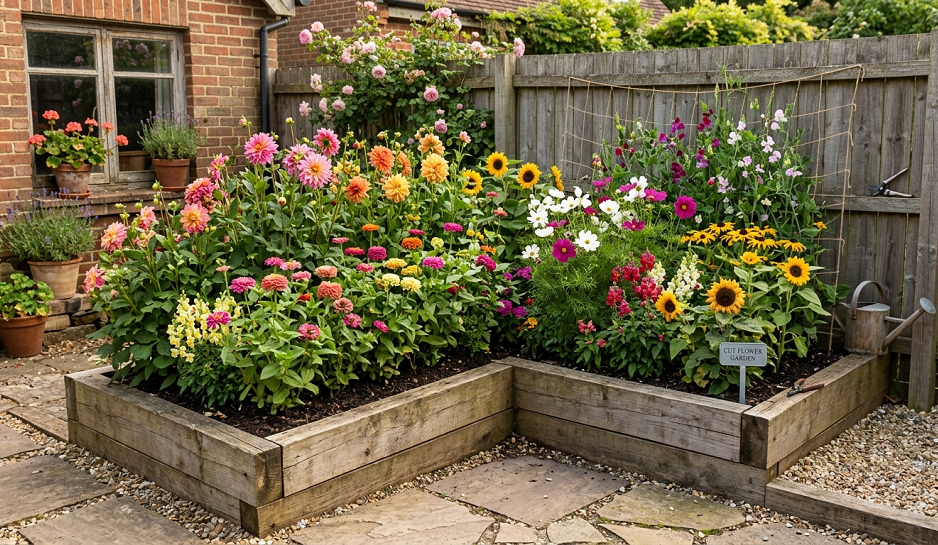
A dedicated cut flower corner is pure joy, and I wish I’d done it a decade earlier. The premise is simple: instead of gardening for landscape beauty or edible production, you grow specifically for cutting — zinnias, sunflowers, dahlias, lisianthus, snapdragons, and cosmos — and you bring those blooms inside all season long.
The corner location works beautifully because cut flower beds are intentionally a bit utilitarian. You’re not trying to win a landscape design award; you’re farming flowers. The enclosed corner keeps things visually contained and gives you a clearly defined dedicated space.
I grow my dahlias in my cut flower corner and they are completely out of control in the best possible way. By August, I have blooms the size of dinner plates in every shade from cream to near-black burgundy. I give bunches away to every neighbor who walks past. It’s embarrassing how many compliments a few dahlia tubers can generate.
For best results, don’t just scatter seeds — plant in rows and install simple wire or twine support grids early in the season before plants need them. Tall-growing flowers like dahlias and sunflowers will topple in wind and rain if they’re not staked, and trying to stake them after they’ve fallen over is a battle you will lose.
9. Create a Privacy Corner with Dense Evergreen Screening Plants
Sometimes the goal isn’t beauty — it’s blocking the neighbor’s back porch or the view of the HVAC unit. A well-planted privacy corner can solve both problems while looking intentional and lush.
Evergreen shrubs are the workhorses here: arborvitae, holly, boxwood, and laurel all provide year-round screening without dropping their coverage in November when you actually need privacy most. For a corner, I like to plant a mix of heights rather than a monotonous row — one taller columnar evergreen as an anchor, flanked by medium-height spreading shrubs, with a groundcover skirt at the front.
Skip the instant gratification impulse to buy the largest container specimens at the nursery. A five-gallon shrub planted well will often overtake a fifteen-gallon container plant within three seasons, because it establishes its root system instead of fighting transplant stress. Bigger isn’t always better; it’s just more expensive.
My privacy corner took two full growing seasons to look truly “done,” but in year three it became a genuine wall of green. No more making awkward eye contact over the fence while watering my tomatoes. Worth every minute of the wait.
10. Build a Corner Pergola or Arbor as a Garden Architecture Feature
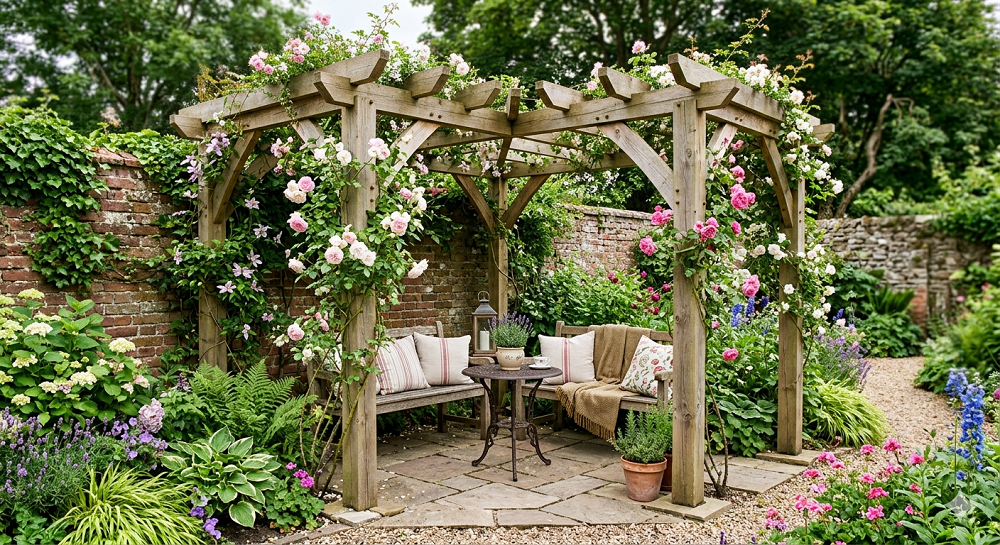
A pergola or arbor in a corner creates instant architectural structure and gives you a framework for climbing plants, hanging lights, or a canvas shade sail. It defines the space, adds height, and transforms a flat yard into one with genuine vertical dimension.
You don’t need to hire a contractor. A basic four-post corner pergola can be a solid weekend DIY project with standard lumber and post anchors. The corner fence walls can act as two of your support points, reducing the number of freestanding posts you need and simplifying construction.
Once the structure is up, grow a wisteria or a climbing hydrangea over it if you have patience for a few years of establishment, or cover it fast with annual hops or scarlet runner beans for same-season results. String lights through the cross-beams and you have an outdoor room that gets used every evening from May through October.
My pergola tip: use 4×4 posts at a minimum, and 6×6 if you ever plan to grow anything substantial on it. Wisteria especially gets genuinely heavy. I saw a neighbor’s lightweight pergola collapse under a mature wisteria vine — not slowly, but all at once, on a Tuesday afternoon. The wisteria was fine. The pergola was not.
11. Design a Corner Rock Garden for Low-Maintenance Beauty
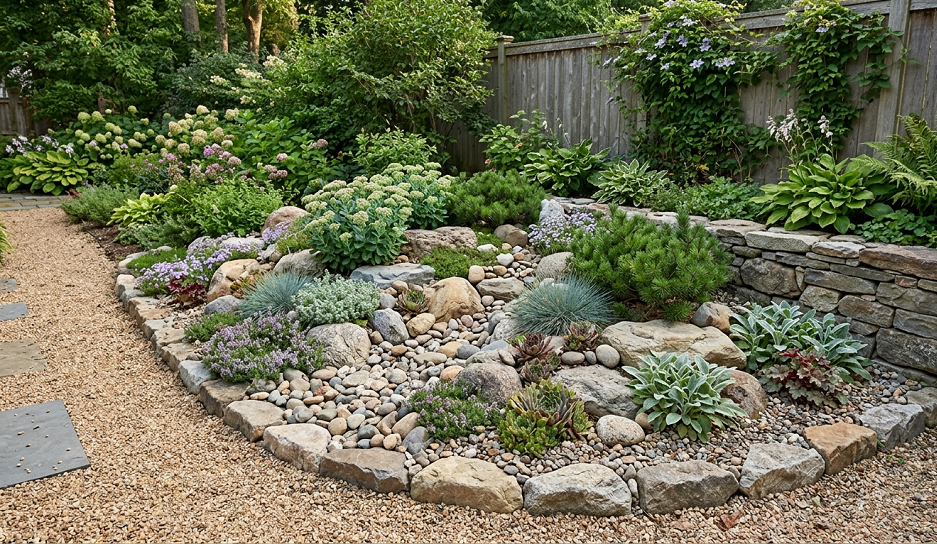
Rock gardens are dramatically underrated. People associate them with the sad gravel-and-cactus affairs that appeared in drought-stricken California yards in the 1990s, but a well-designed rock garden with the right plant selection is genuinely striking — and requires almost no watering, weeding, or maintenance once established.
The corner is a natural home for a rock garden because you can build up elevation toward the back corner and let it slope outward, mimicking a natural alpine environment. Use rocks of varying sizes and bury at least one-third of each rock in the ground — floating rocks look artificial. The arrangement should look like rocks that have always been there, not rocks that were recently placed.
Plant with drought-tolerant perennials: sedums, sempervivums, creeping phlox, ice plant, and woolly thyme all thrive in the well-drained conditions a rock garden provides. Ornamental grasses add movement. A single dwarf conifer gives year-round structure.
My rock garden has been in place for seven years and I spend maybe two hours per year maintaining it. That is not a typo. I weed it once in spring, pull the occasional interloper, and otherwise ignore it entirely. Everything else in my garden is high-maintenance drama. My rock corner is the easy friend I never properly appreciate.
12. Plant a Corner Shade Garden Under an Existing Tree
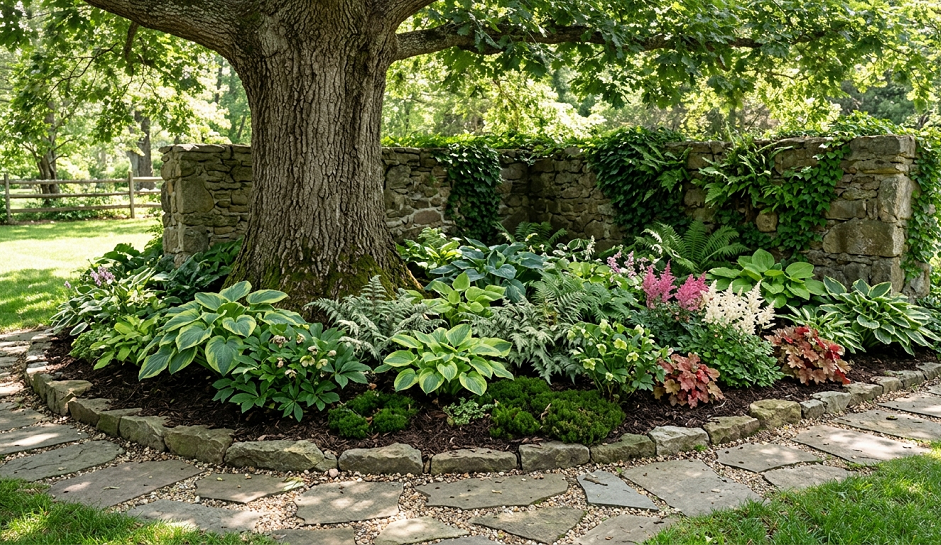
If your corner already has a tree in or near it, stop fighting the shade and lean into it. A shade garden under an existing canopy is one of the most naturally beautiful garden styles you can achieve.
Hostas are the obvious choice and they earn their reputation — hundreds of varieties, interesting foliage, incredibly reliable, and they multiply freely so you can expand your planting every year from your own divisions. But don’t stop at hostas. Ferns, astilbes, heucheras, and epimediums create an extraordinary textural tapestry in conditions where sun-loving plants would fail completely.
The biggest mistake people make with shade gardens is trying to amend the soil aggressively with compost and fertilizer and then wondering why nothing thrives. Tree roots are competitive. Work with the soil that’s there, choose plants that genuinely tolerate root competition, and mulch heavily with shredded wood or leaf mold. Feed with a slow-release balanced fertilizer in spring and otherwise leave it alone.
My shade corner under a large oak is the most peaceful spot in my yard. The light is dappled and cool even in July. The plants are mostly self-sufficient. And on a hot afternoon, it’s the one place I actually want to sit with a cold drink and stare at something green and still.
13. Set Up a Corner Container Garden for Renters and Small Spaces
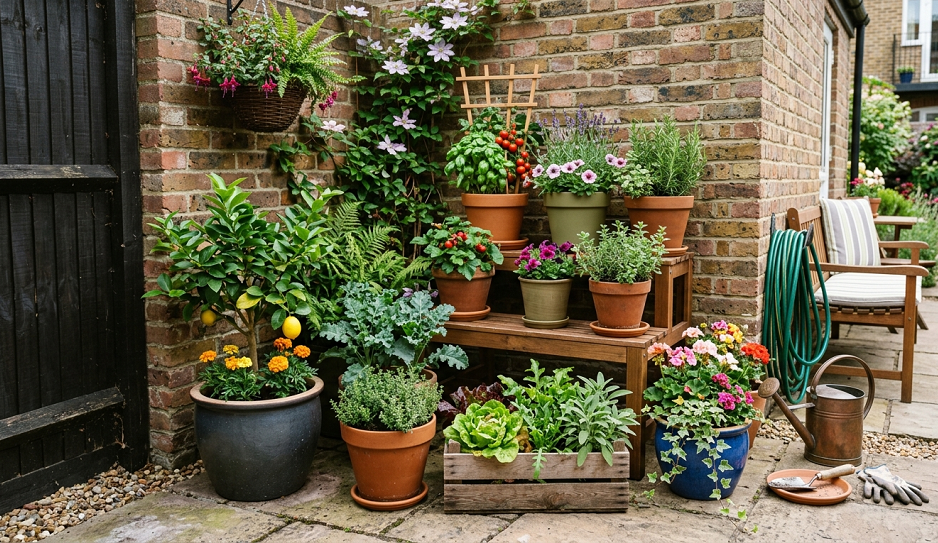
Not everyone can dig up the ground — renters, people with concrete corners, or anyone dealing with terrible compacted subsoil that would take years to remediate. Container gardening in a corner is a completely legitimate approach and can be genuinely spectacular.
The key is scale: use larger containers than you think you need. A single 24-inch pot has five times the planting capacity of a 12-inch pot. Cluster different-sized containers at different heights using pot risers, overturned pots, or a simple wooden plant stand to create the same layered, lush effect you’d get from an in-ground bed.
I’ve seen container corners that looked more abundant than many traditional gardens. The secret is the “thriller, filler, spiller” planting formula: one tall dramatic specimen (the thriller), surrounding compact mounding plants (the filler), and trailing plants draping over the edges (the spiller). Apply it to every large container and you can’t go wrong.
Quick side note on container maintenance: containers dry out fast, especially in corners that get reflected heat from fences. Self-watering containers with reservoirs are genuinely worth the extra cost for anyone who forgets to water regularly (that’s most of us). I resisted them for years thinking they were a gimmick, then installed three and haven’t lost a plant to drought stress since.
14. Grow a Corner Fruit Espalier Against the Fence
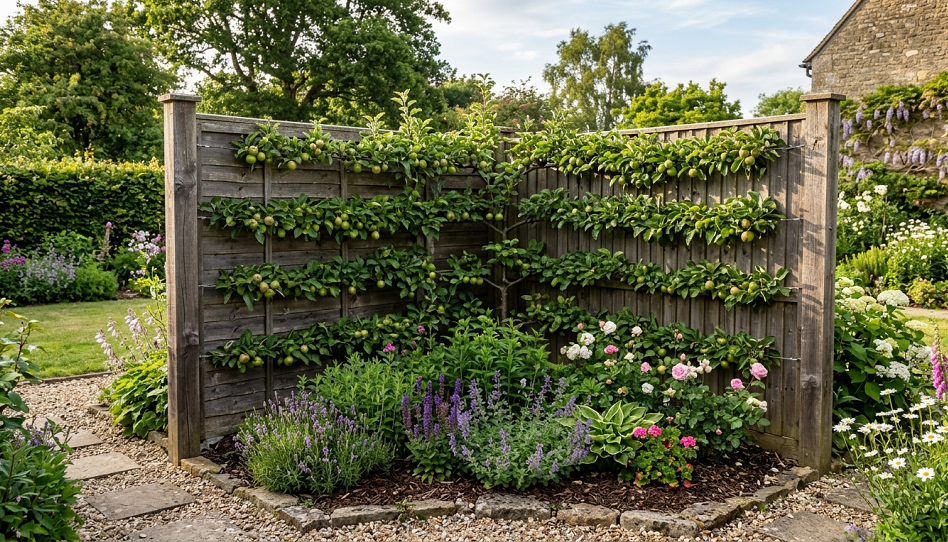
Espaliered fruit trees trained flat against a fence are one of those old-school gardening techniques that somehow manage to look both ancient and modern at the same time. An apple, pear, or fig trained in a flat fan or horizontal cordon pattern against your corner fence turns a boring boundary into a productive, architectural feature.
The corner is ideal for espalier because two fence faces give you two training surfaces — you can grow a tree on each face or wrap a single flexible young tree around the corner. This is genuinely advanced gardening, but it’s not as difficult as it sounds. You’re just tying branches to horizontal wires every few weeks during the growing season and removing anything that grows outward rather than flat.
Start with a young bare-root whip (one or two years old) rather than an established container tree — younger trees are far easier to train into shape. Install your horizontal wire guides before you plant so you’re not trying to hammer in screw eyes around an established tree. Space the wires twelve to eighteen inches apart, starting about eighteen inches from the ground.
My espalier apple took three seasons to look intentional and five seasons to produce a real harvest. It is the most technically demanding thing I’ve grown, and also the most satisfying. It has become the actual centerpiece of my back garden.
15. Install Corner Lighting to Make the Space Work Day and Night
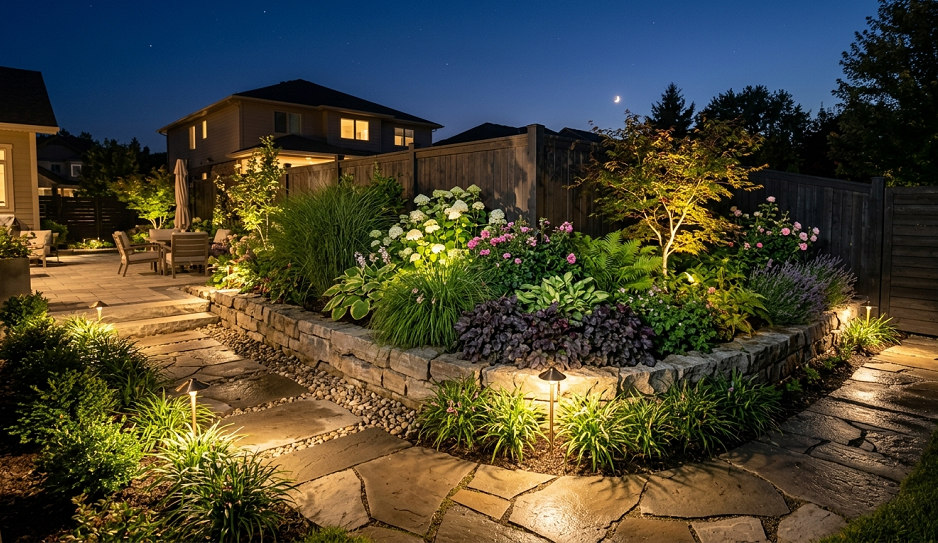
This one gets overlooked constantly, and it’s maddening to me. People build a beautiful corner garden and then never see it after 7pm because it’s pitch dark. Lighting transforms a corner garden from a daytime feature into an all-seasons, all-hours destination.
For planting beds, uplighting a focal tree or shrub creates dramatic shadow play on the fence walls behind it. Low path-style bollard lights define the edges of the space and make it safe to navigate at night. String lights strung from the corner fence intersection outward add a warm, festive ambiance that makes outdoor entertaining feel effortless.
Solar lights have improved significantly in recent years but I still find they underwhelm in winter or in corners that don’t get full afternoon sun. For reliable, consistent performance, low-voltage wired LED landscape lighting is worth the slightly more involved installation. A basic low-voltage transformer and a string of fixtures can light an entire corner garden for pennies of electricity per night.
The psychological effect of good garden lighting in the evening is hard to overstate. My corner looks entirely different at night — more dramatic, more intimate, honestly more beautiful than it does in daylight. It extends the usable season of the garden by at least two months.
16. Design a Corner Meditation or Zen Garden Space
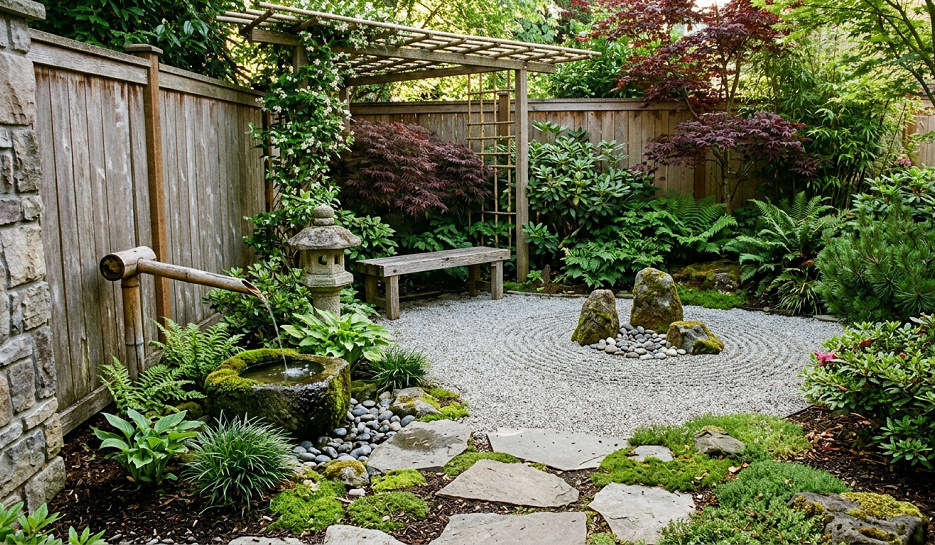
A Zen-inspired corner garden works best when you commit fully to the aesthetic rather than hedging with a few raked pebbles beside a gnome. The core elements are simple: a raked gravel or decomposed granite surface, a few carefully placed large stones, structural plants with clean form, and a deliberate absence of clutter.
Bamboo (clumping varieties only — I cannot stress this enough) makes a magnificent backdrop screen for a Zen corner. The sound of bamboo in a breeze is genuinely meditative. Running bamboo, however, will eat your entire yard, cross under your fence, and colonize your neighbor’s garden as well. I’ve seen it happen. It took a professional removal company with a mini excavator to sort out. Clumping varieties only.
For structural plants, black pine or Japanese maple in the corner anchor, with mondo grass or a low ornamental sedge as groundcover, creates a restrained palette that feels intentional and serene. Add a simple stone lantern or a smooth river rock arrangement and you’ve created something that genuinely rewards quiet contemplation.
Keep the maintenance minimal and the color palette restricted to greens, grays, and occasional seasonal accent. The temptation to add more “just one more thing” is the death of a Zen garden.
17. Convert a Corner into a Wildlife Habitat Garden
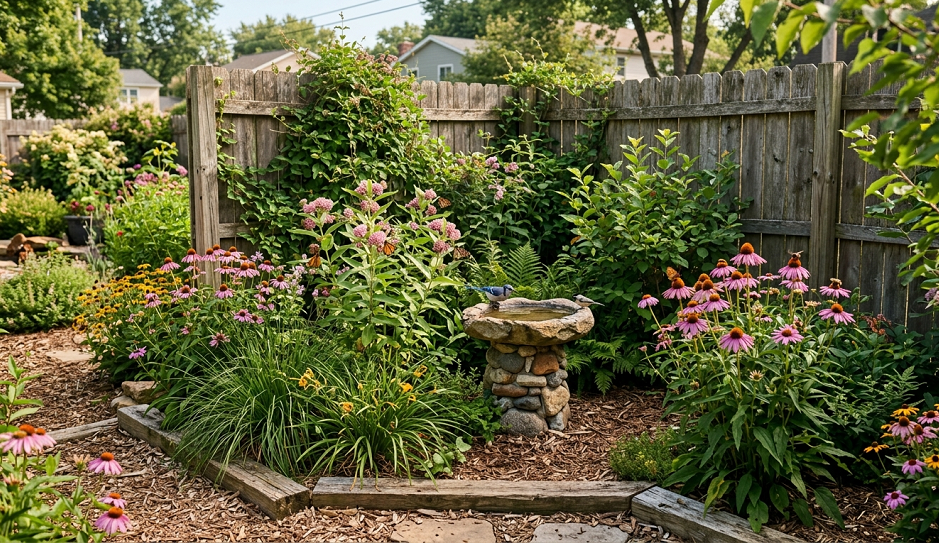
A wildlife corner isn’t an excuse for an unkempt mess (though it can look intentionally wild). It’s a purposefully designed planting that supports birds, insects, amphibians, and small mammals — and it gets richer, more interesting, and more biodiverse every year.
The framework: a brush pile or log stack tucked in the very back of the corner for small mammal and invertebrate habitat. Native shrubs for bird cover and nesting — elderberry, native viburnum, buttonbush. Native perennials for pollinators. A shallow bird bath or small dish of water at ground level for ground-feeding birds and beneficial insects.
Native plants are non-negotiable for a true wildlife garden. Ornamental exotics might look beautiful, but they don’t support the specific insects that birds depend on. Research your regional native plant palette and build from that foundation. A native oak, even a small one, supports hundreds of species of caterpillars — which are the primary food source for nearly every backyard songbird during nesting season.
My wildlife corner started as an experiment and has become my absolute favorite part of my property. I have more bird species visiting than I can keep track of. My kids know more about native plants than most adults because they’ve watched them grow and noticed what visits them. It has turned a dead corner into a living ecosystem, and I am deeply, embarrassingly proud of it.
Real Talk: What’s Not Worth Your Time (Or Money)
I have to be honest with you here, because nobody else will be.
Pre-planted “instant garden” corner packages from big box stores are almost universally terrible value. You get a handful of stressed, root-bound plants that were grown for visual appeal at point-of-sale, not for long-term garden performance. Half will die in the first season. Buy individual plants from a local nursery where staff actually know what they’re selling.
Decorative garden edging — those scalloped plastic or thin metal borders meant to define your corner bed — is a waste of money at every price point. It looks fine for about one season, then frost heaves it, it gets knocked by the lawnmower, and it starts looking worse than no edging at all. Use a proper spade-cut edge and refresh it twice a year. It takes twenty minutes and looks ten times better.
Over-engineered irrigation systems in corners are often overkill unless you’re growing something genuinely water-intensive. A simple soaker hose on a timer threaded through a corner bed costs about twelve dollars and does ninety percent of what a professionally installed drip system does at a fraction of the cost and complexity.
And finally: don’t try to do all 17 of these at once. I once decided to completely overhaul five separate garden areas in a single spring. I burned out by June, finished nothing properly, and spent the rest of the summer looking at half-done projects with deep personal shame. Pick one corner. Do it right. Live with it for a season. Then do the next one.
The Wrap-Up: Your Corner Is Waiting
Every dead corner in your yard is potential energy. It’s a frame without a painting, a stage without a show. The hardest part isn’t the planting or the building or even the planning — it’s just getting started, getting your hands dirty, and accepting that the first version of anything won’t be perfect.
My best corner garden came out of my worst idea executed badly. I changed it, improved it, ripped half of it out and started over, and three years later it’s the thing people walk over specifically to look at. Gardening is revision, not perfection.
The parting wisdom I’d give any gardener tackling a corner space: start with structure, fill in with plants, and don’t underestimate the power of a single well-chosen focal point. A dead corner doesn’t need seventeen things done to it. It needs one good idea done with intention.
Now I want to hear from you — what’s your most difficult corner situation? Is it deep shade, terrible soil, a weird shape, a nosy neighbor, or just the overwhelming paralysis of too many options? Drop your question or your own hard-won corner garden tip in the comments below. I read every one, and some of the best ideas I’ve ever tried came from a reader who knew something I didn’t.

About Syprose Kiche
Syprose Kiche is the creator and writer behind My Besuited Home, a practical home and garden website covering DIY projects, gardening, lawn care, landscaping, home improvement, and outdoor living. She focuses on turning everyday homeowner questions into clear, practical guides backed by careful research and useful real-world considerations.