
A walkway border has a job that an ordinary flower bed doesn’t: it has to stay out of the way. A plant that looks tidy in a nursery pot in May can be sprawling across the path by August. It brushes ankles, soaks pant legs after rain, and hides the edge of a step. Most disappointing path plantings come from two mismatches. One is between the size of the pot and the size of the mature plant. The other is between the plant and the light the strip of soil actually receives.
The thirteen plants below are sorted by exposure, seven for sun and six for shade. Each one comes with its mature size, its hardiness range, and the situations where it causes problems.
Why Walkway Borders Behave Differently From Other Flower Beds
Soil beside a walkway is rarely ordinary garden soil. When a path is built, the base is usually compacted gravel or crushed stone, and the strip beside it often holds leftover construction fill. Roots meet a hard layer a few inches down, and water drains in odd ways. Concrete and pavers also absorb heat and radiate it back, so a sunny path edge can run drier and hotter than the middle of the same bed.
Then there is use. People walk, carry groceries, push strollers, and roll wheelbarrows. A plant that flops sideways in rain or leans toward the light is a daily annoyance here, even though the same habit would look relaxed in a cottage border.
A few practical consequences follow:
- Mature width matters more than height. A 2-foot plant set 6 inches from the edge will cover the path. A common guideline is to plant at a distance from the edge equal to about half the plant’s mature spread, though that is a rule of thumb and not a code requirement.
- Keep the usable path wide enough. Many designers aim for at least 36 inches of clear walking space on a main path, and more if two people walk side by side or a wheelbarrow needs to pass. Measure the path after the plants have filled in.
- Prepare the strip properly. Loosen the soil 8 to 12 inches deep, pull out builder’s rubble, and mix in compost for the moisture-loving plants. Skip the compost for lavender, thyme, and other plants that prefer lean, sharply drained soil.
- Winter salt is a real risk. Rock salt (sodium chloride) can burn foliage and build up in soil along paths. Sand or calcium magnesium acetate is gentler, though no de-icer is risk-free, so read the label.
Work Out Your Light Before You Choose Anything
Plant tags use “full sun,” “part shade,” and “full shade” loosely, and the differences matter more than they sound.
Full sun means six or more hours of direct light. Part shade is roughly three to six hours, ideally gentler morning light. Shade means less than three hours of direct sun, though bright reflected light still counts for something. Dappled light under a high tree canopy is a separate case: it can support more than a solid shadow cast by a house wall.
Check your strip on a sunny day at three points: mid-morning, early afternoon, and late afternoon. Note when the light arrives and leaves. A bed that gets sun until 11 a.m. behaves very differently from one that gets sun only after 3 p.m., because afternoon sun is hotter and scorches shade-adapted foliage faster.
Trees complicate the picture. Beds under established trees are not just shady, they are often dry, since roots compete for water. Treat those spots as dry shade and choose accordingly.
Seven Border Plants for Full Sun
1. English Lavender (Lavandula angustifolia)
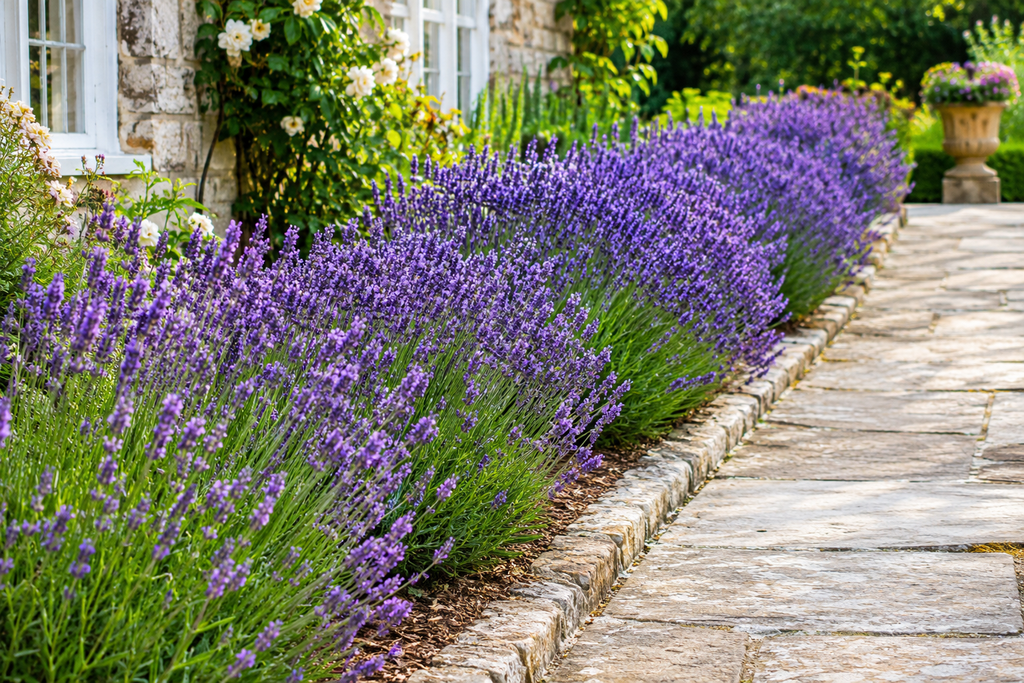
Compact varieties such as ‘Munstead’ and ‘Hidcote’ generally stay around 18 to 24 inches tall and wide. Hardiness is typically listed as zones 5 to 8, with a few varieties reaching colder. The gray-green foliage looks good even when nothing is in bloom, and the flower spikes appear in early to midsummer.
The biggest threat is wet soil. Lavender tolerates drought but not soggy roots, and it struggles in heavy clay and in humid climates where air stays damp. Mulch it with gravel instead of bark, which holds moisture against the crown. Prune lightly after flowering and never cut into leafless woody stems, which rarely regrow.
Fragrance carries best where people brush past, so lavender suits the edge of a walkway near a door or gate. Check the ASPCA’s toxic plant database if pets chew vegetation.
2. Catmint (Nepeta)
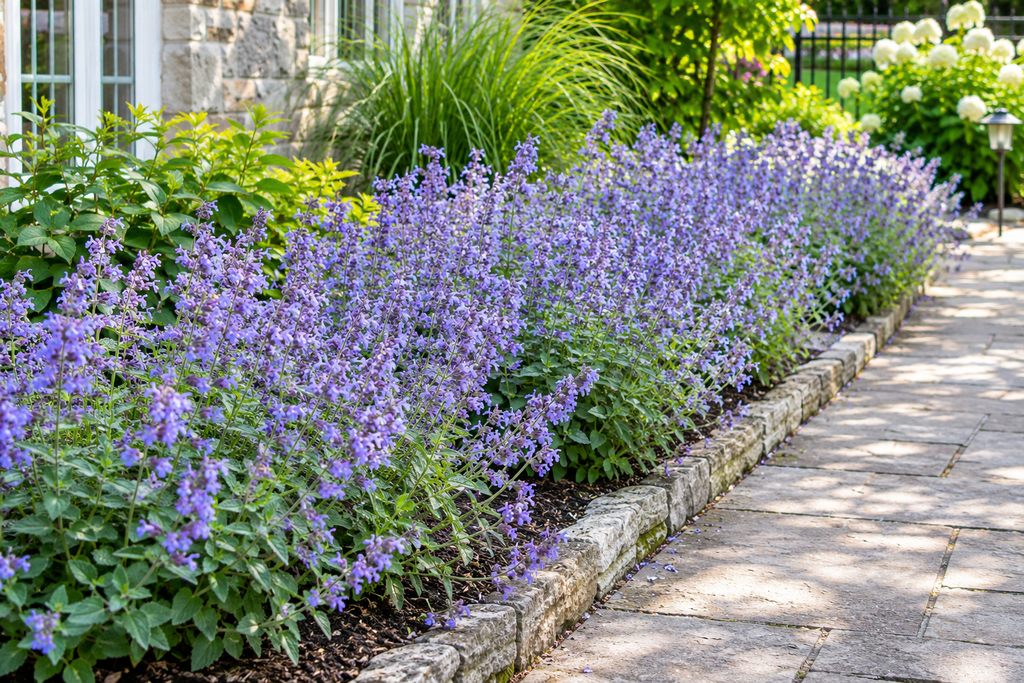
Catmint blooms from late spring into fall when sheared back. ‘Walker’s Low’ reaches roughly 2 to 3 feet, which is too large for a narrow strip. Compact selections such as ‘Little Titch’ stay closer to 8 to 12 inches. Most catmints are hardy in zones 3 to 8.
After the first flush of lavender-blue flowers fades, cut the plant back by about half. It reblooms and holds its shape. Skipping that shearing is the main reason catmint splits open in the middle and flops across a path.
Bees visit the flowers, and deer and rabbits generally leave it alone. Cats may roll in it, which can flatten plants in a neighborhood with cat traffic.
3. Dwarf Fountain Grass (Pennisetum alopecuroides ‘Hameln’)
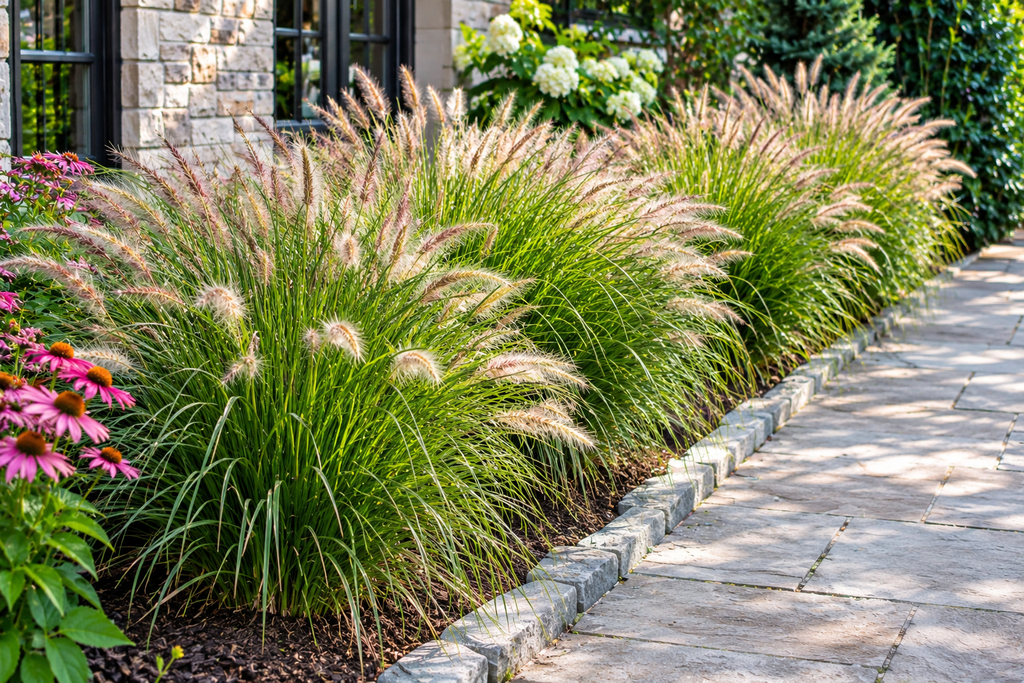
This is the tall voice in the sun list: roughly 2 to 3 feet in height and spread, hardy in about zones 5 to 9. Soft bottlebrush plumes arrive in midsummer and last into fall, catching low light in the evening.
Use it at corners, at the bend of a curved path, or at the back of a deeper border, set at least 18 inches from the edge. Cut it back to a few inches in late winter before new growth starts.
One caution: some fountain grasses self-seed or are listed as invasive in parts of the country. Check your state’s invasive plant list or your local extension office before planting.
4. ‘Autumn Joy’ Sedum (Hylotelephium)
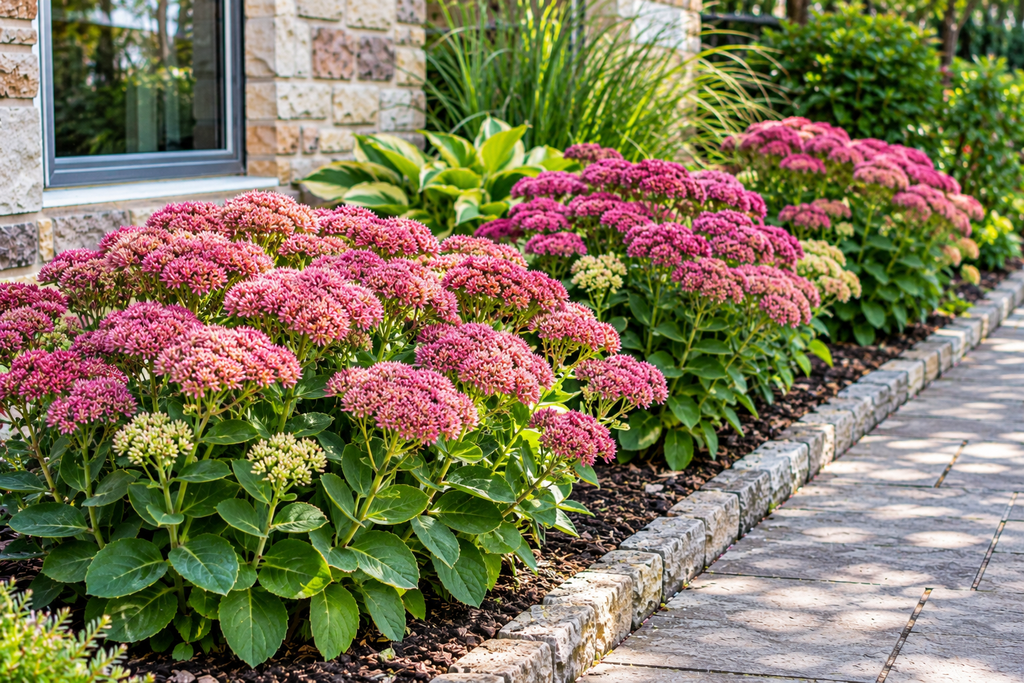
Fleshy gray-green foliage starts in spring and builds into broad heads of pink flowers in late summer that age to rusty red. It grows about 18 to 24 inches tall and wide, hardy in zones 3 to 9. It tolerates heat and drought well once established.
The common failure is flopping. Rich soil, too much shade, or heavy fertilizer produce lanky stems that split open after rain. Pinching or cutting the stems back by about half in late spring or early summer keeps the plant sturdier.
Leave the seed heads standing through winter. They look good frosted, and birds sometimes use them. Cut them back in early spring.
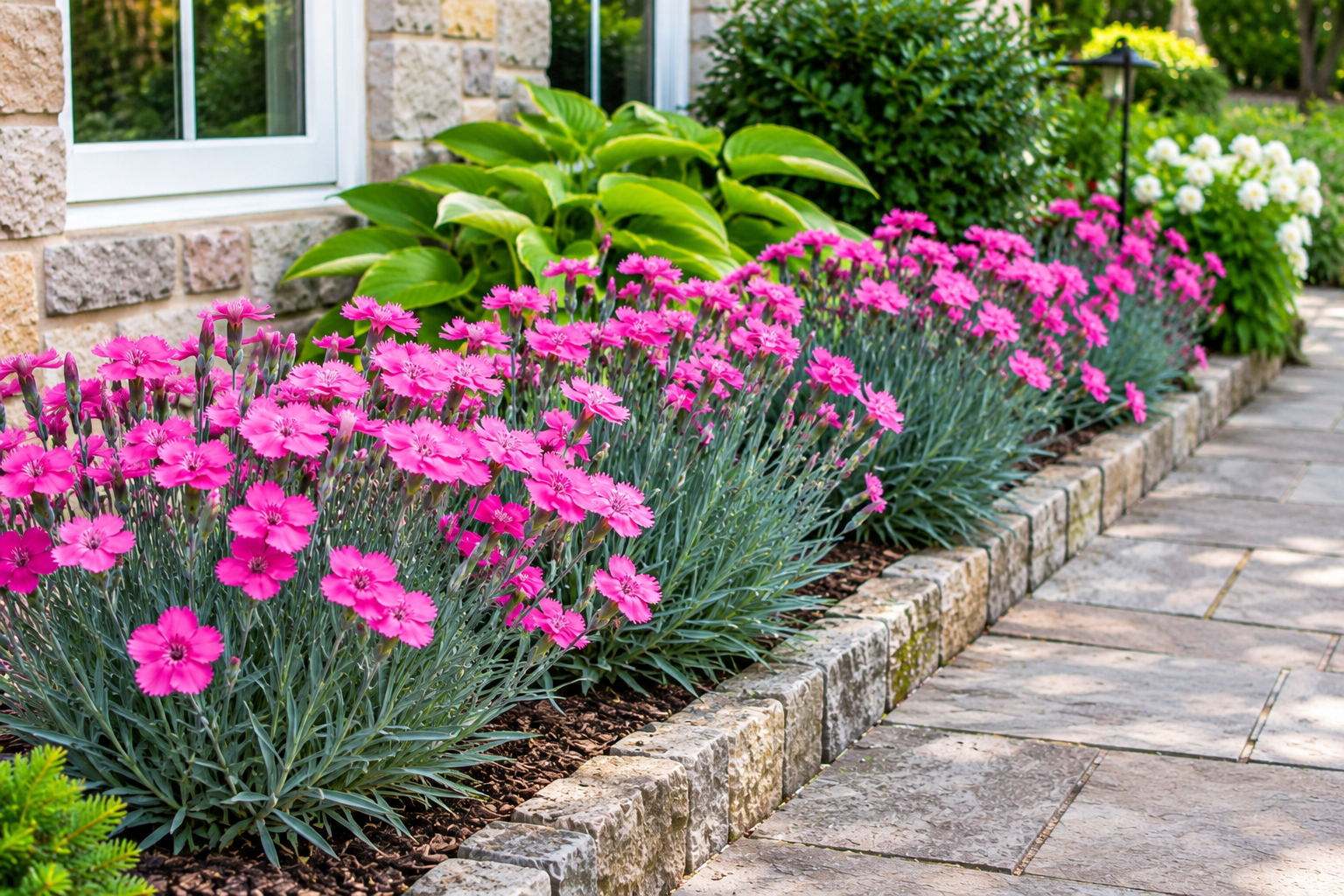
5. Cheddar Pinks (Dianthus gratianopolitanus)
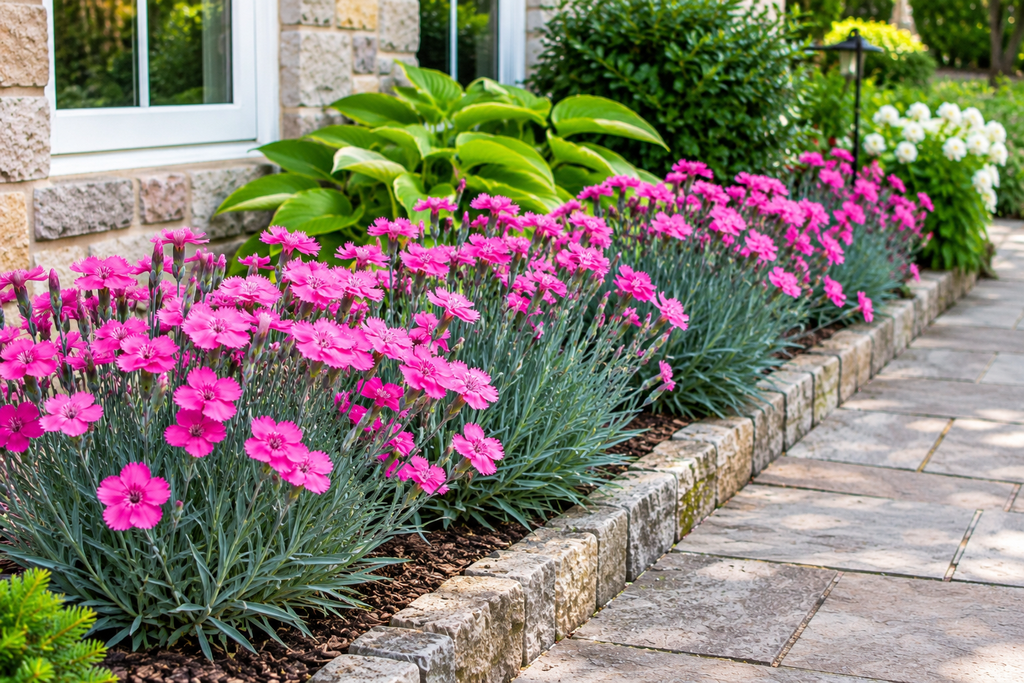
A low, mat-forming plant, usually 6 to 12 inches tall, hardy in zones 3 to 9. ‘Firewitch’ is a popular selection with magenta flowers and a spicy-clove scent in late spring and early summer. The blue-gray foliage stays attractive in winter in many climates.
Pinks suit the very front of the border, where a taller plant would be a hazard. They want sharp drainage and sun, and they struggle in wet winters, where the mat can rot. Deadheading after the first bloom tidies the plant and sometimes prompts a second flush.
6. Salvia ‘May Night’ (Salvia × sylvestris)
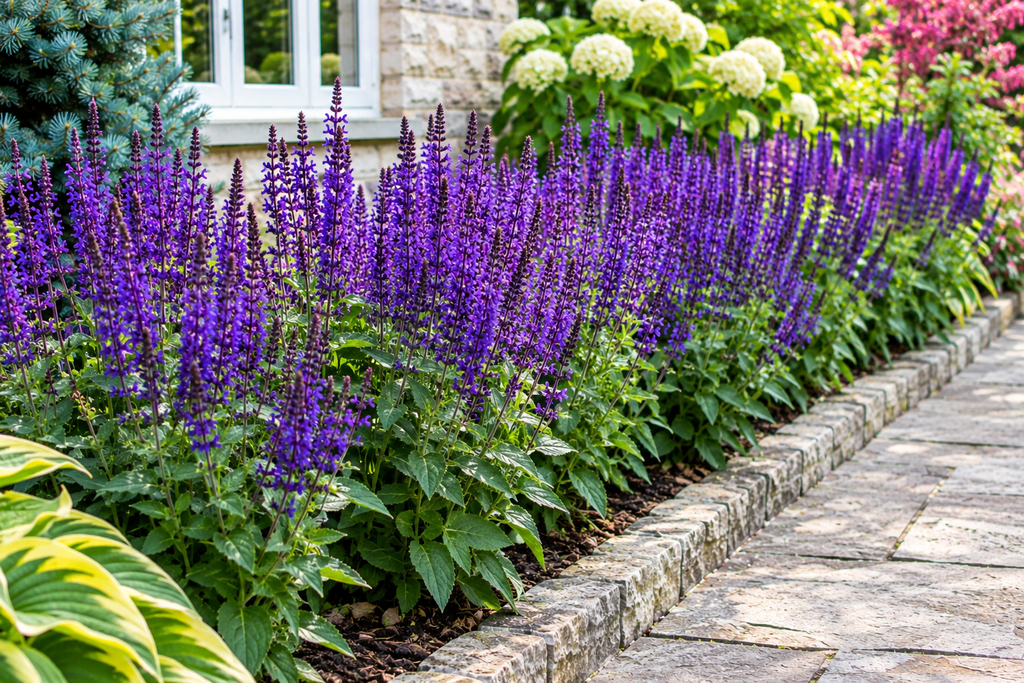
Upright spikes of deep violet-blue appear in late spring to early summer. The plant grows around 18 to 24 inches tall, hardy in roughly zones 4 to 8. It is also generally ignored by deer and rabbits.
After the first wave of flowers fades, shear the spikes down to the foliage. A second, lighter round of bloom often follows. Without shearing, the stems tire and the plant looks scruffy for the rest of summer.
Salvia pairs well with catmint’s softer texture and with the gray foliage of lavender and dianthus.
7. Creeping Thyme (Thymus serpyllum and related species)
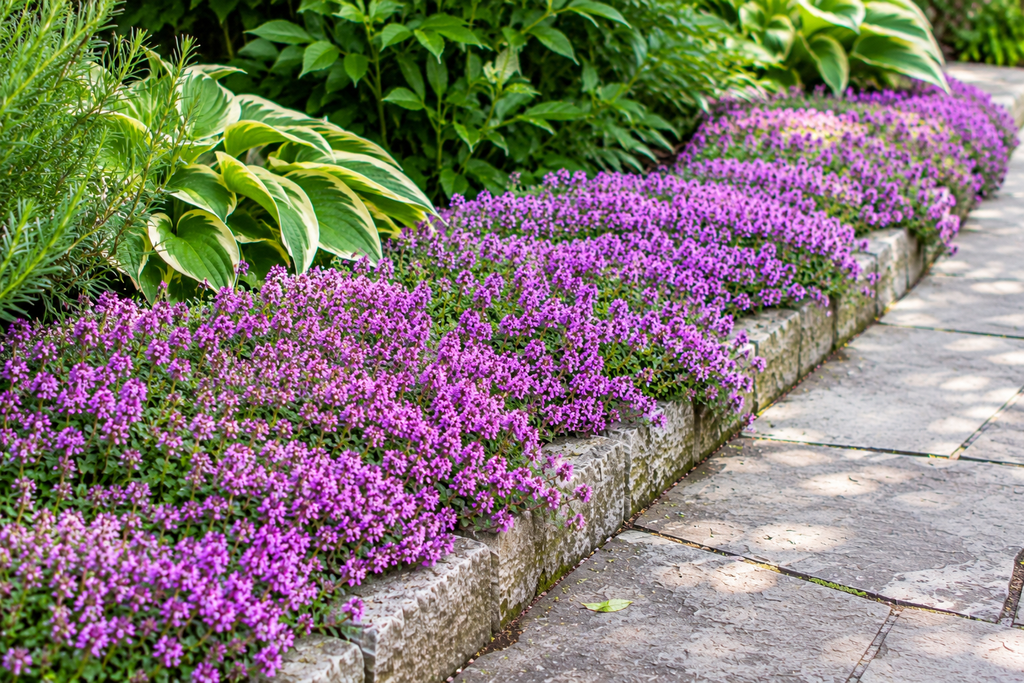
Thyme grows only 2 to 3 inches tall and spreads into a dense carpet. Most creeping types are hardy in zones 4 to 9. Tiny flowers in pink, purple, or white appear in late spring or early summer, and the foliage releases fragrance when stepped on.
It tolerates light foot traffic, which makes it useful for softening the line between pavers and soil, or for filling gaps between stepping stones. It will not survive constant heavy use and dislikes wet, rich soil. Plant plugs 8 to 12 inches apart and keep weeds out until the mat fills in.
Six Border Plants for Shade and Part Shade
8. Hosta (small to medium cultivars)
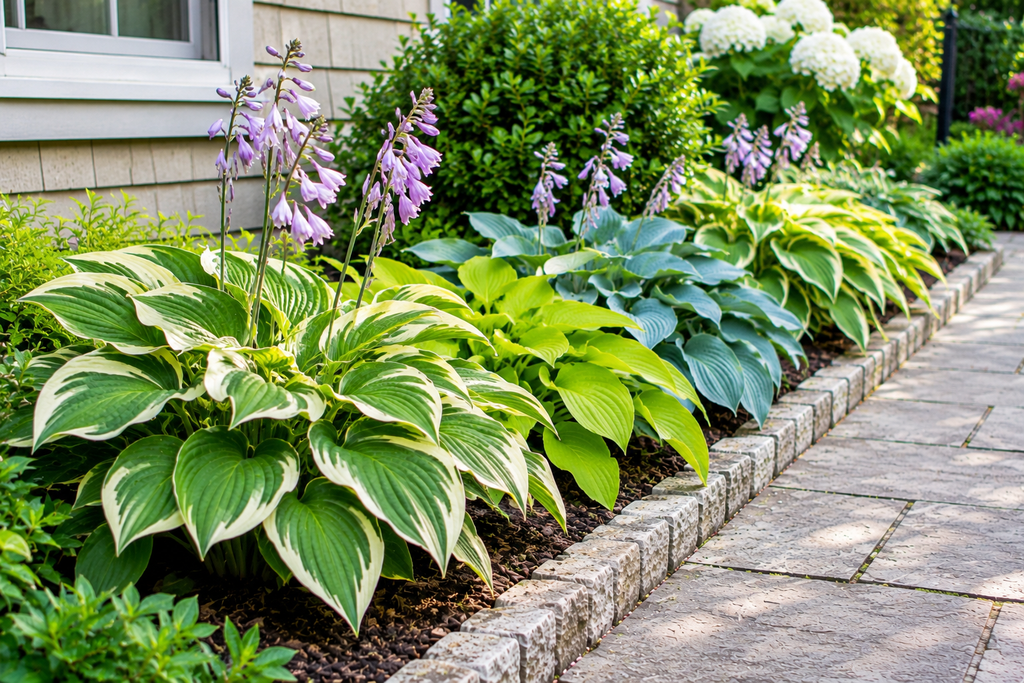
Hostas range from 6 inches to several feet, and the size you choose decides whether it works beside a path. ‘Blue Mouse Ears’ stays under about 8 inches, while mid-sized types such as ‘Halcyon’ reach around 18 inches and spread wider. Hardy in zones 3 to 9.
Blue and thick-leaved selections tend to hold up better against slugs than thin, light-green ones, though none is slug-proof. Deer and rabbits like hostas, which makes them a poor choice on a path through woods. The leaves also burn in hot afternoon sun, so the western side of a house can be rough on them.
Hostas die back in winter, leaving bare soil. Plant them in front of evergreen hellebores or heuchera so the strip never looks empty. Hostas are commonly listed as toxic to dogs and cats.
9. Coral Bells (Heuchera)
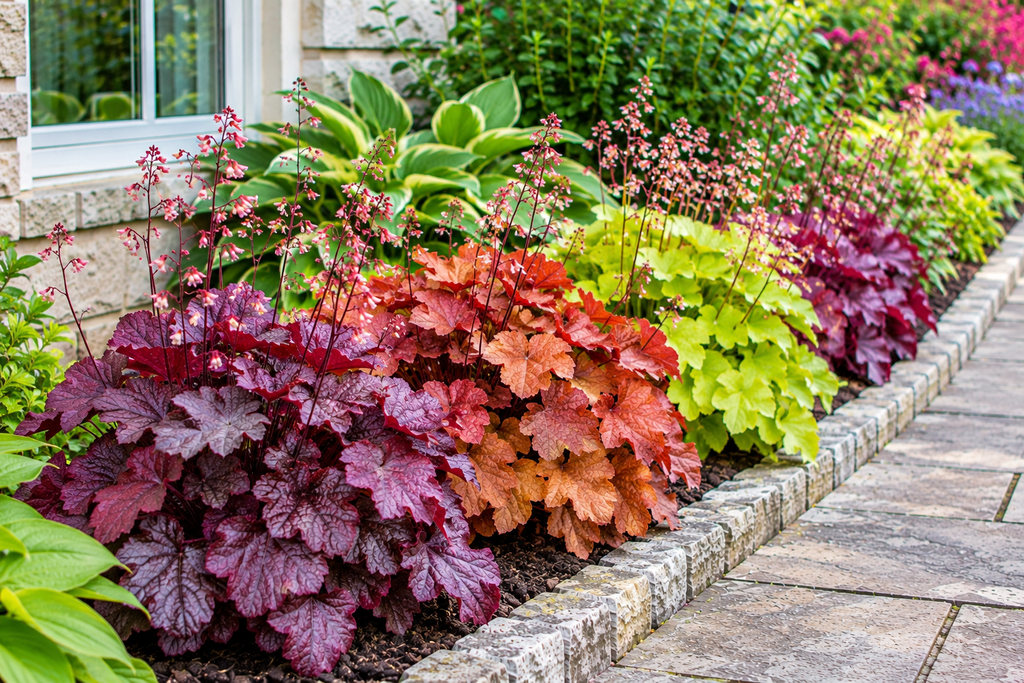
Heuchera forms neat mounds of leaves 8 to 12 inches high, with airy flower stalks reaching 18 to 24 inches in early summer. Foliage colors include purple, caramel, lime green, and silver. Hardy in zones 4 to 9.
Heuchera dislikes soggy soil, so it does better in slightly raised or well-drained spots. In regions with hard freezes and thaws, the crowns can heave upward out of the soil, and gently pushing them back down in spring helps. Dark-leaved varieties can scorch in strong afternoon sun, and varieties derived from Heuchera villosa tend to handle heat better.
Because the leaves are evergreen or semi-evergreen in many climates, heuchera supplies color along a path through the cold months.
10. Lenten Rose (Helleborus × hybridus)
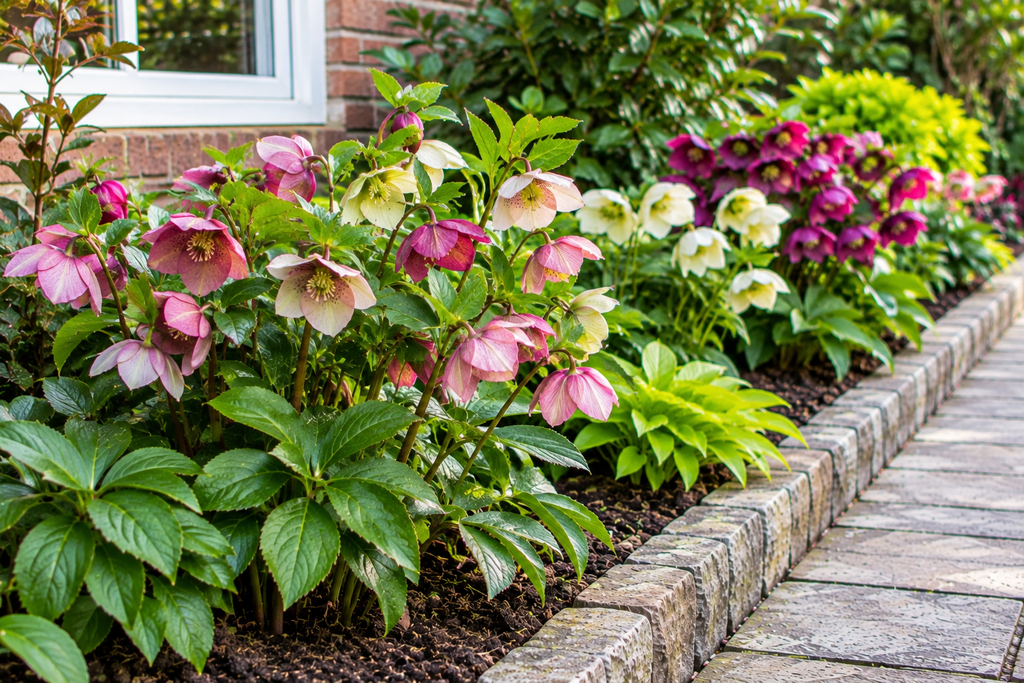
Hellebores bloom from late winter into early spring, when little else does. Plants reach about 12 to 18 inches tall with a similar or wider spread, hardy in roughly zones 4 to 9. The flowers nod downward, so planting them where you can see the faces from the path, such as at the top of a slight slope, makes them worth the effort.
Established plants tolerate dry shade better than most perennials, and deer and rabbits avoid them. Hellebores are slow to settle in, and the first season or two can feel underwhelming. In late winter, cut off tattered old leaves before the flower buds emerge.
All parts of the plant are toxic if eaten, and the sap can irritate skin, so wear gloves when cutting and avoid planting where children or pets nibble leaves.
11. Japanese Forest Grass (Hakonechloa macra)
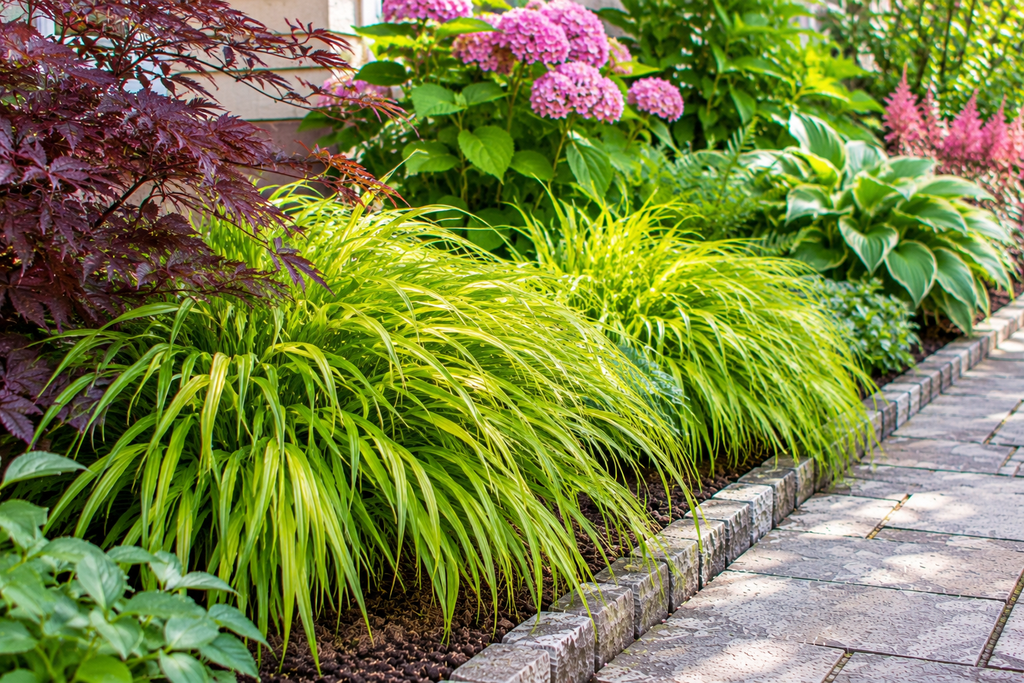
Arching, bamboo-like blades form a slow-spreading mound about 12 to 18 inches high, hardy in roughly zones 5 to 9. ‘Aureola’ has gold-and-green striped leaves that brighten dim spots, and the foliage turns orange-bronze in fall before fading to tan.
It likes consistent moisture and rich, well-drained soil. In hot climates it needs afternoon shade, since leaf tips scorch in strong sun. It is slow to fill in and often expensive, so buy fewer plants and give them time.
The soft, flowing texture contrasts well with the bold leaves of hosta.
12. Brunnera ‘Jack Frost’
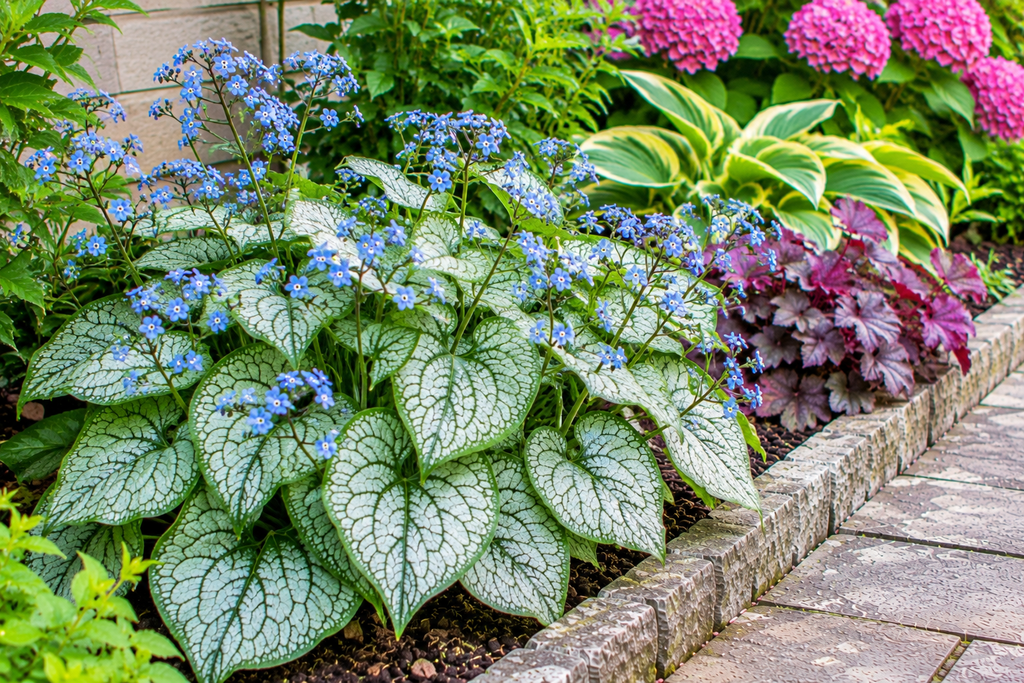
Silver heart-shaped leaves with green veining form a mound 12 to 15 inches tall and about twice as wide, hardy in zones 3 to 8. Sprays of tiny sky-blue flowers appear in spring and resemble forget-me-nots.
The silver foliage glows in shade and stays visible after dark, which helps on an unlit path. It needs steady moisture, and dry soil or hot sun produces brown, crispy leaf edges. Give it a spot that stays damp, such as near a downspout (not directly under it) or under a tree that is not competing heavily for water.
13. Astilbe
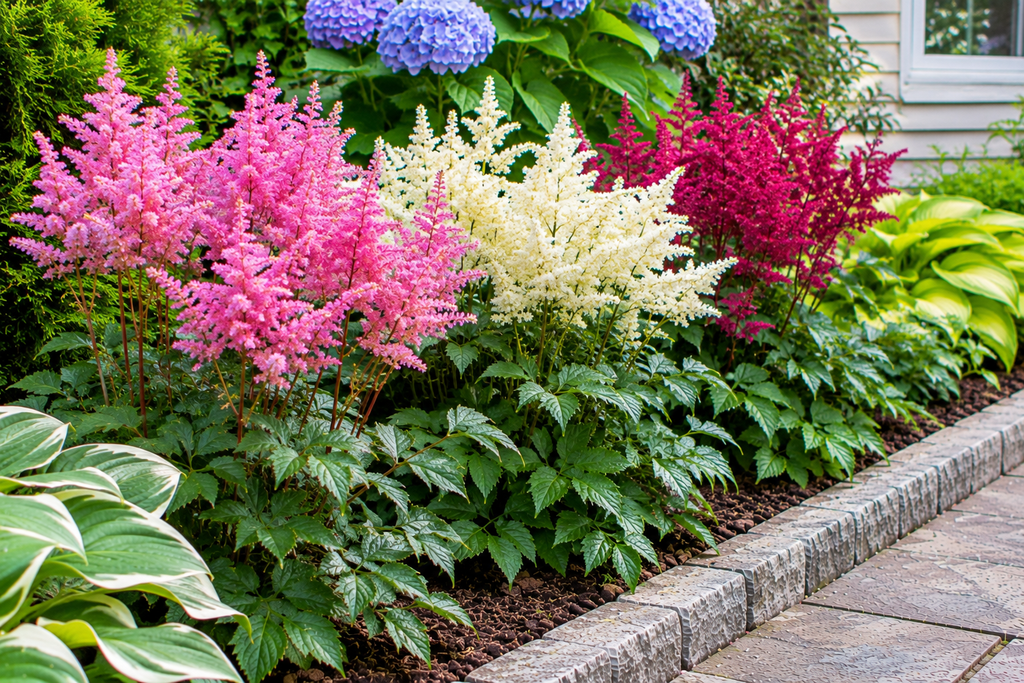
Feathery plumes of pink, red, or white rise above ferny foliage in early to midsummer. Compact types such as ‘Visions’ grow around 18 to 24 inches, and dwarf selections can stay near 8 to 12 inches. Hardy in roughly zones 4 to 8.
Astilbe is the most moisture-dependent plant on this list. In dry soil it scorches and sulks quickly, so it works only where the ground stays damp or where you will water regularly. Plumes dry to a rusty brown that can be left standing through fall for texture.
Side-by-Side Comparison
| Plant | Light | Mature height | Zones (approx.) | Best season |
| English lavender | Full sun | 18–24 in | 5–8 | Early to midsummer |
| Catmint (compact) | Full sun | 8–36 in by variety | 3–8 | Late spring to fall |
| Dwarf fountain grass | Full sun | 2–3 ft | 5–9 | Midsummer to fall |
| ‘Autumn Joy’ sedum | Full sun | 18–24 in | 3–9 | Late summer to fall |
| Cheddar pinks | Full sun | 6–12 in | 3–9 | Late spring |
| Salvia ‘May Night’ | Full sun | 18–24 in | 4–8 | Late spring to early summer |
| Creeping thyme | Full sun | 2–3 in | 4–9 | Late spring |
| Hosta (small/medium) | Part to full shade | 6–24 in | 3–9 | Spring to fall foliage |
| Coral bells | Part shade | 8–12 in (flowers to 24) | 4–9 | Year-round foliage |
| Lenten rose | Part to full shade | 12–18 in | 4–9 | Late winter to spring |
| Japanese forest grass | Part shade | 12–18 in | 5–9 | Summer to fall |
| Brunnera ‘Jack Frost’ | Part to full shade | 12–15 in | 3–8 | Spring foliage and flowers |
| Astilbe | Part shade | 8–24 in | 4–8 | Early to midsummer |
Zones are approximate and vary by cultivar, so confirm against the plant tag and your local extension service.
Setting Out the Border: Spacing, Height, and Layers
A walkway border usually works best when plants are layered by height, shortest at the path edge and tallest at the back. In a strip only 18 to 24 inches wide, that often means two rows at most. One row of a single low plant, repeated, can look cleaner than a crowded mix.
Space plants center to center at about their mature spread. For 18-inch plants along a 10-foot stretch, that works out to roughly six or seven plants, not twenty. Crowded plants compete for water and trap humidity around leaves, which encourages mildew and fungal spots. Gaps look sparse for the first year, but groundcover thyme or annuals can fill them temporarily.
Repeat plants in groups of three or five at intervals along the path. Repetition gives the eye a rhythm, and odd numbers look less formal than pairs. Keep low plants near steps, doorways, and sharp turns, where people step off the path or look down. Save the taller plants for the middle of the run or the back of the border.
Light-colored foliage such as silver brunnera, blue-gray dianthus, and gold-striped Hakone grass remains visible at dusk. If you plan to install path lights, set the plants so they won’t grow taller than the fixtures.
Pairs that suit shared conditions include lavender with dianthus and thyme (all prefer lean, dry soil), catmint with salvia (similar bloom timing and shearing needs), and hosta with brunnera and astilbe (all prefer moisture and shade).
Planting and First-Season Care
Spring and early fall are the safest planting windows in most of the U.S. Fall planting works best when it happens at least six weeks before the first hard frost, which gives roots time to settle. Dig the hole as deep as the root ball and two to three times as wide, and set the crown level with the soil surface. Planting too deep is a common cause of crown rot, especially for dianthus, lavender, and heuchera.
Water thoroughly after planting and keep the soil evenly moist through the first season, usually about an inch of water a week including rainfall. Established lavender, sedum, thyme, and catmint need far less. The moisture-loving plants (brunnera, astilbe, Hakone grass) will always need more attention in dry spells.
Spread about 2 inches of mulch, keeping it a few inches away from crowns. Use shredded bark or leaf mold for shade plants, and gravel or a thin layer of grit for the sun-loving, drought-tolerant group.
Common mistakes to avoid:
- Buying by pot size and ignoring tag dimensions.
- Planting a tall catmint or fountain grass right at the edge.
- Putting thirsty plants and drought-tolerant plants on the same irrigation line.
- Using plastic landscape fabric under perennials, which blocks water and organic matter from reaching soil and makes dividing plants difficult.
- Forgetting that evergreen foliage near paths can collect leaf litter and slippery debris in fall.
FAQ
What if my walkway runs from full sun into shade?
Choose plants for the most limiting spot in each section, and use a repeat plant to tie the two together. Heuchera is a common bridge, since many varieties tolerate part sun in cooler climates and part shade in warmer ones. Avoid forcing a sun-lover into a shaded patch just to keep the border uniform.
Do these plants tolerate de-icing salt?
None on this list is reliably salt-proof. Keep salt off beds where possible, shovel snow instead of relying on de-icers, or use sand for traction. Plants nearest the walkway will take the most damage, and flushing the soil with water in spring can help.
Are any of these safe around pets and children?
Several are commonly listed as toxic if eaten, including hosta and hellebore, and lavender and dianthus may cause mild reactions. Check each plant against the ASPCA’s database before planting if a pet chews vegetation. Hellebores deserve extra caution because the sap can irritate skin.
When is the best time to plant?
Spring and early fall, as described above. Summer planting is possible but demands steady watering.
Key Takeaways
Pick plants for the light and moisture your strip actually gets, not the look you saw in a photo, and check mature width before buying. Keep low plants at the edge and tall ones back, repeat them in groups, and leave at least 36 inches of clear walking space. For sunny paths, lavender, catmint, dianthus, and thyme do well in lean, well-drained soil. For shade, hosta, heuchera, brunnera, and hellebore give color and texture from late winter to fall.

About Syprose Kiche
Syprose Kiche is the creator and writer behind My Besuited Home, a practical home and garden website covering DIY projects, gardening, lawn care, landscaping, home improvement, and outdoor living. She focuses on turning everyday homeowner questions into clear, practical guides backed by careful research and useful real-world considerations.