
Does your front porch look a little naked? Don’t worry, mine did too for about three years until I realized that digging up the entire lawn wasn’t the answer. I spent way too many weekends trying to grow a “perfect” English garden in the ground, only to have the neighborhood rabbits treat it like an all-you-can-eat buffet. That’s when I switched to planters, and honestly, I’ve never looked back.
Planters are the ultimate “cheat code” for curb appeal. They let you control the soil, the water, and most importantly, they stay where you put them. If you’re tired of your house looking like the “before” picture in a real estate brochure, these front yard planter ideas are going to save your Saturday. I’ve made the mistakes—like the time I planted a mint variety that eventually tried to enter my crawlspace—so you don’t have to.
1. Using Oversized Modern Black Planters for a High-Contrast Look
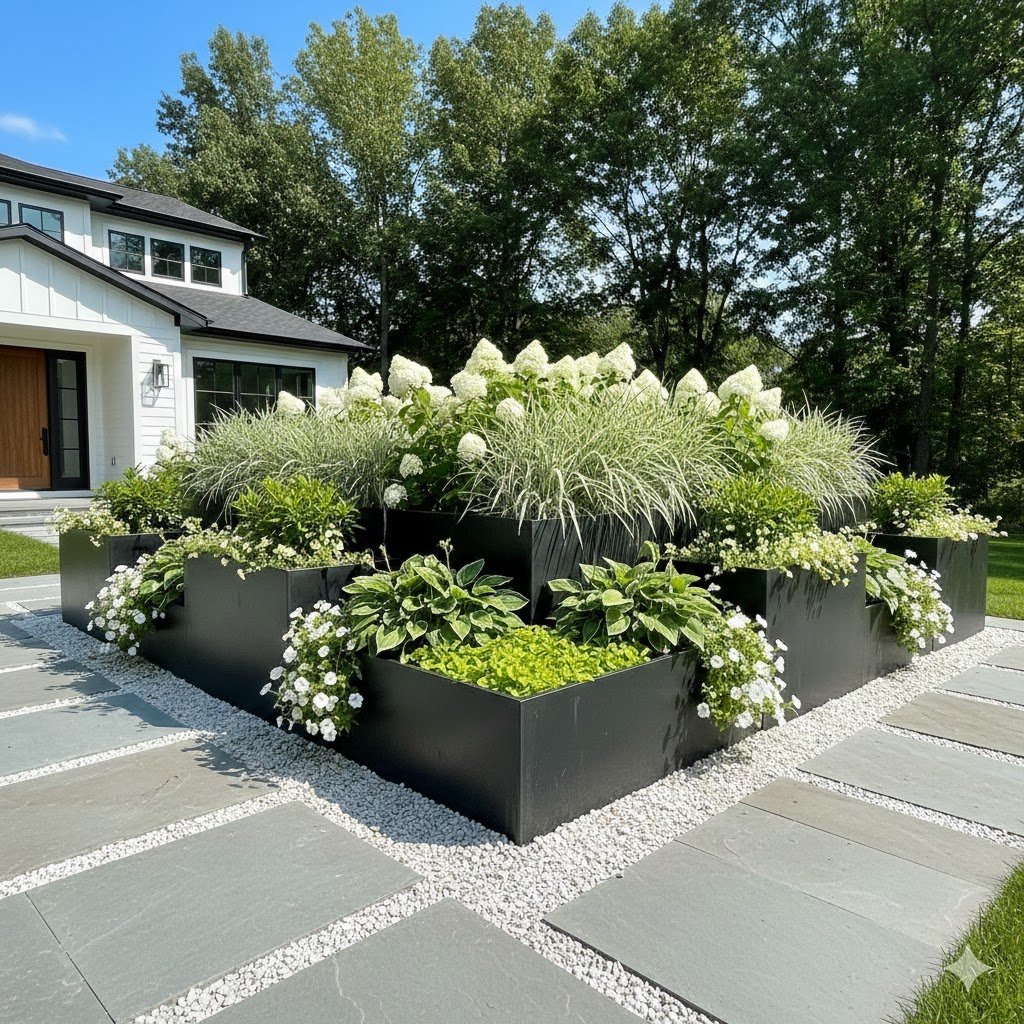
If you want your house to look like a million bucks without actually spending it, go for oversized black planters. I’m talking big—at least 30 inches tall. Small pots look like clutter from the street; big pots look like architecture. I once bought a pair of tiny terracotta pots for my front steps, and from the sidewalk, they just looked like two lost orange muffins.
Black provides a sharp, sophisticated contrast against almost any house color. Whether you have white siding, red brick, or gray stone, a matte black finish makes the green of your plants pop in a way that’s impossible to ignore. It’s the “little black dress” of the gardening world.
When you’re searching for these online, look for “lightweight resin” or “fiberglass.” Trust me, you do not want to try moving a 3-foot ceramic pot once it’s full of wet dirt. I nearly threw my back out trying to shimmy a heavy concrete planter two inches to the left during the Great Porch Reorganization of 2018. Use the light stuff; your spine will thank you.
For the actual planting, keep it simple. A single, structural plant like a Sansevieria (Snake Plant) or a tall Ornamental Grass looks stunning in a black vessel. You don’t need a chaotic mix of colors here. The goal is “expensive hotel lobby,” not “wildflower explosion.”
2. Low-Maintenance Succulent Bowls for Sunny Porches
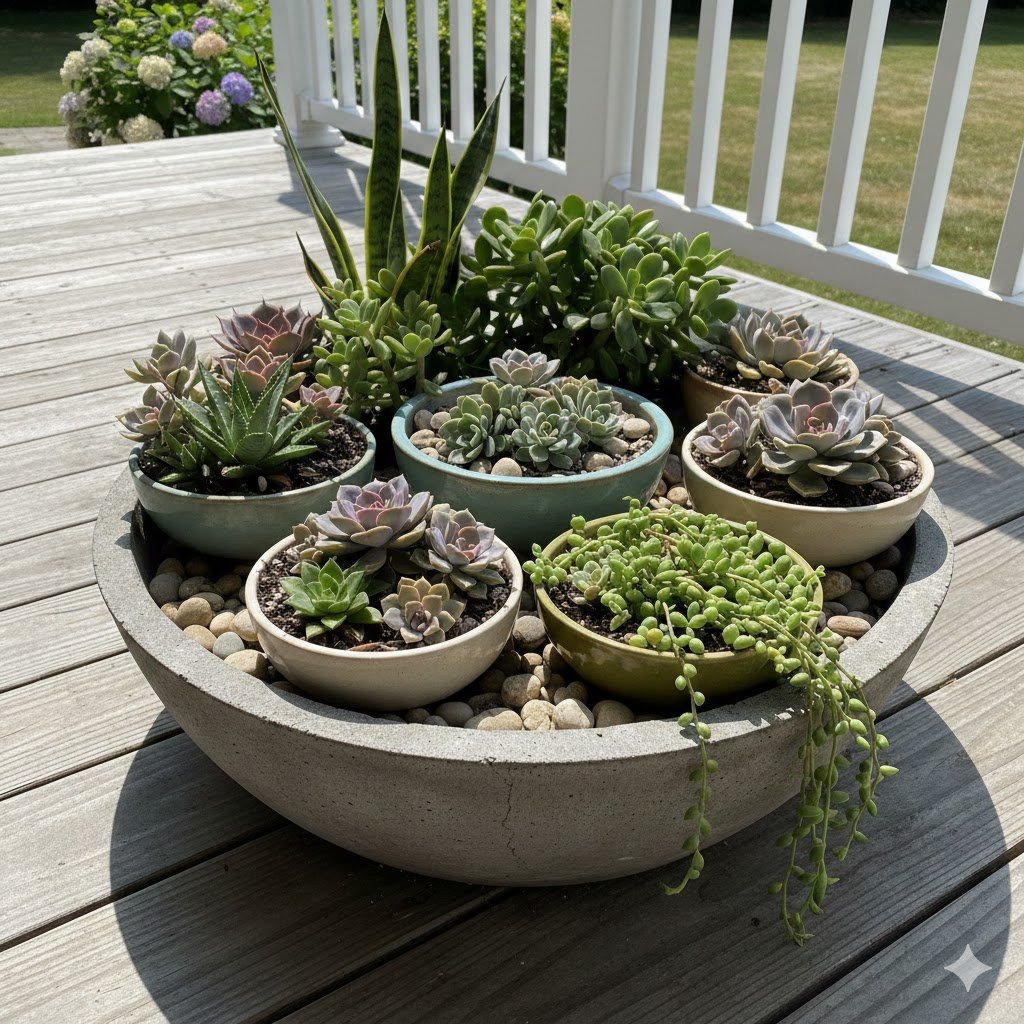
Succulents are the lazy gardener’s best friend, and I say that with nothing but love. If your front yard gets baked by the afternoon sun and you’re the type of person who forgets to water until the plants start screaming, succulent bowls are your soulmate. I used to try growing petunias in my west-facing entryway, and they’d be crispy by Tuesday.
To make this look professional, find a wide, shallow “bowl” style planter. I prefer stone or concrete textures for these because they ground the look. You want to mix different heights and textures: a tall Aloe, some “spiller” types like Donkey’s Tail, and some colorful “rosette” types like Echeveria.
The trick to succulents is the “thriller, filler, spiller” method, but in miniature. People often make the mistake of using regular potting soil. Don’t do it. You need a gritty cacti mix. I once used standard soil for a succulent arrangement during a particularly rainy June, and by July, the whole thing had turned into a mushy, grey soup.
These are perfect for “drought-tolerant front yard ideas.” Since they grow slowly, you won’t be out there pruning every weekend. You can basically ignore them for two weeks, and they’ll actually thank you for it. They are the ultimate “set it and forget it” curb appeal boost.
3. Tiered Cedar Planter Boxes for a Custom Built-In Feel
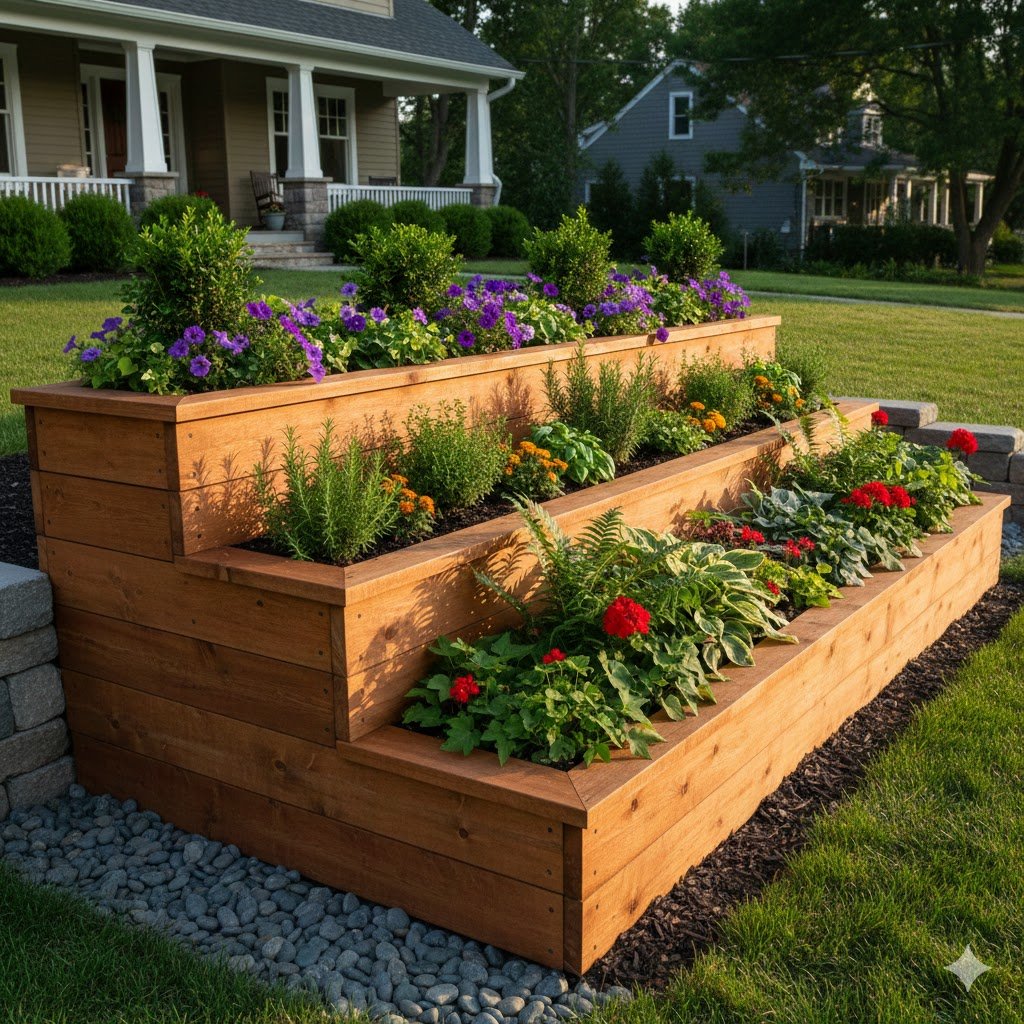
Cedar is the gold standard for outdoor wood, and for good reason. It smells like a spa, it resists rot, and it ages to a beautiful silvery-grey if you don’t stain it. I built a set of tiered cedar boxes three years ago to hide a weird concrete lip on my foundation, and it’s still the thing neighbors ask me about most.
The “tiered” part is important because it adds verticality. Instead of one flat line of flowers, you get a staircase of color. This is a great way to handle “sloped front yard landscaping” without having to hire a contractor for a retaining wall. You just stagger the boxes to follow the grade of the land.
You’ll find these listed often as “vertical garden planters” or “stepped raised beds.” If you aren’t handy with a saw, you can buy pre-cut kits that snap together like Legos. Just make sure the interior is lined with landscape fabric. I forgot the liner on my first set, and every time I watered, a stream of mud would leak out onto my white sidewalk. Not the “curb appeal” I was going for.
In these boxes, I love a mix of edible and ornamental. Tuck some Tuscan Kale or Purple Basil in with your Marigolds. It looks lush, smells incredible, and you can grab a garnish on your way back inside. Just watch out for the neighborhood dogs—I’ve learned the hard way that a low-hanging tomato is basically a tennis ball to a Golden Retriever.
4. Classic White Urns for Traditional Symmetry
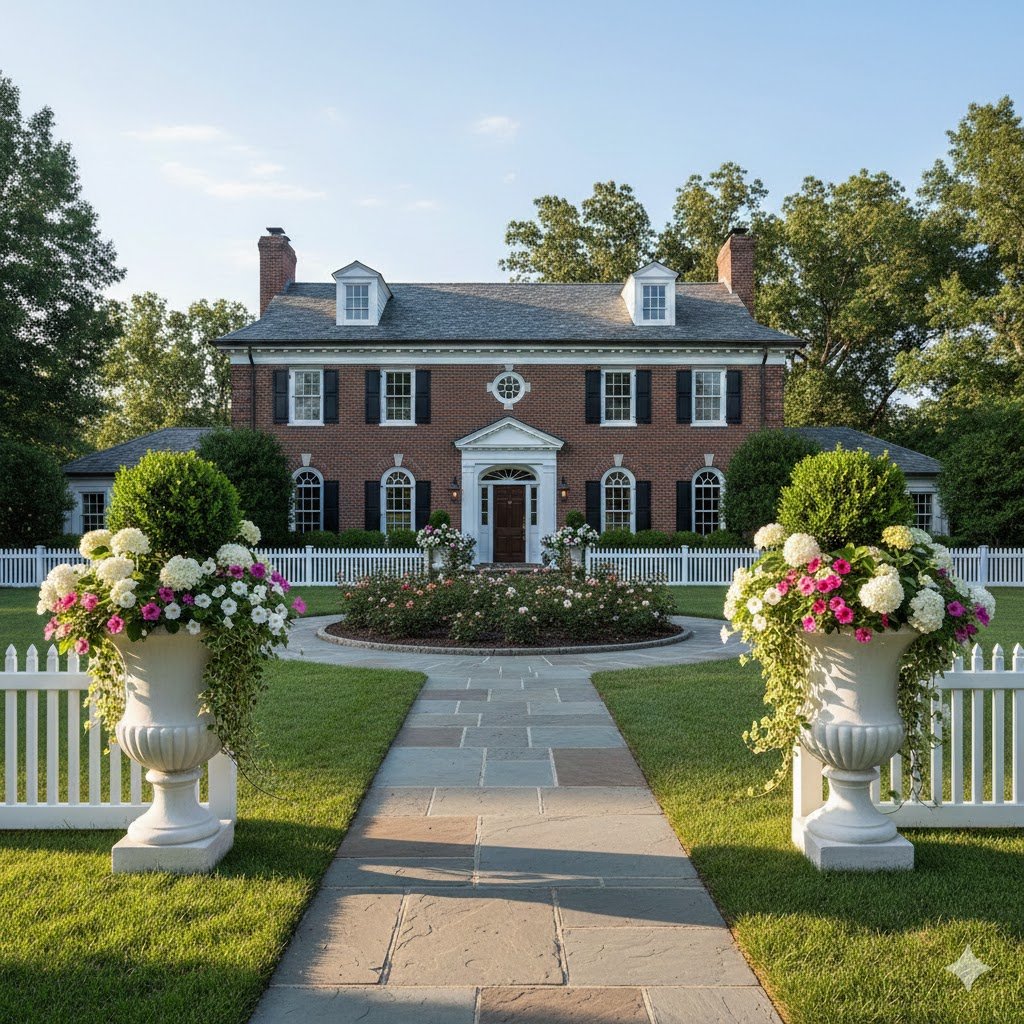
There is a reason you see white urns in every “Southern Living” magazine. They are timeless. If you have a traditional-style home, a pair of symmetrical white urns flanking the front door is the fastest way to make the place look dignified. It’s like putting a tuxedo on your house.
I’m a big fan of the “Victorian Pedestal” style. You want something with a bit of height so the plants are at eye level. When people search for “front door planter ideas,” this is usually the look they are aiming for. It’s clean, it’s crisp, and it screams “I actually have my life together.”
For the planting, go with the classic Geranium and Vinca Vine combo. Or, if you want to be a bit more modern, try a neatly clipped Boxwood Ball. I once tried to do a “wild and messy” look in a formal white urn, and it just looked like the urn was being eaten by a swamp monster. Keep it manicured.
One pro tip: fill the bottom half of these tall urns with empty plastic milk jugs or crushed soda cans. If you fill the whole thing with dirt, it will weigh 400 pounds and you’ll never be able to move it. Plus, most plants don’t need three feet of soil anyway. I learned this after wasting $60 on “premium” potting soil for two pots that only needed about a bag’s worth of actual root space.
5. Industrial Galvanized Metal Troughs for a Modern Farmhouse Vibe
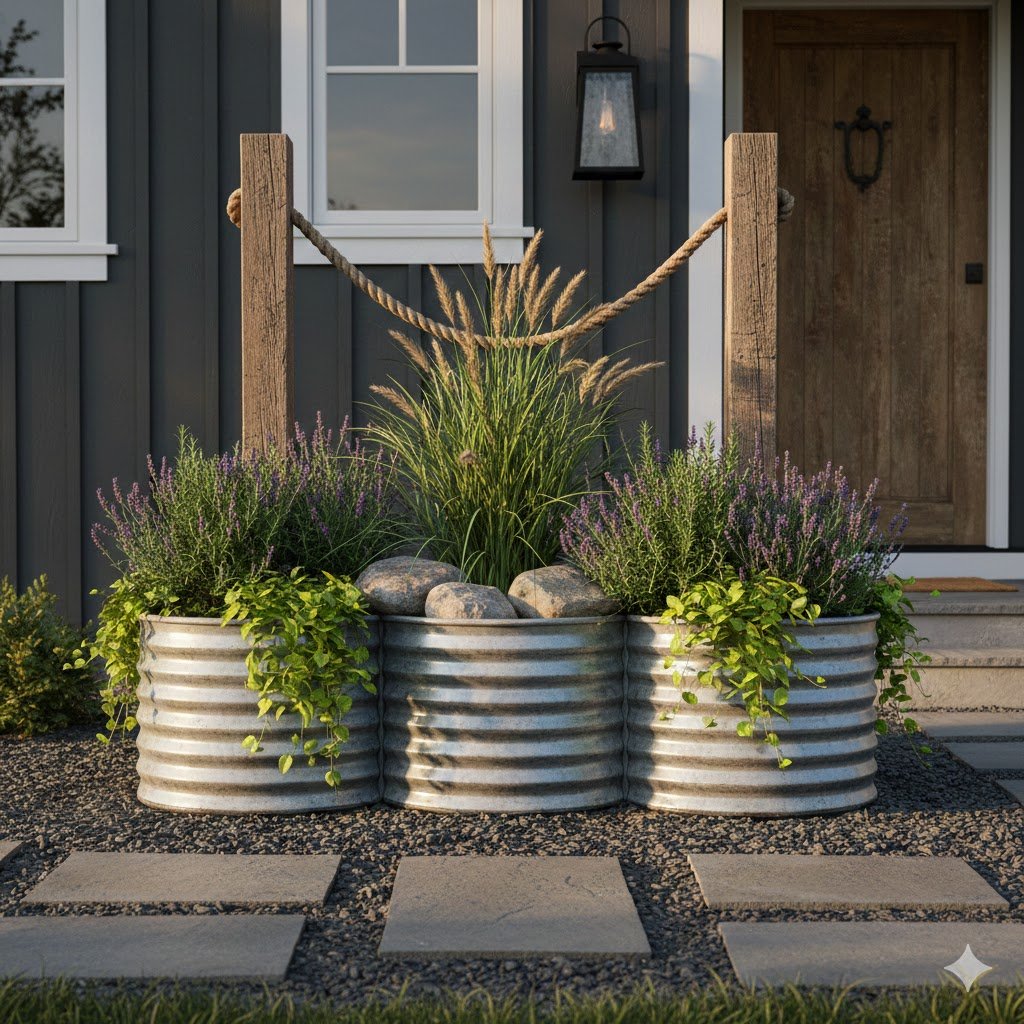
The “Modern Farmhouse” trend isn’t going anywhere, and galvanized steel troughs are the backbone of that look. I love using these because they are practically indestructible. You can hit them with a lawnmower (guilty) or have a hail storm, and they just get “more character.”
These are often sold as “stock tanks” at farm supply stores for a fraction of what “designer” planters cost. I once found a 4-foot trough at a tractor supply shop for forty bucks, while the local boutique nursery was selling a “vintage-inspired” version for two hundred. Shop where the farmers shop, friends.
The silver metallic finish looks incredible against dark charcoal or navy blue houses. However, be warned: metal gets hot. If you live in a place like Texas or Arizona, you need to line the inside with foam board or heavy plastic, or you’ll literally cook the roots of your plants. I toasted a perfectly good crop of petunias in a metal bin back in 2015 because I didn’t realize the soil was reaching 110 degrees.
Fill these with tall, wispy plants like Russian Sage or Lavender. The airy texture of the plants softens the hard lines of the metal. It’s a great way to add “industrial garden decor” to your front yard without making it look like a junkyard.
6. Using Brightly Colored Glazed Ceramic for a Pop of Personality
Sometimes, a house just needs a “slap in the face” of color. If your home is a neutral tan or beige, a bright cobalt blue or a deep turquoise ceramic pot can be the focal point that ties everything together. I have a neighbor who has a very boring grey house, but she put two massive lime-green pots by her porch, and now it’s the coolest house on the block.
Glazed ceramic is heavy, which is actually a plus if you live in a windy area. My front porch acts like a wind tunnel, and I’ve seen lightweight plastic pots cartwheel down the street like tumbleweeds. My heavy ceramic pots don’t budge.
When searching for these, use terms like “frost-proof glazed planters.” If you live in a climate that freezes, cheap ceramic will crack and flake off like a bad sunburn. I lost a gorgeous red pot my first winter in the Midwest because I didn’t realize it wasn’t “frost-rated.” It basically shattered into a thousand red shards by February.
In these colorful pots, I like to use plants with dark foliage. A Deep Purple Sweet Potato Vine dripping over the side of a bright blue pot is a showstopper. It creates a high-energy look that makes people slow down when they drive by.
7. Window Box Planters for Instant Curb Appeal
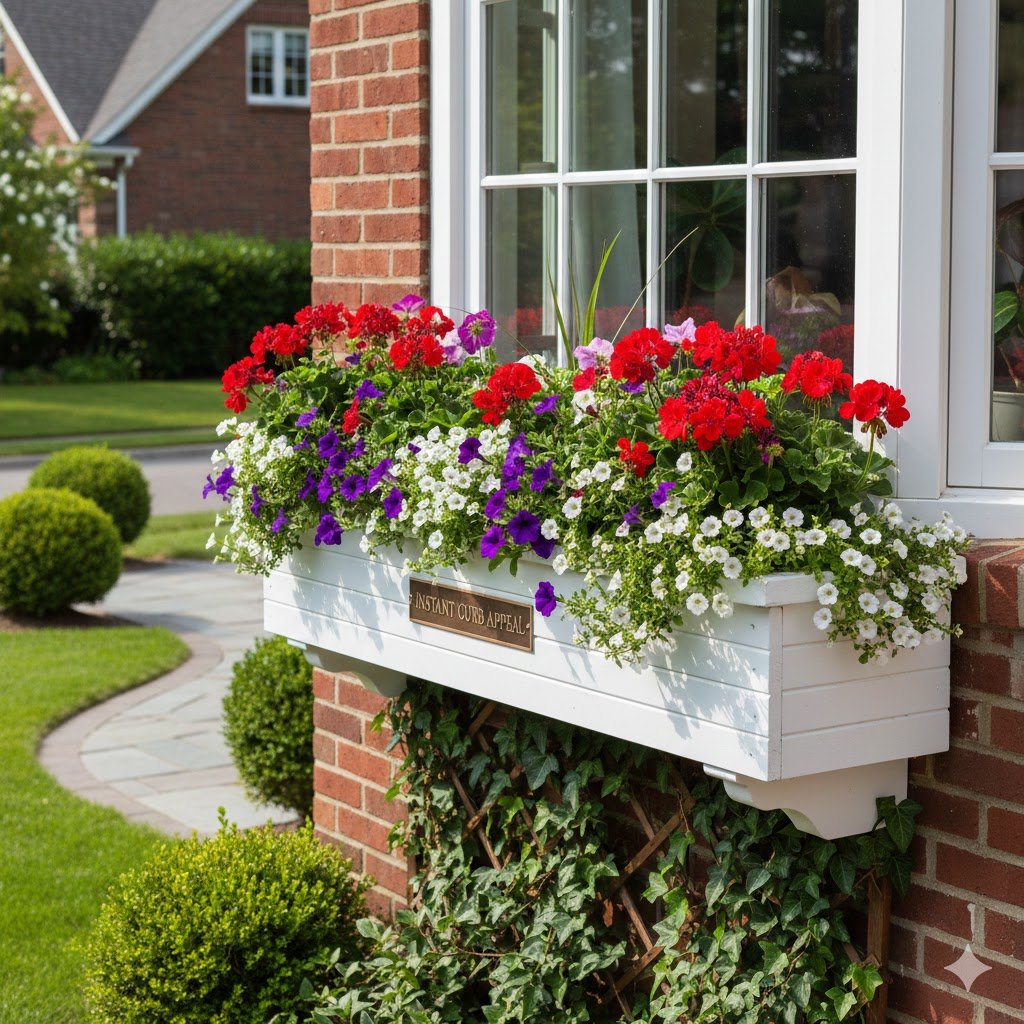
If you don’t have a porch, window boxes are your best friend. They draw the eye up and make the house look taller and more “cottage-core.” I’ve installed window boxes on every house I’ve lived in, and they are the single best investment for “front of house flower ideas.”
The key here is the “spiller” plant. You want something that hangs down at least 12 to 18 inches. Creeping Jenny or Trailing Lobelia are my go-tos. Without the spillers, the window box just looks like a haircut that’s too short. You want it to look like the plants are escaping.
Installation is the scary part for most people. Please, for the love of your siding, use proper brackets. I once tried to “DIY” a mounting system with some old nails and twine—don’t ask—and woke up to the sound of my window box crashing into the hydrangeas below. Use the heavy-duty stuff.
Also, consider “self-watering window boxes.” Because they are elevated and exposed to the wind, window boxes dry out faster than almost anything else in the garden. If you don’t want to be out there with a watering can every single morning, a built-in reservoir is a lifesaver. I switched to self-watering liners two years ago, and I finally stopped killing my begonias.
8. Grouping Different Sized Pots for a “Curated” Cluster
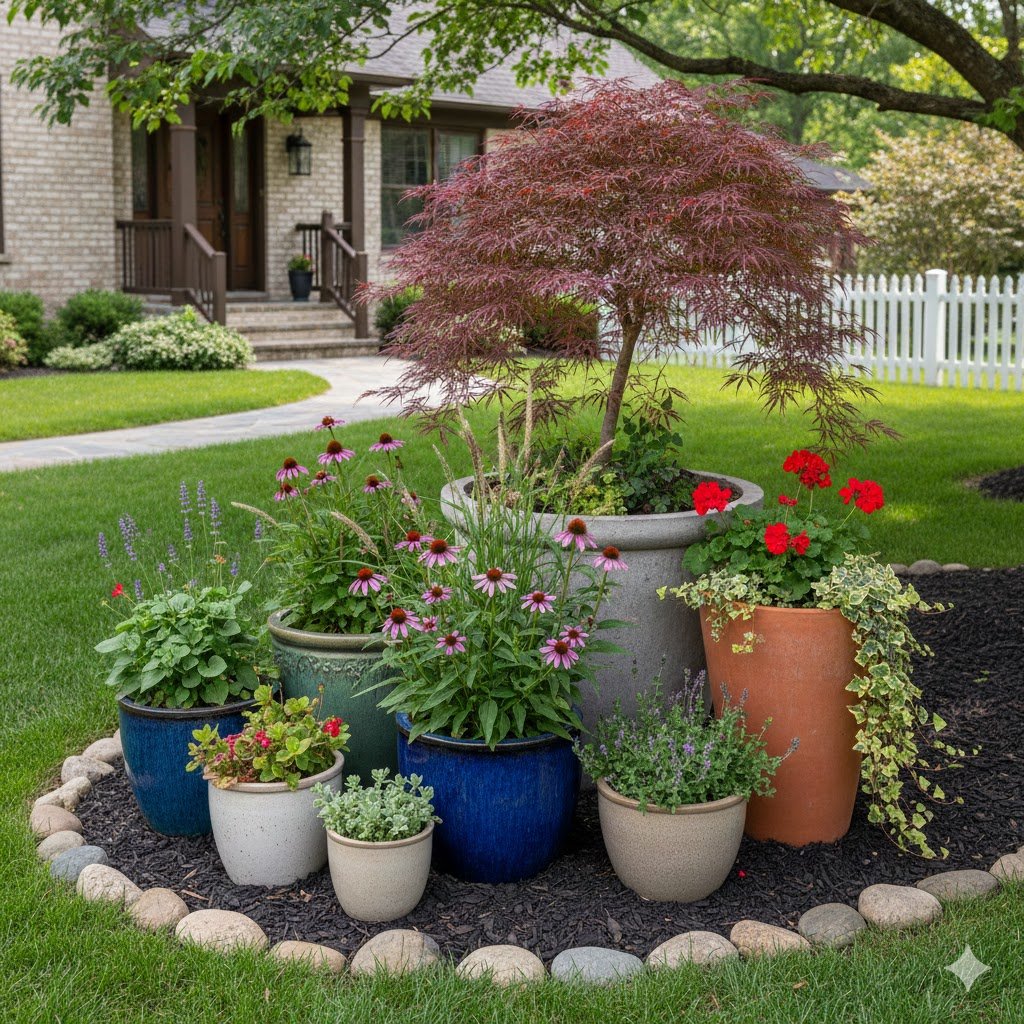
One lone pot looks like an accident. Three pots of different heights look like a “design choice.” This is the easiest way to fill a large, empty corner of a porch or a landing. I call this the “Power of Three.”
You want a large, medium, and small version of the same style or color. For example, three different sized terracotta pots, or three different heights of the same concrete texture. This creates a visual “rhythm” that guides the eye. It’s a classic “porch styling tip” that designers use all the time.
In the large pot, put something tall (a Dwarf Alberta Spruce). In the medium, something bushy (Hydrangeas). In the small one, something colorful (Pansies). It creates a little ecosystem of color and texture. I once tried to group five pots of the exact same size together, and it just looked like a grocery store display. Vary those heights!
This setup is also great for “seasonal front yard decor.” You can swap out the plants in just the small pot to match the season—mums for fall, pansies for spring—without having to redo the whole “anchor” arrangement. It’s the most efficient way to keep your curb appeal fresh year-round.
9. Monochromatic “All-White” Garden Planters
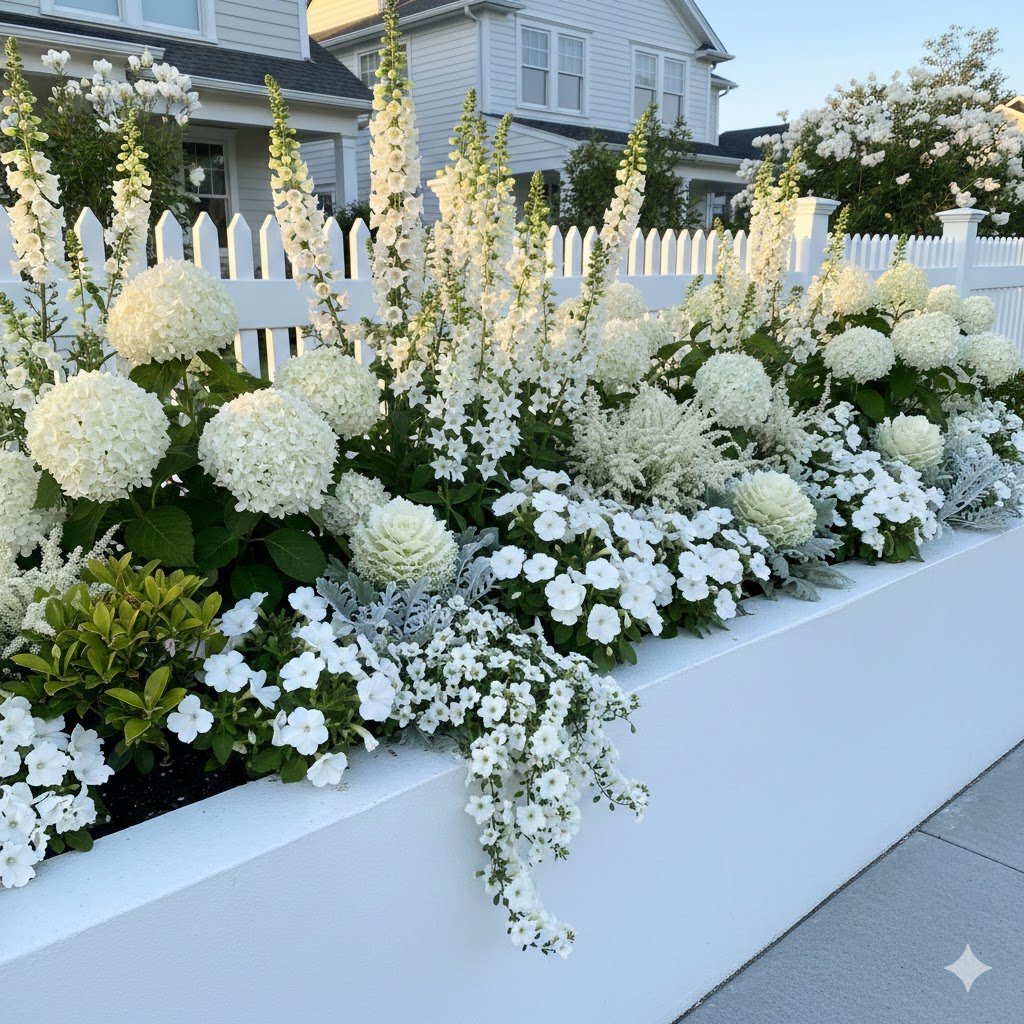
If you want a look that is incredibly sophisticated and a little bit “Hamptons,” go with an all-white flower palette. Use white pots, white flowers, and variegated green-and-white foliage. It is clean, calming, and looks absolutely stunning under porch lights at night.
I did an all-white “Moon Garden” in my front planters last year using White Caladiums, Bacopa, and Diamond Frost Euphorbia. It was the most “high-end” my house has ever looked. White flowers have a way of glowing at dusk that colorful flowers just can’t match.
When you’re looking for “elegant planter ideas,” white-on-white is the winner. It takes the guesswork out of color matching. You don’t have to worry if this shade of pink clashes with that shade of orange. If it’s white, it works.
A quick warning: white pots show dirt. If you’re a “messy” gardener like me, you’ll need to wipe them down with a damp cloth every now and then. I once let my white ceramic pots get covered in splash-back from the mulch, and they ended up looking like they were camouflaged for a swamp mission. A little maintenance goes a long way here.
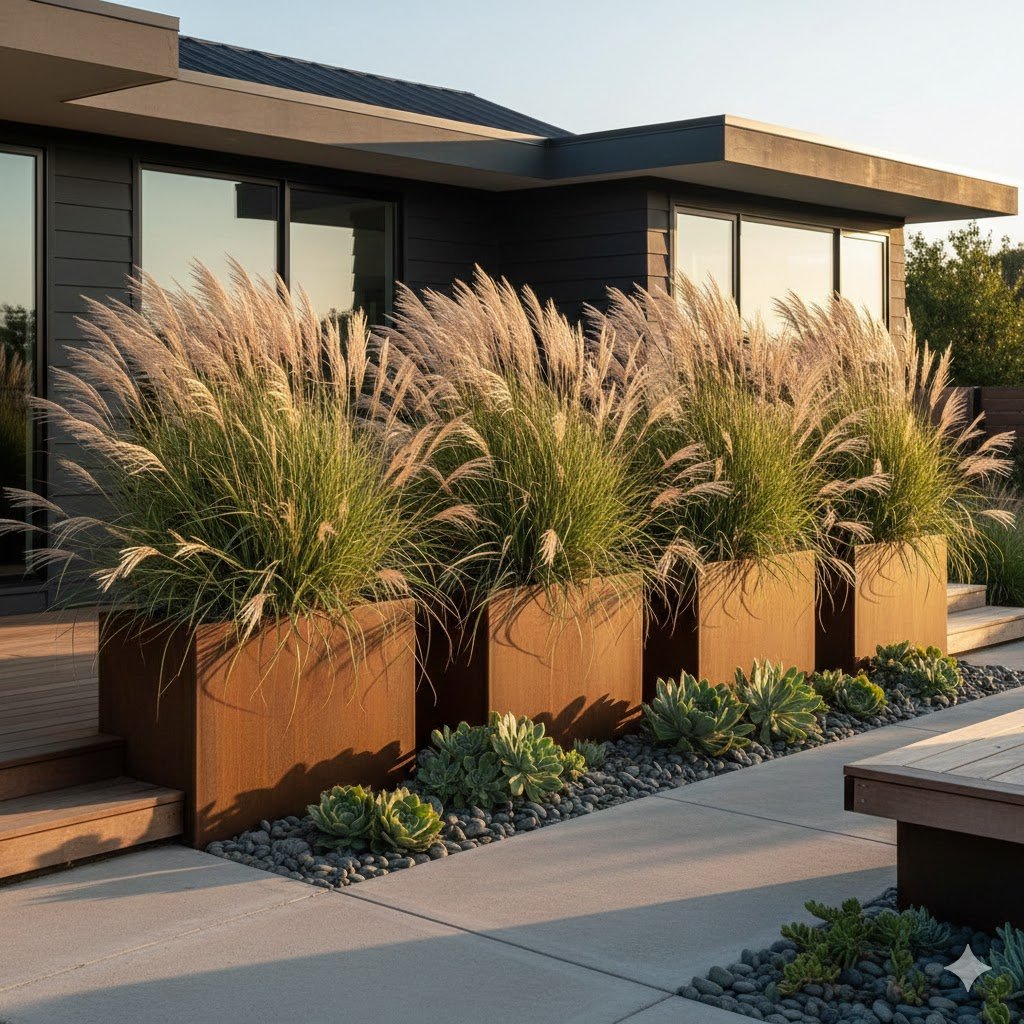
10. Tall Grasses in Troughs for Privacy and Texture
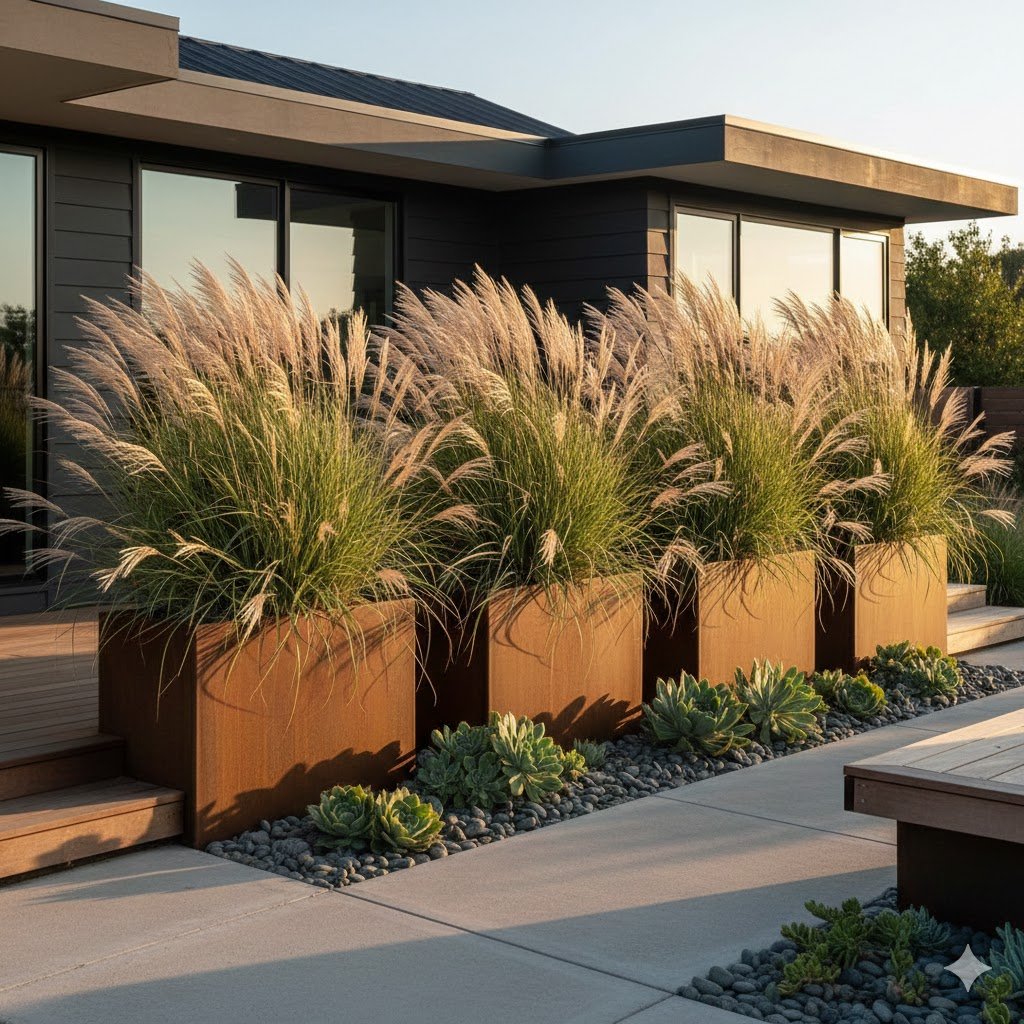
Sometimes curb appeal isn’t just about flowers; it’s about solving a problem. If your front porch feels a little too exposed to the street, use tall planters with Ornamental Grasses to create a “living screen.” It’s softer than a fence and much prettier to look at.
I used Karl Foerster Feather Reed Grass in long rectangular troughs to create a bit of a barrier between my seating area and the sidewalk. It provides just enough “visual noise” to make the porch feel private without blocking the view entirely. Plus, the sound of the wind rustling through the grass is incredibly relaxing.
Search for “privacy planters” or “trough planters for balcony.” You want something at least 2 feet long. The best part is that many of these grasses stay standing through the winter, providing “winter curb appeal” when everything else has turned into a brown stick.
Don’t buy the “running” varieties of grasses unless you want them to eventually break your planter. Stick to “clumping” varieties. I once planted a type of bamboo that was labeled “clumping” but definitely had “running” ambitions—it nearly cracked a heavy-duty resin pot in half within two seasons. Stick to the well-behaved reeds and fescues.
11. Edible Front Yard Planters: Beauty You Can Eat
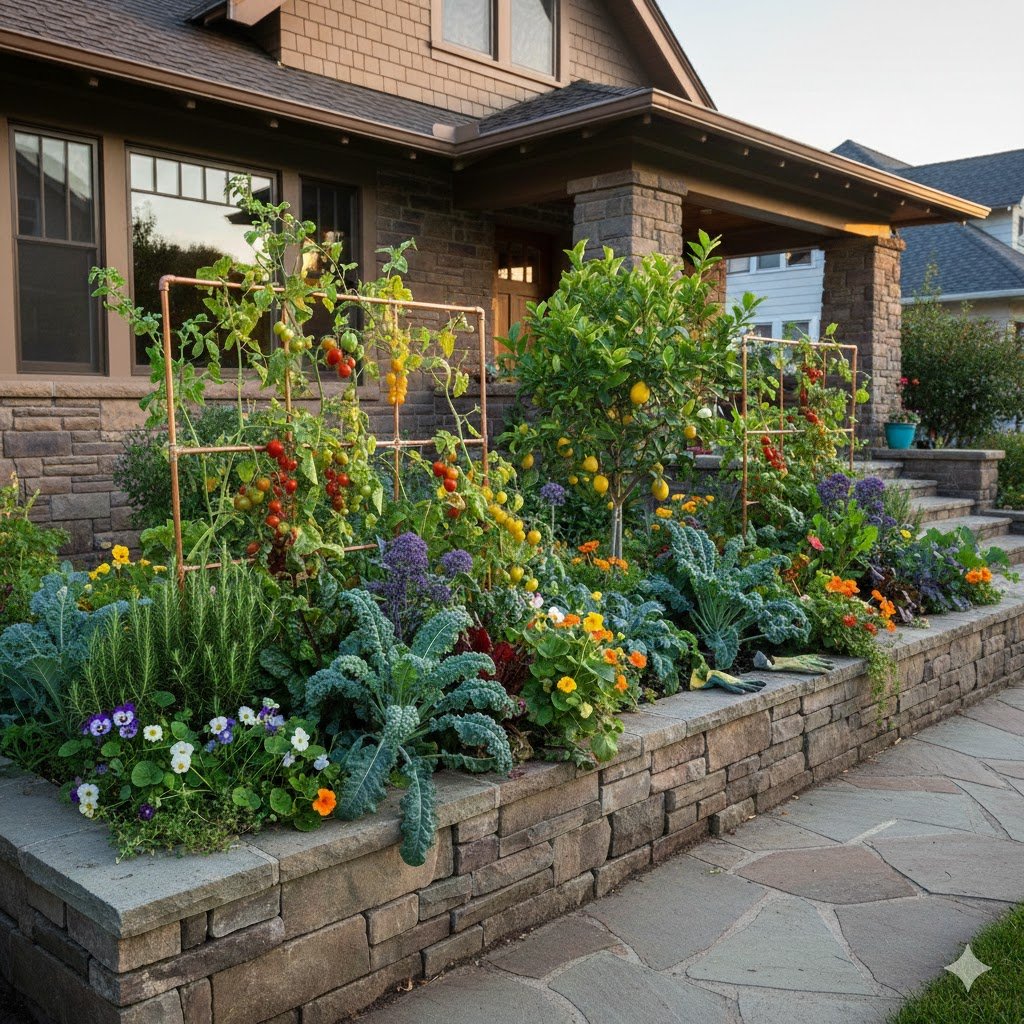
Who says front yard planters have to be purely decorative? If you’re short on backyard space, or you just want to be “that neighbor” who hands out fresh herbs, edible planters are the way to go. A big pot of Rainbow Chard is just as beautiful as any ornamental leaf plant.
I like to mix Strawberries into my hanging baskets. They have pretty white flowers, and then the berries hang down like red jewels. It’s a “functional landscaping” win. Just be prepared to share with the local birds; I’ve had many a standoff with a cardinal over the last ripe berry.
When searching for plants, look for “patio” or “compact” varieties. You don’t want a standard zucchini plant in a front yard pot; it will grow five feet wide and look like an alien invasion. Look for “Bush Slicer” cucumbers or “Tiny Tim” tomatoes.
The “Real Talk” here: Edibles need more food than flowers. You have to fertilize them regularly if you want them to look good. A hungry tomato plant gets yellow and “leggy” really fast, which is the opposite of curb appeal. I use an organic fish emulsion once a week—it smells like a pier for about an hour, but the plants love it.
12. Hanging Baskets with “Extreme” Spillers
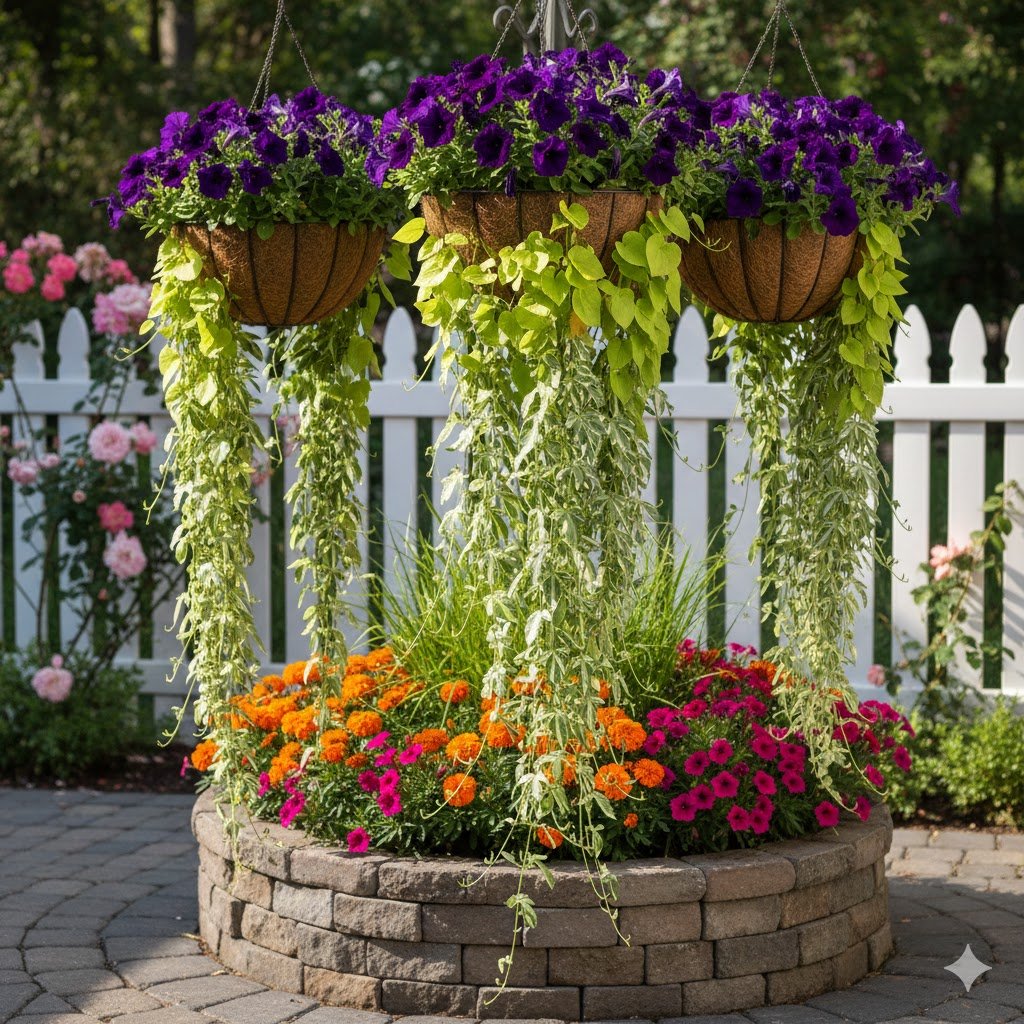
Hanging baskets are a classic, but most people buy those sad, tiny ones from the hardware store that die by July. If you want “instant curb appeal,” you need to go big. I’m talking 14-inch or 16-inch coco-fiber liners.
The trick is to plant the sides, not just the top. Poke holes in the coco-liner and tuck plants in there too. This creates a “ball of flowers” effect rather than just a flat top. When people search for “best hanging plants for front porch,” they are looking for that “overgrown cottage” look.
Petunias and Calibrachoa (Million Bells) are the kings of the hanging basket. They will grow three feet long if you feed them. I once had a petunia basket that got so long it started interfering with the screen door. My husband had to “tunnel” through the flowers to get the mail.
One side note: hanging baskets dry out in about four minutes. In the heat of summer, you might need to water them twice a day. If you aren’t committed to that life, stick to the ground-level pots. I’ve lost more hanging baskets to “Sunday afternoon naps” than I care to admit.
13. Using Tropicals for a “Vacation at Home” Feel
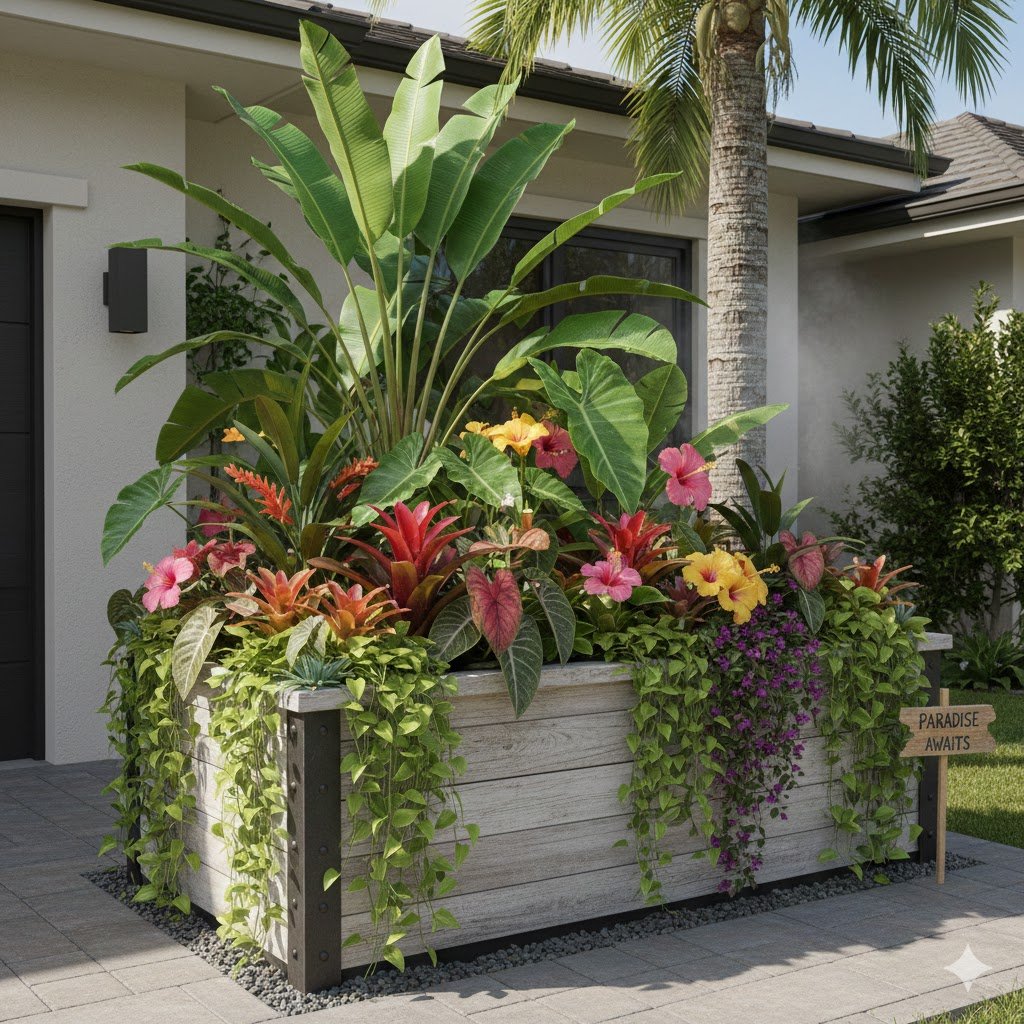
If you want your house to stand out, go tropical. Hibiscus, Mandevilla, and Canna Lilies bring a “resort” vibe to a standard suburban front yard. They have big, bold leaves and neon-bright flowers that you can see from three houses away.
I love a tall Kimberly Queen Fern in a pedestal planter. It’s classic, lush, and handles the sun better than the finicky Boston Ferns. I used to try Boston Ferns on my sunny porch, and they’d drop brown needles every time the wind blew. The Kimberly Queen is much tougher.
Search for “tropical patio plants” or “flowering vines for pots.” A Mandevilla on a small trellis in a pot is an absolute showstopper. It climbs, it blooms, and it looks like you’ve been spending your weekends in Hawaii.
Keep in mind, these aren’t hardy in most places. Unless you live in Florida, you’ll either have to bring them inside for the winter or treat them as “expensive annuals.” I’ve tried to overwinter Hibiscus in my basement, but it usually just ends up being a hotel for spider mites. Now, I just buy new ones every May and call it my “vacation budget.”
14. Concrete Troughs for a Minimalist Aesthetic
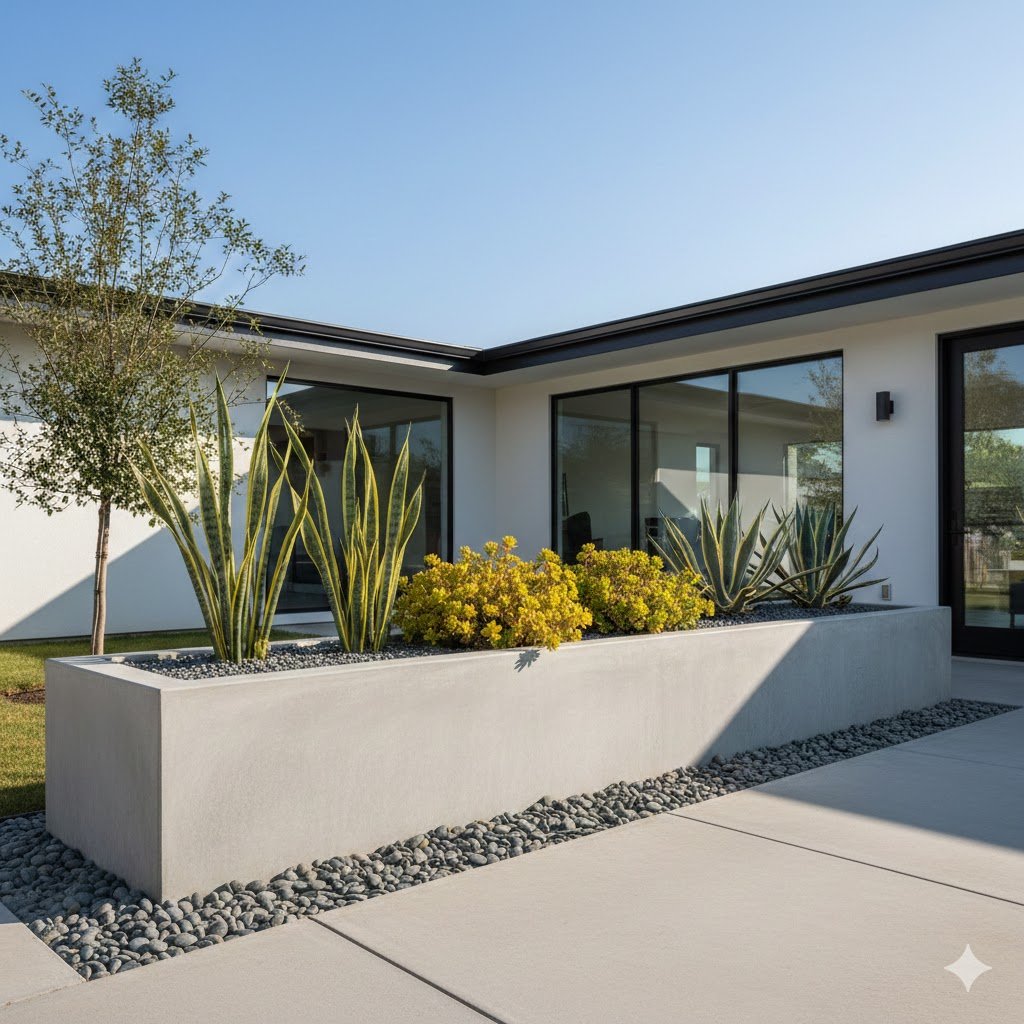
If your style is more “Modern Museum” and less “Grandma’s Garden,” concrete is your material. Real concrete is incredibly heavy and expensive, so I usually go for “faux-concrete” made of GFRC (Glass Fiber Reinforced Concrete). It looks the same but won’t require a forklift to move.
Long, low concrete troughs are perfect for lining a walkway. I like to plant them with nothing but Blue Fescue or Mondo Grass. The repetition of the same plant in a clean, grey vessel is incredibly soothing. It’s “architectural planting” at its best.
When searching for these, look for “modern minimalist planters” or “zen garden troughs.” They work best when they follow the lines of your house. If you have a long, straight sidewalk, place the troughs parallel to it.
The “Real Talk”: Concrete (and faux-concrete) can sometimes look a bit “cold.” If your house is already very modern and grey, you might want to add some wood elements or “warm” flowers to balance it out. I once did an all-grey-on-grey setup and my brother asked if I was turning the front yard into a parking garage. Balance is key.
15. The “Wild” Native Plant Pot
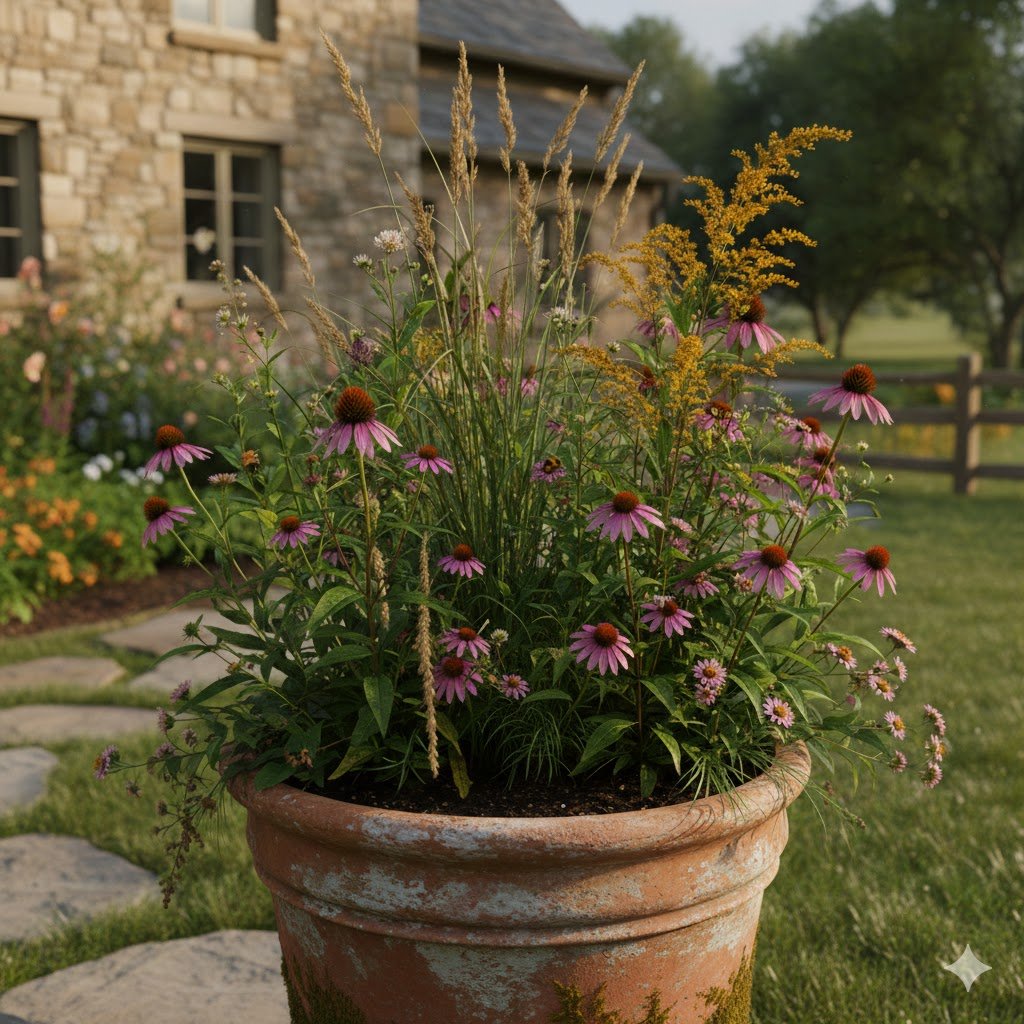
Finally, let’s talk about “native plant gardening.” You can do this in pots! Using native wildflowers in containers is a great way to support local bees and butterflies while still keeping the “messy” look of a meadow contained and tidy.
I love using Purple Coneflower (Echinacea) or Black-Eyed Susans in large wooden barrels. They are tough as nails, they don’t need fancy soil, and the pollinators go absolutely wild for them. It’s like having a tiny nature documentary happening on your front porch.
Search for “native plants for containers [Your State].” Using plants that actually belong in your climate means less watering and zero worrying about “fussy” behavior. They want to be there.
The bonus? At the end of the season, you can leave the dried seed heads on the plants. They look “rustic” and provide food for birds during the winter. I used to be obsessed with “deadheading” everything, but now I leave the coneflowers alone so the goldfinches have something to snack on. It’s a win-win for everyone.
Real Talk: What’s Not Worth Your Time?
Before you go out and buy twenty pots, let’s get real about what fails.
First, small pots are a trap. Anything smaller than 10 inches in diameter will dry out before you finish your morning coffee. Unless you’re doing a fairy garden, go big or go home. I have a graveyard of tiny “cute” pots in my shed that I will never use again because they are impossible to keep hydrated.
Second, cheap plastic “terracotta-look” pots usually look cheap. They fade in the sun and turn a weird chalky pink after one season. If you want the terracotta look, either buy the real clay (and accept it might crack) or invest in high-quality resin that is UV-resistant.
Third, don’t skip the drainage. If a pot doesn’t have a hole in the bottom, it’s a decorative “sleeve,” not a planter. I once planted a beautiful arrangement in a “pot” that didn’t have a hole, a big rainstorm hit, and my plants literally drowned in a standing pool of water within 48 hours. If you love a pot without a hole, get a drill and a masonry bit and make one.
Parting Wisdom from the Dirt
Curb appeal isn’t about having the perfect lawn; it’s about creating a welcoming “vibe.” Planters are the easiest, most flexible way to do that. Start with two big ones by the door and see how it feels. You don’t have to do all fifteen ideas at once!
What’s the biggest “plant fail” you’ve ever had on your front porch? Tell me your horror stories in the comments—I promise I’ve probably done something worse! If you need help picking a specific plant for a shady corner or a windy spot, just ask. I’m happy to help you avoid my old mistakes.

About Syprose Kiche
Syprose Kiche is the creator and writer behind My Besuited Home, a practical home and garden website covering DIY projects, gardening, lawn care, landscaping, home improvement, and outdoor living. She focuses on turning everyday homeowner questions into clear, practical guides backed by careful research and useful real-world considerations.