

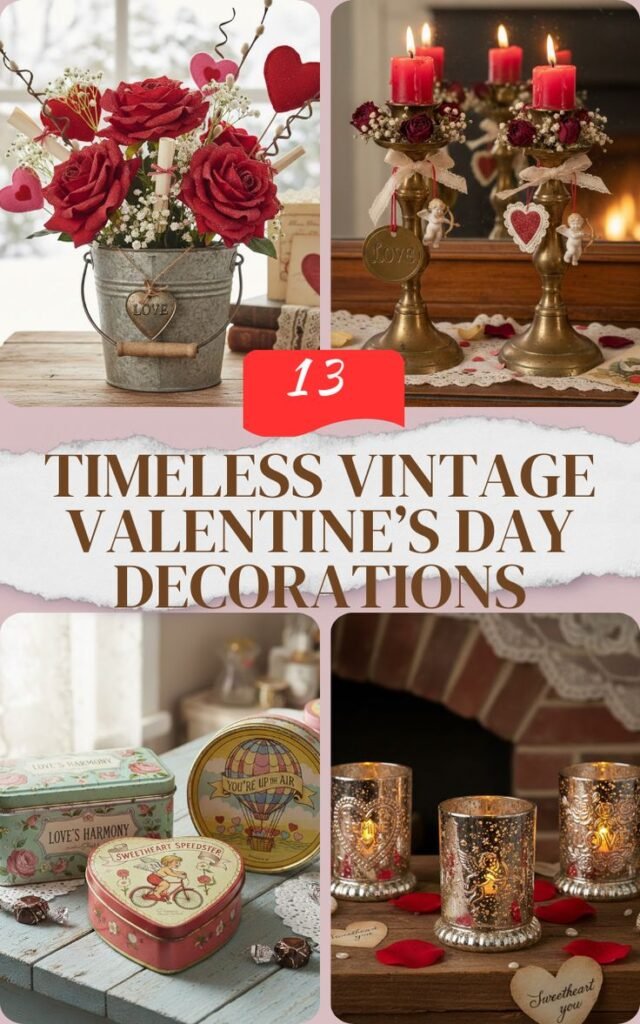
I’ll be the first to admit it: I am a sucker for nostalgia. There is just something about the soft patina of a weathered postcard or the delicate clink of pink Depression glass that makes my heart skip a beat. While modern decor is sleek and fun, it often lacks the “soul” that comes with vintage pieces. If you want your home to feel like a warm hug this February, you’ve come to the right place.
The “Coquette” and “Grandmacore” aesthetics are taking over our feeds for a reason. We are all craving a bit of slowness and sentimentality. This year, I’m skipping the neon plastic hearts from the big-box stores and leaning into a classic, “shabby chic” vibe. We’re talking creamy whites, faded reds, tattered lace, and Victorian-era charm.
In this guide, I’ve put together 13 of my favorite vintage Valentine’s decorations that will transform your space into a romantic retreat. These aren’t just things you buy; they are pieces that tell a story. Whether you are a seasoned thrifter or just starting your collection, these ideas are practical, affordable, and undeniably beautiful.
Let’s explore the dusty bins of history and find some treasures!
13 Timeless Vintage Valentine’s Day Decorations to Fall in Love With
1. Honeycomb Paper Hearts
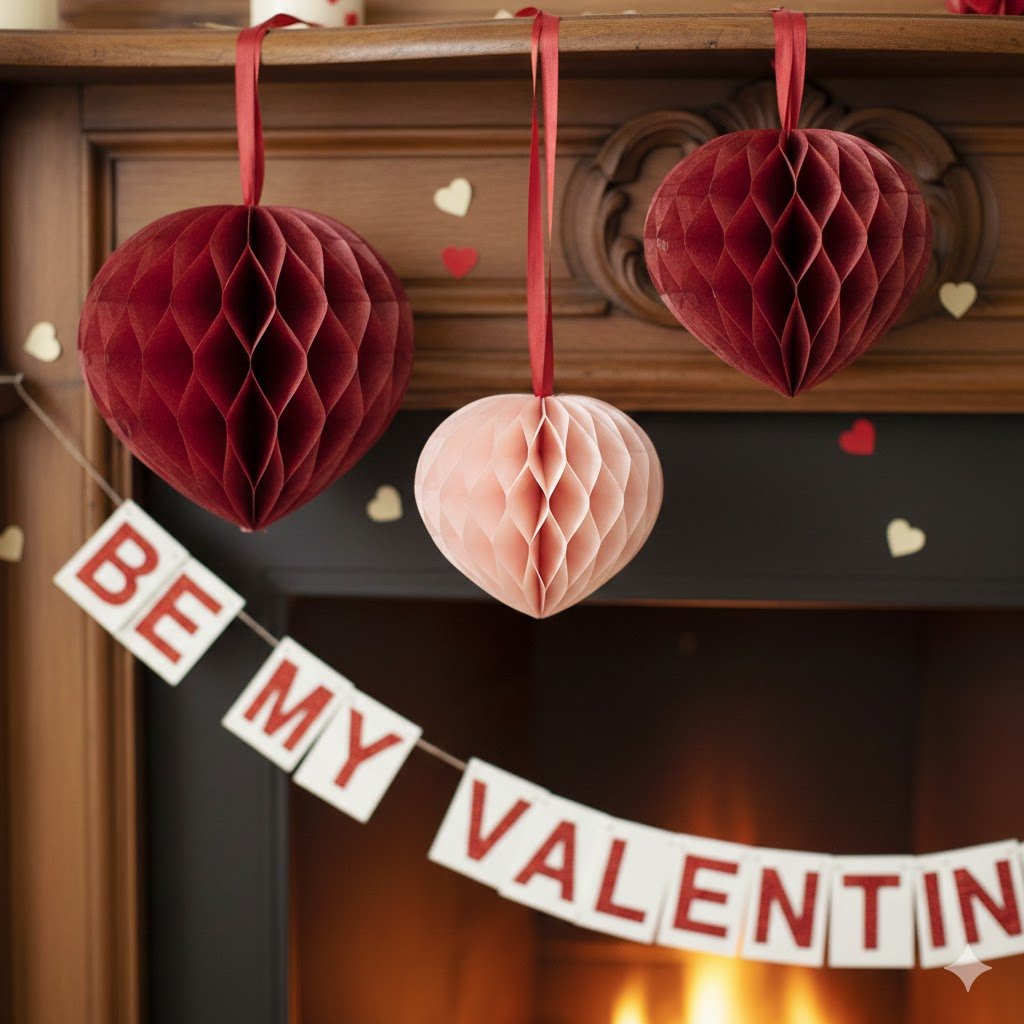
If you grew up in the mid-20th century, or even if you just love 1950s aesthetic, you know exactly what I’m talking about. Honeycomb paper decorations are those accordion-style tissue paper shapes that pop open and clip together. They have a certain mathematical beauty to them, and when they catch the light, they glow with a soft, diffused color.
I love these because they are incredibly lightweight. You don’t need heavy-duty nails or hardware to display them; a bit of baker’s twine or even some clear scotch tape will do the trick. They come in every shade of red, pink, and white imaginable. The vintage ones often have a slightly “muted” tone because the paper has aged, which actually makes them look more expensive and sophisticated.
To style these effectively, don’t just put one on a table. I recommend stringing them across a mantel at varying lengths. This creates a “waterfall” effect that draws the eye upward and makes your ceiling feel higher. You can also hang them in a window so they dance in the breeze whenever the heater kicks on.
If you are lucky enough to find original 1950s honeycomb hearts at an antique mall, grab them! They often have charming scalloped edges or even little glitter accents that modern reproductions just can’t mimic. Just be careful when opening them, as the old glue can be brittle. A tiny paperclip is often better than the built-in adhesive strips for these older pieces.
Finally, consider the scale. Using a mix of tiny 3-inch hearts and giant 12-inch hearts adds depth to your display. It turns a simple decoration into a full-blown art installation. It’s a low-cost way to make a high-impact statement in your living room or dining area.
2. Victorian Scraps & Decoupage
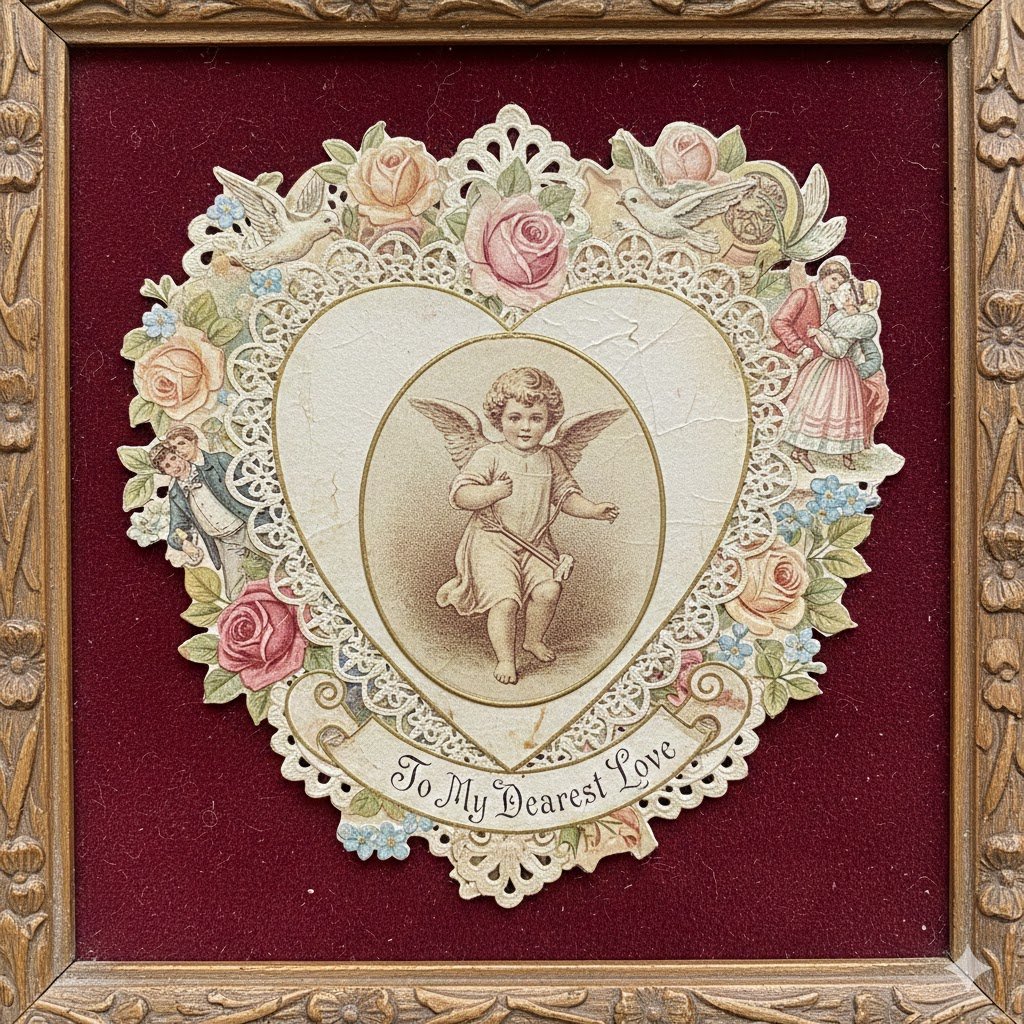
Long before we had digital stickers, people in the late 1800s used “scraps.” These were beautifully embossed, colorful paper cutouts used for scrapbooking and decorating. They usually featured cherubs, birds, flowers, and intertwined hearts. They are the epitome of Victorian romance—intricate, lush, and deeply sentimental.
I find that using authentic Victorian scraps adds a layer of history that you just can’t get from a printer. You can find these at paper ephemera shows or on sites like Etsy. They usually have a soft, velvety texture and colors that feel rich but grounded. They represent a time when Valentine’s Day was treated with the utmost gravity and artistic flair.
One of my favorite DIY projects is to create a “scrap” shadow box. You take a vintage wooden frame, line the back with some tea-stained linen, and use tiny foam adhesives to “float” the paper scraps inside. This gives them a 3D effect that looks like a museum exhibit. It’s a great conversation piece for an entryway or a guest bathroom.
If you aren’t ready to commit to a shadow box, try decoupage. You can apply these scraps to a plain wooden heart or even the lid of a jewelry box using a bit of matte Mod Podge. The key is to layer them. Start with a lace background, add a floral scrap, and finish with a tiny “To My Sweetheart” sentiment. It’s a meditative process that results in a one-of-a-kind heirloom.
Remember, the goal with Victorian decor is “more is more.” Don’t be afraid of the flourishes. The scrolls, the gold gilding, and the intricate die-cuts all work together to create a sense of opulence. It’s the perfect antidote to the “sad beige” minimalism that has been popular lately.
3. Depression Glass in Pink & Amber
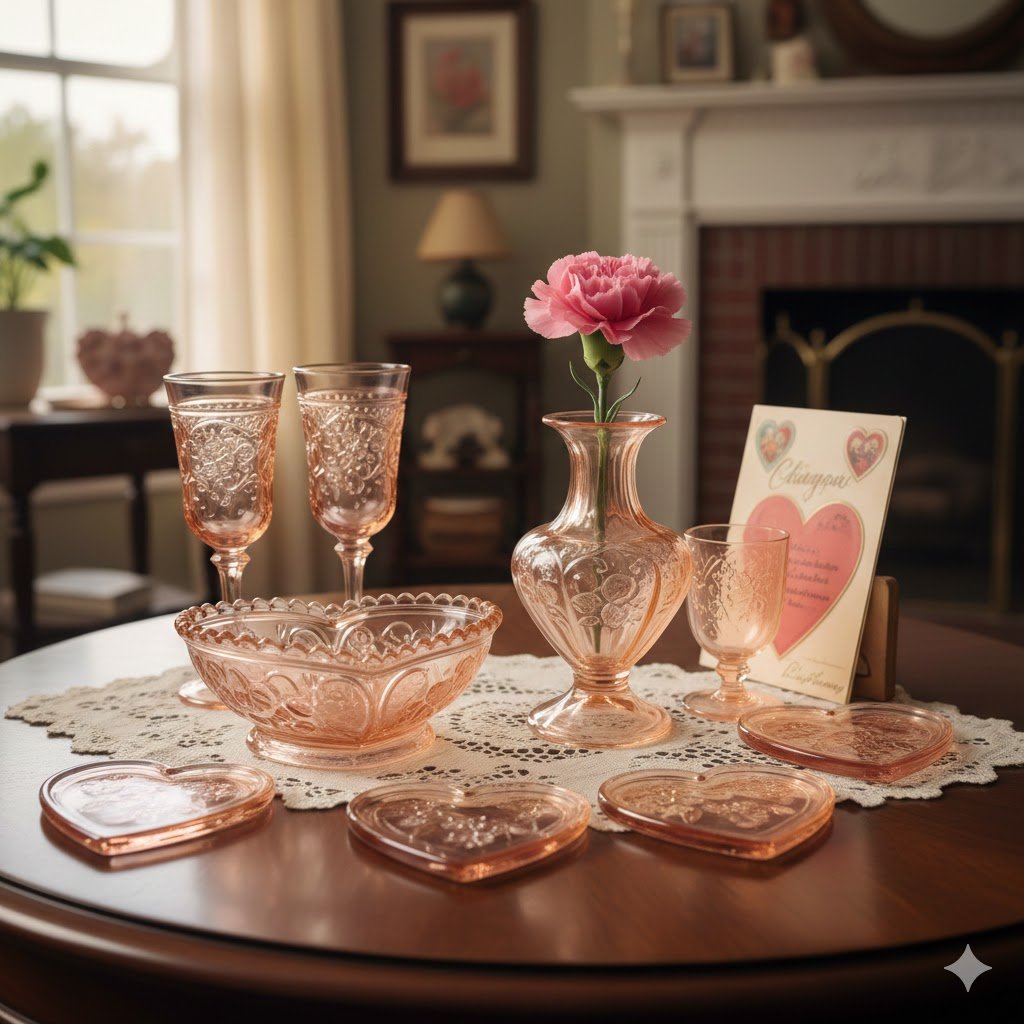
During the 1930s, glass companies started producing colorful, patterned glassware that was often given away in boxes of oatmeal or at movie theaters. Today, collectors (like me!) hunt for “Pink Depression Glass” with a fervor. There is something magical about the way pink glass warms up a room. It feels like golden hour, even on a cloudy February morning.
When you are setting a Valentine’s table, pink glass is your secret weapon. You don’t need a full set of 12; even just two wine glasses or a single serving platter can anchor the whole look. The patterns—like “American Sweetheart” or “Mayfair”—feature delicate etchings of roses and scrolls that fit the holiday perfectly.
I often use a pink glass pitcher as a vase. Instead of bright red roses, which can look a bit harsh against the pink, I opt for dried baby’s breath or white carnations. The transparency of the glass allows you to see the stems, which adds to the natural, “collected” feel of the arrangement. It’s simple, elegant, and very 1930s.
Another trick is to use amber-colored glass alongside the pink. The warm orange-brown of the amber mimics the look of candlelight and keeps the pink from looking too “saccharine” or babyish. This combination feels sophisticated and “adult vintage.” Place them on a white linen tablecloth, and you’ve got a scene straight out of a classic film.
If you’re worried about the cost, keep an eye out at thrift stores. While some patterns are pricey, you can often find “orphan” plates or saucers for just a few dollars. These are perfect for serving a single chocolate truffle or a slice of strawberry cake. It’s the little details that make a vintage Valentine’s Day feel special.
4. Antique Postcard Displays
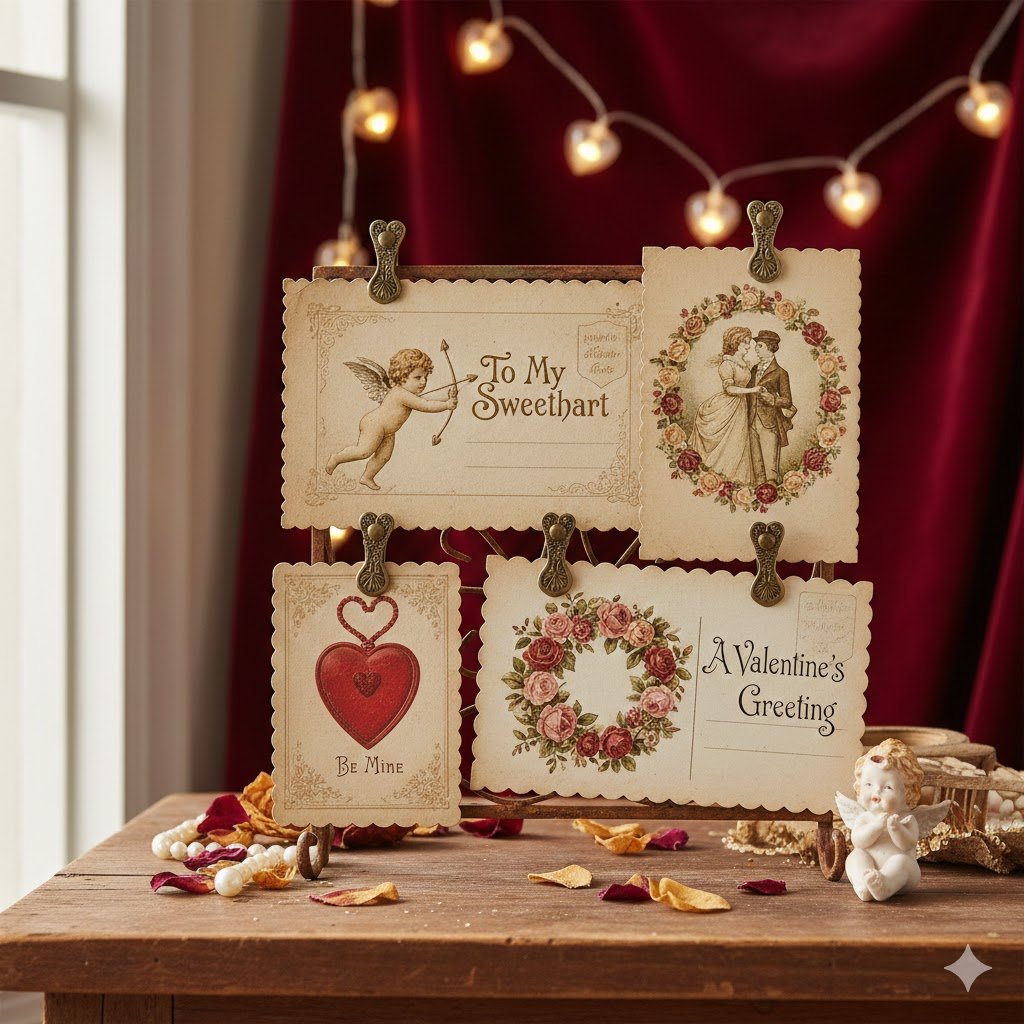
Back in the early 1900s, people didn’t just send text messages; they sent postcards with stunning lithography and heartfelt, handwritten notes. I love collecting these because of the “hidden” history on the back. Seeing a message like “To my dearest Clara, from your devoted Arthur, 1912” adds a layer of real-world romance to your decor.
Displaying these postcards is an art in itself. You don’t want to just tack them to a wall with putty. Instead, look for vintage “flower frogs”—those heavy lead or glass spiked discs used for flower arranging. You can slip a postcard between the metal pins, and it will stand upright on a shelf. It’s a sturdy and stylish way to show off the artwork.
Another fun idea is to use a vintage brass clip or a clothespin on a string. I like to hang a “laundry line” of postcards across a mirror in the hallway. As people walk by, they can see the beautiful front illustrations, and if the mirror is positioned right, they might even catch a glimpse of the cursive handwriting on the back.
If you have a particularly beautiful postcard, consider framing it in a double-sided glass frame. This allows you to flip it over whenever you want to read the message. It protects the fragile paper from oils on your hands while turning a 25-cent find into a piece of legitimate wall art.
When searching for postcards, look for “embossed” ones. These have a raised texture that you can feel with your fingers. They were the “premium” cards of their day and often featured vibrant colors and even silk inserts. They are small, but they pack a huge punch in terms of vintage personality.
5. Tattered Lace Table Runners
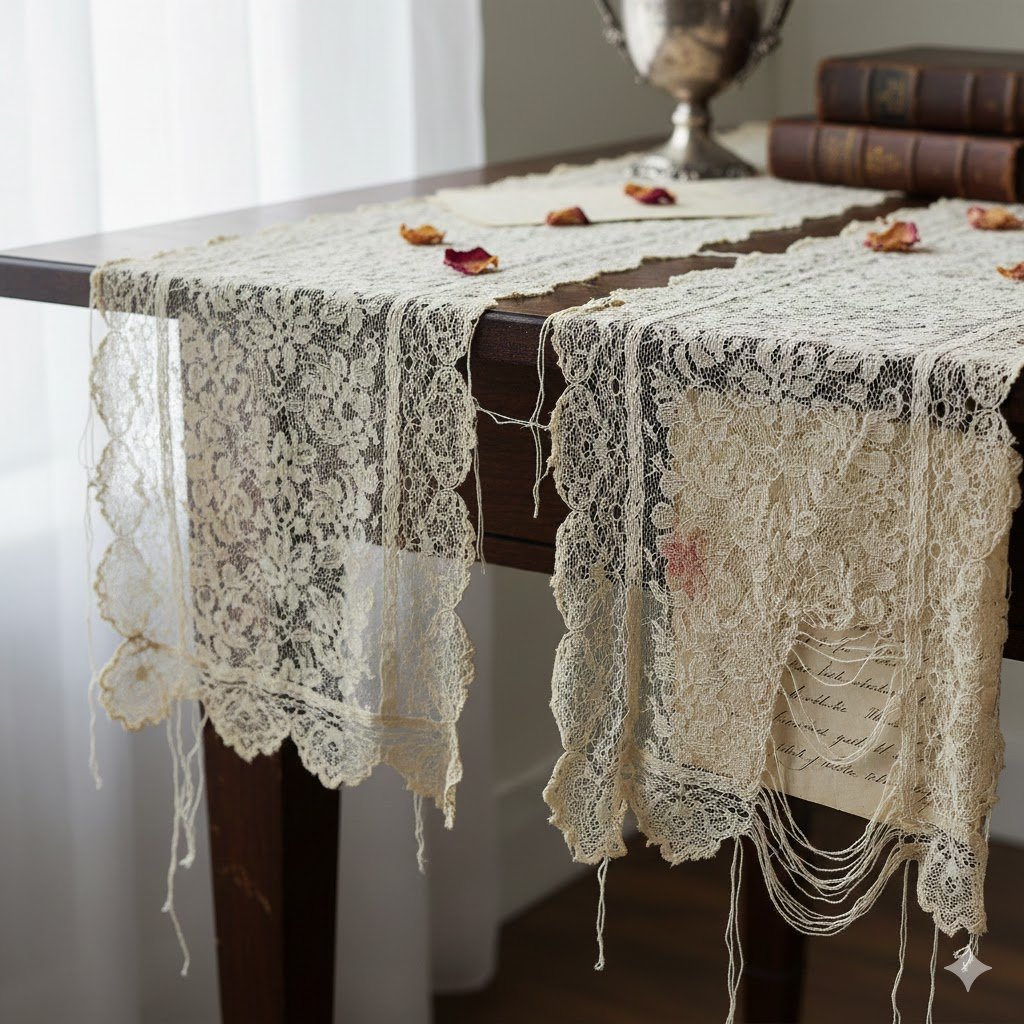
Texture is the unsung hero of vintage decorating. While a plastic tablecloth is easy to clean, it doesn’t have the “soul” of a hand-crocheted lace runner. I look for pieces that have a bit of history—maybe a few loose threads or a slight yellowing that proves they’ve seen many dinner parties over the decades.
Lace adds a softness to the home that balances out hard surfaces like wooden dining tables or marble countertops. For Valentine’s Day, I prefer “eyelet” lace or heavy “Venetian” lace. These patterns are more defined and look beautiful when layered over a darker color, like a deep red or a rustic burlap.
Don’t worry if you find a piece of lace that has a small stain or a hole. In the world of vintage decor, we call that “character.” You can strategically place a vase of flowers or a candle holder over the blemish. The goal is to make the home feel lived-in and loved, not perfect and sterile.
I also love using lace in unexpected places. Try draping a small lace doily over the back of an armchair or using a lace ribbon to tie back your curtains. It filters the sunlight in a way that creates beautiful, intricate shadows on the floor. It’s like living inside a Victorian lace-making shop.
If you’re feeling crafty, you can even dye vintage lace. A quick dip in some hibiscus tea or a very diluted red fabric dye will give the lace a “blush” tint. This keeps the vintage feel but aligns it perfectly with a Valentine’s color palette. It’s an easy way to customize your finds.
6. Vintage Wood Alphabet Blocks
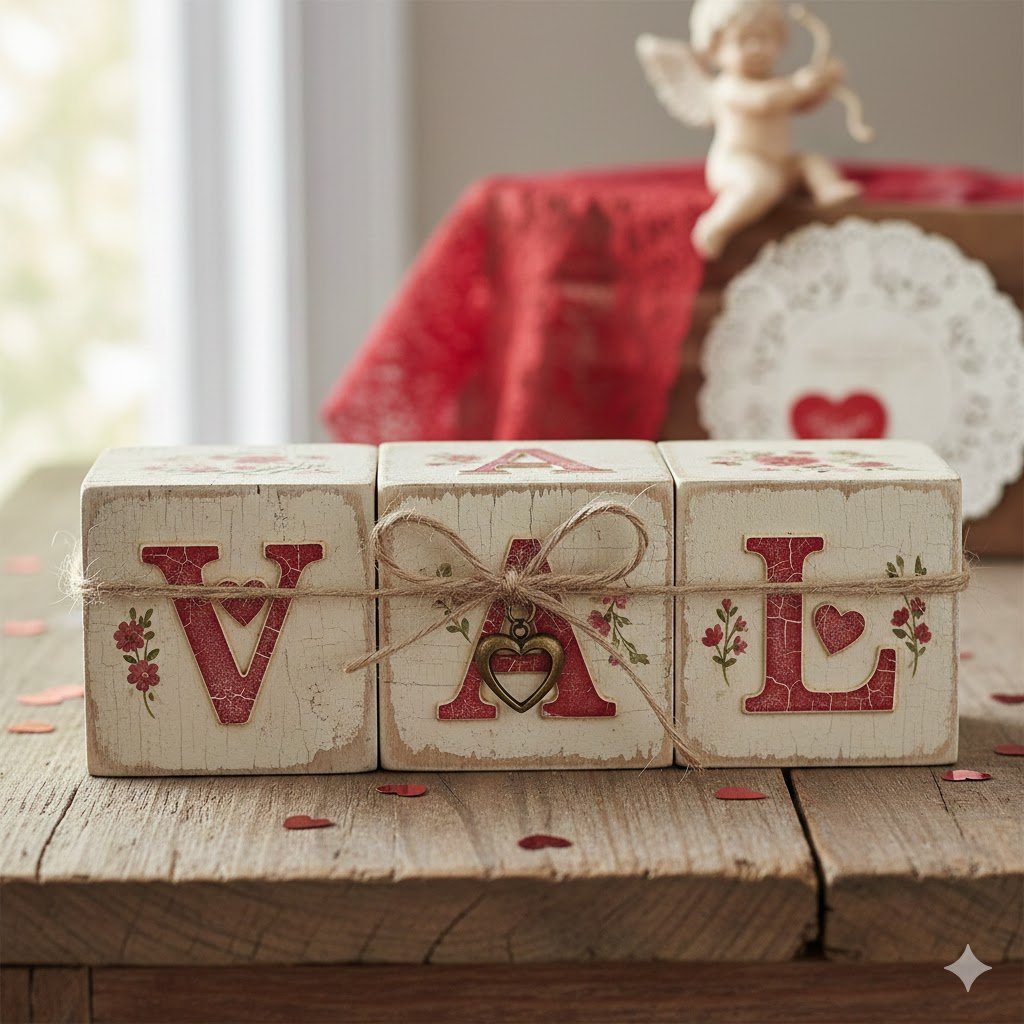
There is something inherently nostalgic about old wooden blocks. They remind us of childhood, simplicity, and the building blocks of love. For Valentine’s Day, I hunt for blocks from the 1940s or 50s that have that classic primary color palette or faded pastels. They add a playful, “toy box” charm to a bookshelf.
The most obvious way to use these is to spell out holiday-themed words. “LOVE,” “XOXO,” “KISS,” or “MINE” are all easy four-letter options. I like to nestle these among my books or place them on the mantel next to a clock. It’s a subtle nod to the holiday that doesn’t feel too “over the top.”
If you can find blocks with different fonts or colors, mix them up! A “mismatched” look is actually more “vintage” than a perfectly uniform set. It looks like you’ve collected them over time from different sets. This adds to the “shabby chic” vibe we are going for.
For a more creative display, try stacking them vertically in a glass apothecary jar. It keeps them contained and turns them into a colorful column of “love.” You can even mix in some red marbles or small wooden hearts to fill the gaps. It’s a great way to add height to a side table display.
I’ve also seen people drill tiny holes in the top of the blocks and insert a wire to hold a photo. Imagine a vintage block spelling “LOVE” while holding a black-and-white photo of your grandparents. It’s a powerful way to honor the legacy of love in your family.
7. Galvanized Metal Florist Buckets
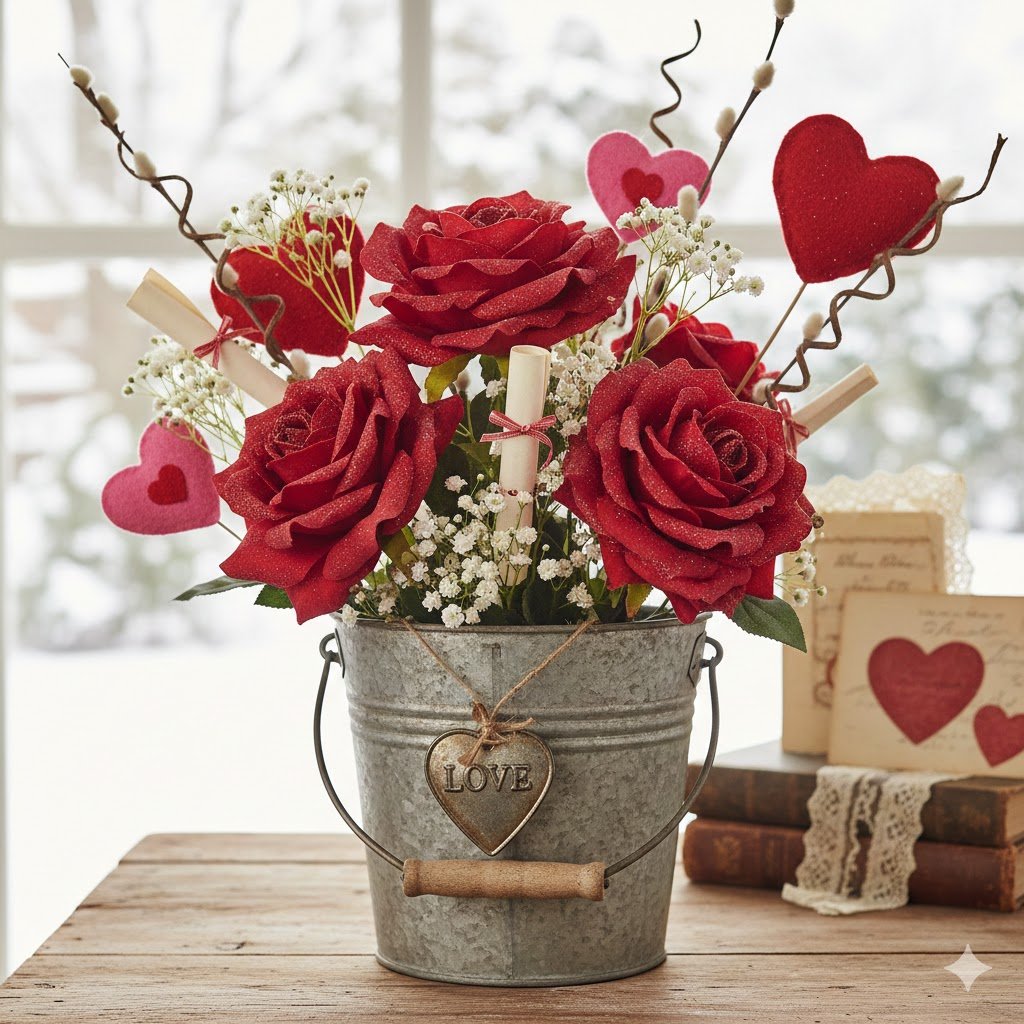
Nothing says “I love you” like flowers, but instead of a modern glass vase, try using a galvanized metal bucket. These buckets were once the workhorses of French flower markets and local nurseries. They have a rugged, industrial feel that provides a perfect “masculine” balance to the “feminine” lace and pink glass.
The silvery-gray patina of galvanized metal makes red flowers look incredibly vivid. If you put a bunch of deep red tulips or “Black Magic” roses in a metal bucket, the colors will pop in a way they wouldn’t in a clear vase. It feels effortless and “farmhouse chic.”
To make this work indoors, you’ll need to make sure the bucket is watertight. Many old buckets have tiny pinholes in the bottom from rust. I usually just hide a plastic quart container or a glass jar inside the bucket to hold the water and the stems. This keeps your furniture safe while maintaining the aesthetic.
If you have a large bucket, place it on the floor in the entryway. Fill it with long branches of pussy willow or dried eucalyptus. You can then hang a few of those honeycomb paper hearts we talked about earlier from the branches. It creates a “Valentine’s Tree” that greets everyone as they walk through the door.
For a smaller version, look for “sap buckets” or small metal pails. These are great for holding a bundle of dried lavender on a bedside table. The smell is relaxing, and the look is pure vintage country. It’s a simple, low-maintenance way to bring the holiday into every room of the house.
8. Retro Tin Candy Boxes
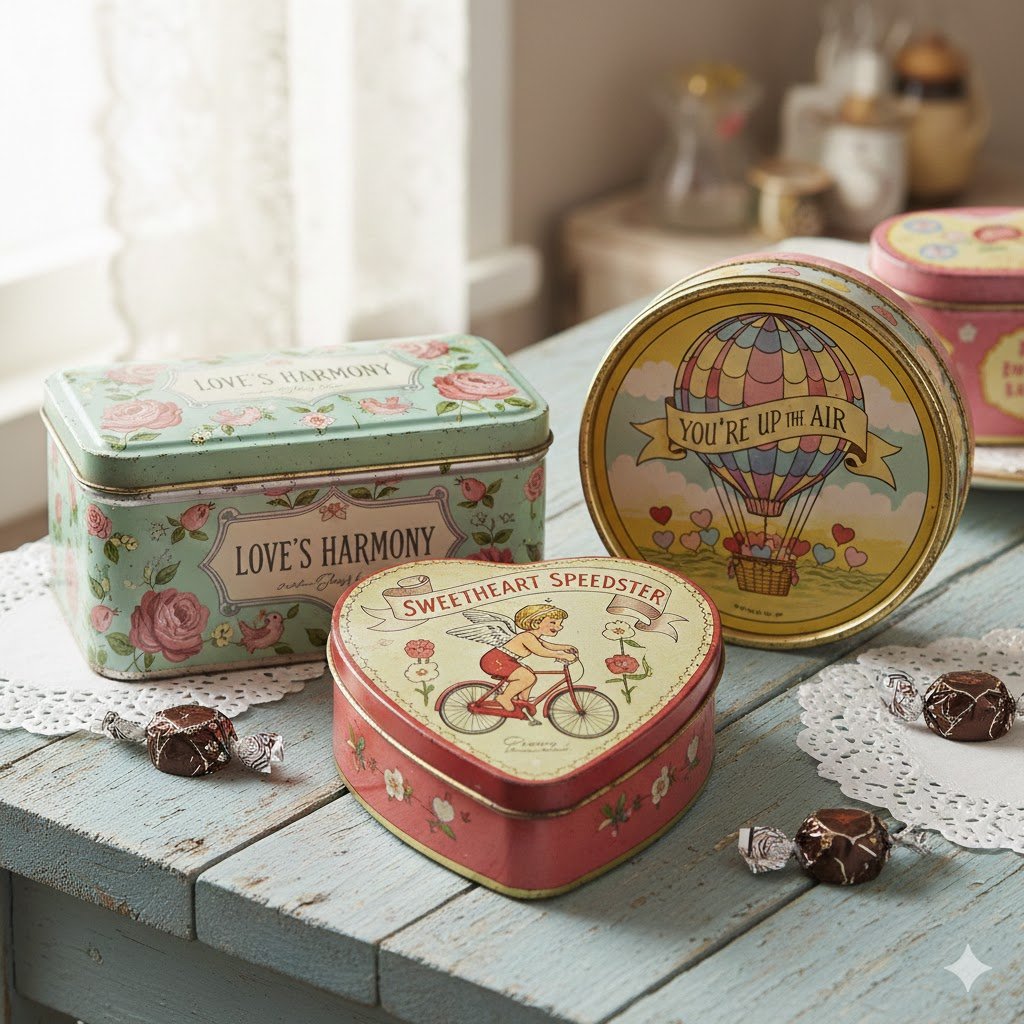
Before everything came in plastic bags, candy was a luxury sold in beautiful tin boxes. Brands like Whitman’s, Hershey’s, and Brach’s used to compete for the most beautiful Valentine’s tin. These are fantastic because they are both decorative and functional.
I love to stack three or four tins of varying sizes on an entryway table. The largest goes on the bottom, and the smallest on top. It creates a pyramid of vintage graphics. You can use the top tin to hold your keys or outgoing mail. It’s a “working” piece of decor that looks like a curated collection.
The graphics on these tins are often incredible. You’ll find illustrations of elegant couples, 1950s housewives, or classic floral arrangements. The colors are usually deep reds and golds, which feel very festive. Even if the tin has a few scratches, that just adds to its history.
If you are hosting a Valentine’s party, use these tins to serve actual treats! Line them with a bit of parchment paper and fill them with heart-shaped cookies or homemade fudge. It’s a much more charming presentation than a modern plastic platter, and your guests will love looking at the vintage designs.
Don’t limit yourself to just “Valentine” specific tins. Any old red or white tin—like an old tobacco tin or a tea canister—can work. As long as it fits the color scheme, it will contribute to the overall vintage vibe. It’s all about the “mix” rather than the “match.”
9. Hand-Stitched Quilts (Red and White)
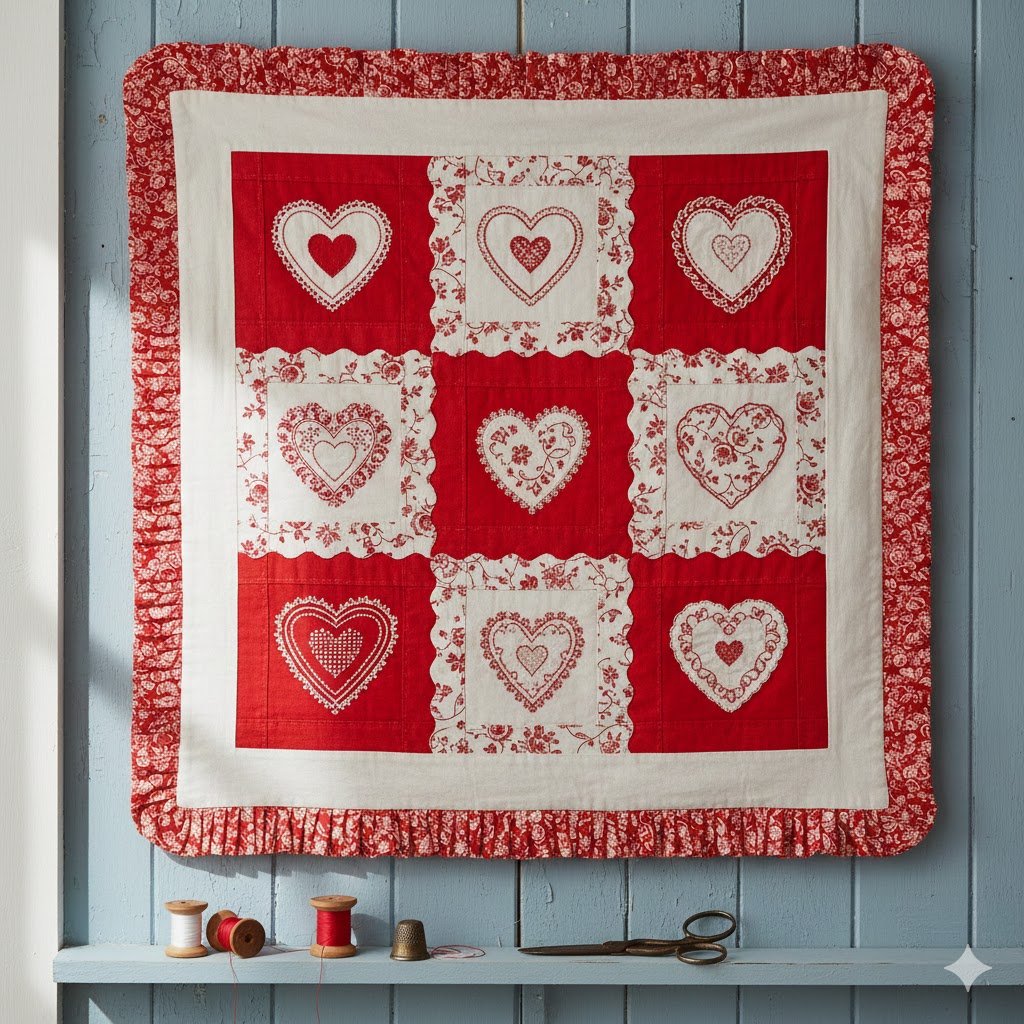
A quilt is the ultimate symbol of a cozy home. For February, I specifically look for “Two-Color Quilts” in red and white. These were very popular in the late 19th and early 20th centuries. Whether it’s a “Sawtooth Star” or a “Heart” pattern, a red and white quilt is a bold, graphic statement.
Draping a quilt over the back of your sofa instantly changes the mood of the room. It softens the furniture and makes the space feel ready for a movie night. If you have a white sofa, a red quilt will make the room feel vibrant and energetic. If you have a dark sofa, it adds a much-needed pop of brightness.
If you don’t want to use a full-sized quilt, look for “quilt squares” or “crib quilts.” You can frame a single beautiful square and hang it on the wall like a piece of art. It’s a great way to preserve a damaged vintage quilt that might be falling apart in other areas.
I also love using a quilt as a makeshift “rug” for a cozy indoor picnic. Spread it out on the floor, add some pillows, and serve some wine and cheese. It’s a romantic, vintage-inspired date night that costs nothing but feels incredibly special.
When washing vintage quilts, be very careful! Always use a gentle cycle with cold water and a mild detergent. Better yet, hand wash them in the bathtub. Never put them in the dryer; air drying is the only way to ensure the old threads don’t snap. Taking care of these pieces ensures they’ll be around for many more Valentine’s Days to come.
10. Mercury Glass Votives
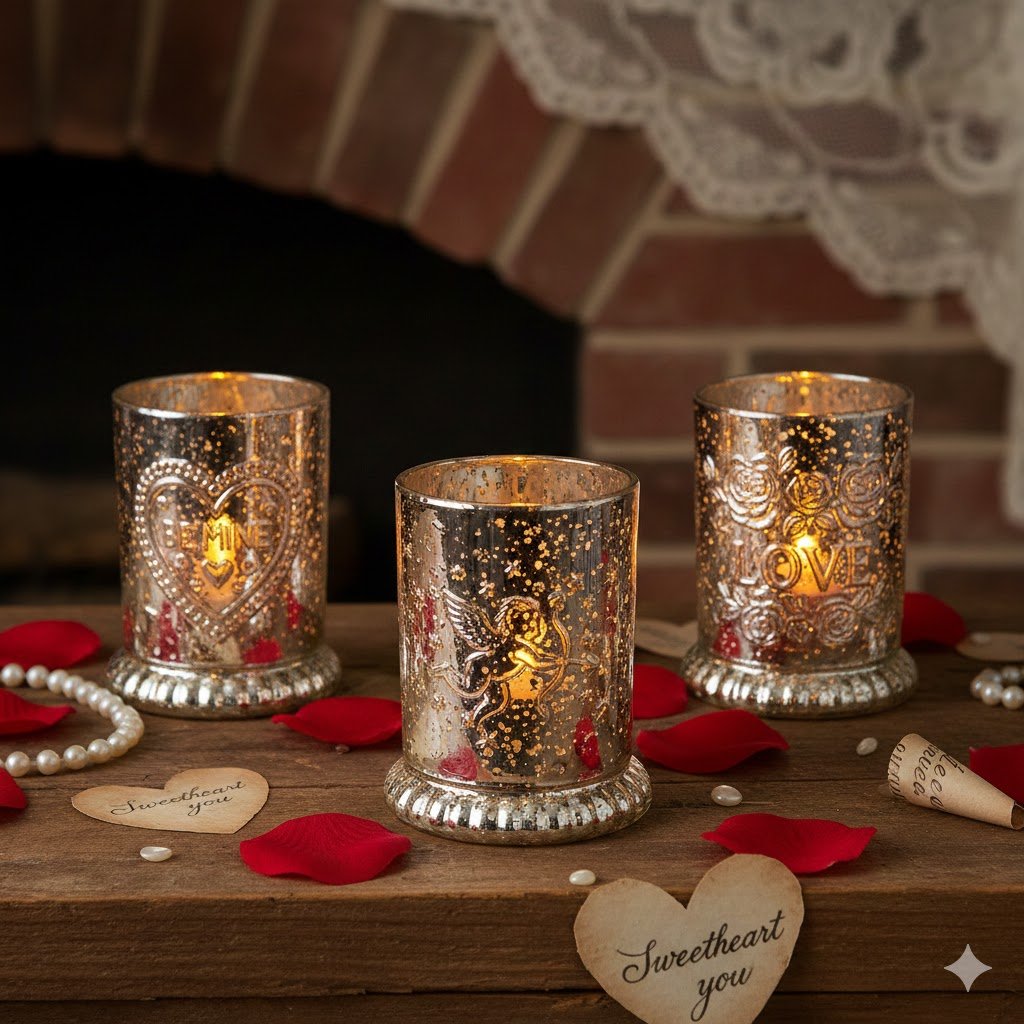
Mercury glass (or “silvered glass”) has a speckled, metallic finish that looks like it’s been aged by time. It was originally created in the mid-1800s as a cheaper alternative to real silver. Today, it’s prized for the way it reflects candlelight in a soft, “broken” pattern.
For Valentine’s Day, I like to scatter mercury glass votives all over the house. I put them on the mantel, the dining table, and even the bathroom vanity. When you light a candle inside, the light peeks through the “thinned” areas of the silvering, creating a magical, starry effect.
You can find mercury glass in silver, gold, and even pink or red. I recommend sticking to the silver or pink for a Valentine’s look. The silver reflects the red of your other decorations, while the pink adds a soft, rosy glow to everyone’s skin (it’s very flattering lighting for a romantic dinner!).
Try grouping three or five votives of different shapes together on a silver tray. This creates a “cluster” of light that acts as a centerpiece. You don’t need expensive candles; even simple tea lights will look high-end when placed inside mercury glass.
If you can’t find authentic vintage mercury glass, there are many “faux” versions available today. To make them look more “real,” you can lightly mist the inside with a bit of vinegar and water to encourage a little bit of patina. But if you can find the real deal at an antique shop, the weight and the “glow” are incomparable.
11. Framed Sheet Music
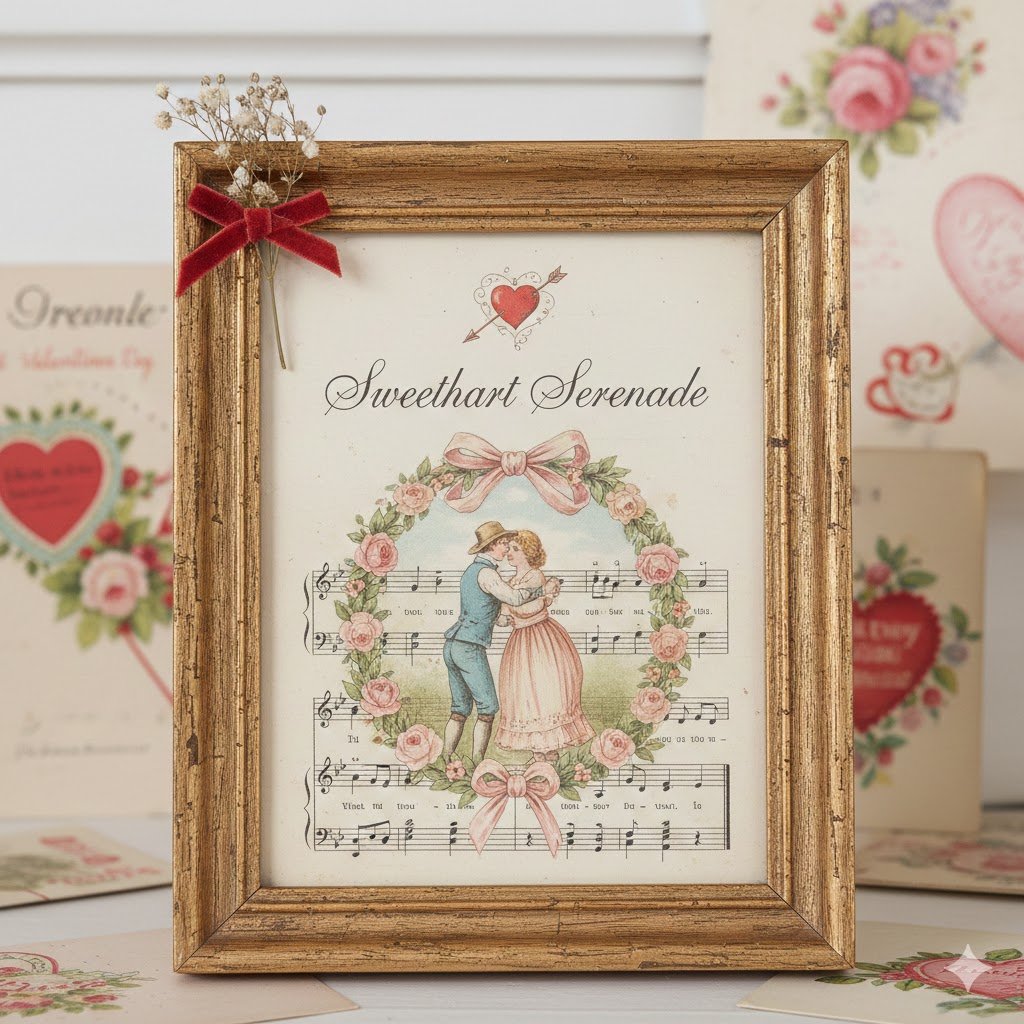
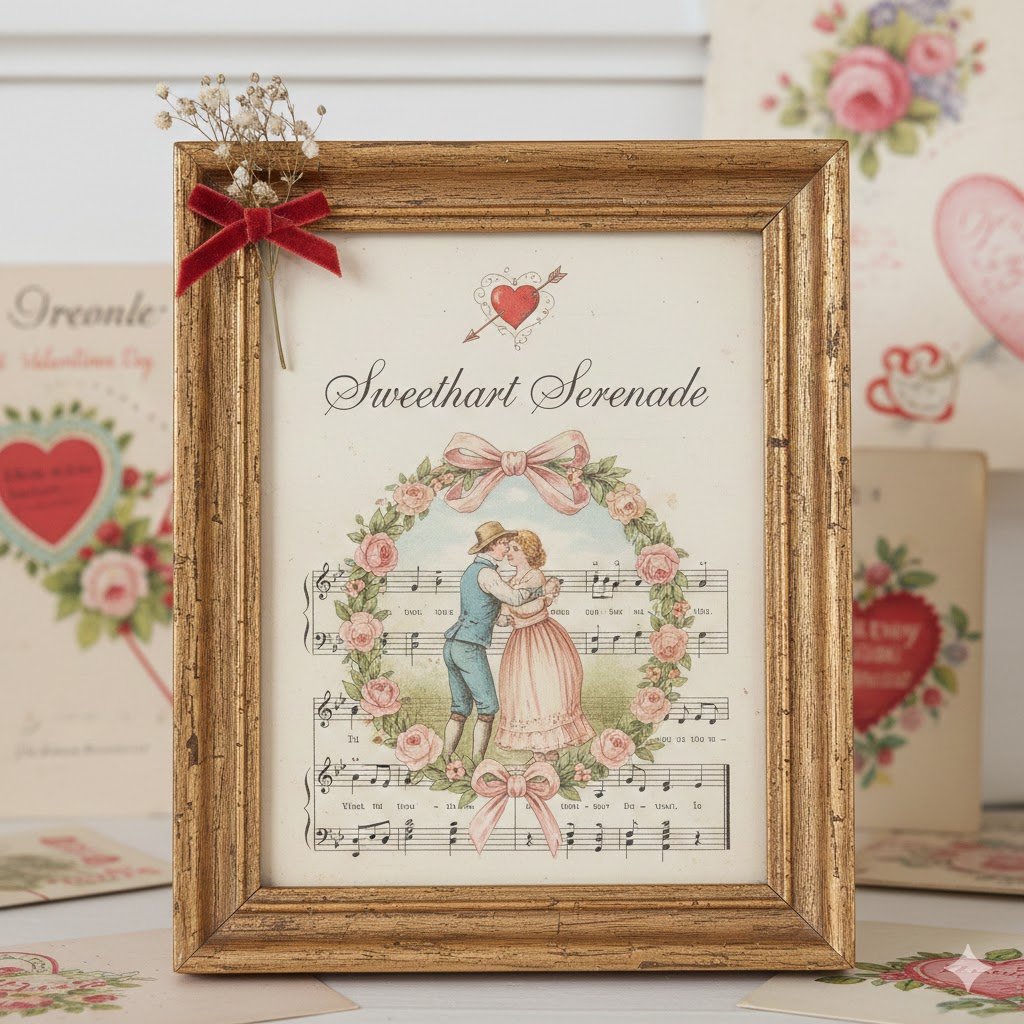
Music is the language of love, and vintage sheet music is a work of art. Before the digital age, people bought “sheet music” for the latest radio hits to play on their pianos at home. These covers were often illustrated with beautiful, romantic scenes and elegant typography.
Look for songs with titles like “Let Me Call You Sweetheart,” “Always,” or “My Funny Valentine.” The paper is usually a beautiful “ivory” or “parchment” color that feels very warm. I like to find sheets from the 1920s through the 1940s for the best illustrations.
Framing these is an easy and inexpensive way to fill a large wall space. You can buy cheap frames from a thrift store, paint them a matte black or a soft cream, and pop the music inside. It’s a sophisticated way to celebrate the holiday without using a single heart-shaped item.
If the sheet music is too damaged to frame, don’t throw it away! You can use it as gift wrap for a small Valentine’s present. Tie it with a red velvet ribbon, and you have the most beautiful gift under the sun. You can also cut the music into heart shapes and use them as “place cards” for a dinner party.
I’ve also seen people use vintage sheet music to make “paper roses.” It takes a bit of practice with a hot glue gun, but the result is a bouquet that will never die and carries the lyrics of a love song on every petal. It’s the ultimate “Grandmacore” craft project.
12. Milk Glass Vases
Milk glass is that opaque, “creamy” white glass that was ubiquitous in the 1950s. Brands like Fenton and Westmoreland made everything from candy dishes to elaborate vases in this style. It has a “clean” look that feels vintage but still works perfectly in a modern home.
The reason milk glass works so well for Valentine’s Day is the contrast. When you put bright red roses or pink peonies in a stark white milk glass vase, the colors look much more intense. It’s a very “graphic” look that draws the eye immediately.
I like to collect the “hobnail” pattern—the one with the little bumps all over the surface. It adds a lot of visual interest and texture. You can line up three small milk glass “bud vases” in a row down the center of your table, each with a single red stem. It’s simple, balanced, and very chic.
Don’t forget about milk glass bowls! You can fill a large milk glass compote with red apples or even those conversation heart candies. The white background makes the colors of the candy pop, and the weight of the glass makes it feel like a substantial piece of decor.
Milk glass is also incredibly easy to find at thrift stores and garage sales for just a few dollars. It’s one of the most accessible vintage “collectibles” out there. Just give it a good scrub with some warm soapy water, and it will look brand new—even if it’s 70 years old.
13. Thrifted Brass Candlesticks
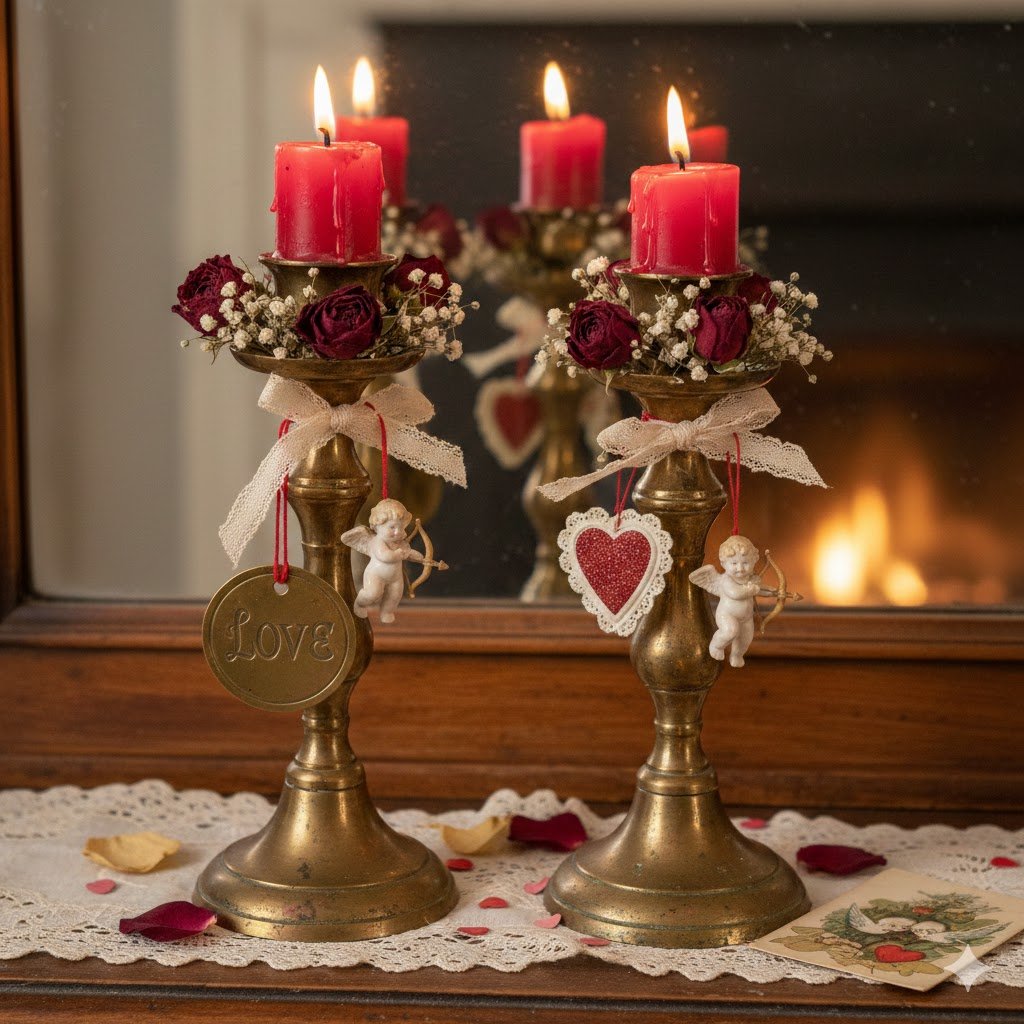
Finally, no vintage Valentine’s setup is complete without brass candlesticks. Brass adds a “warmth” that silver or chrome just can’t match. It feels grounded, historical, and deeply romantic. The way the gold-tone metal reflects the flicker of a flame is the definition of “mood lighting.”
The trick to making brass candlesticks look “curated” rather than “cluttered” is to vary the heights. I look for a mix of short, medium, and tall sticks. When you group them together, it creates a “skyline” of light that feels very intentional.
For Valentine’s Day, don’t just use white candles. Try dark “oxblood” red or even a soft “dusty rose.” Beeswax tapers are my favorite because they have a natural, sweet scent and a beautiful matte texture. They burn slower and drip less than cheap paraffin candles, too.
If your brass is too shiny and looks “new,” you can actually age it! A little bit of salt and vinegar can speed up the tarnishing process, giving it that dark, “antique” look in just a few hours. Personally, I like a bit of a “middle ground”—a little shine, but plenty of character.
Place your brass candlesticks on a mantel or a sideboard. Surround the base with some of that “tattered lace” we mentioned earlier, and maybe a few “Victorian scraps.” You’ve now created a “vignette”—a little scene that tells a story of romance and history.
How to Style Your Vintage Finds
Now that you have your 13 items, how do you put them all together? The key is balance. You don’t want your house to look like an antique shop that exploded. Pick one “hero” area, like your mantel or your dining table, and go all-out there. For the rest of the house, just add small “nods” to the theme.
- Start with a Neutral Base: Use white linens or wooden surfaces to let the vintage colors shine.
- Layer Textures: Put the metal bucket on the lace runner; put the paper heart next to the brass candlestick.
- Use Odd Numbers: Items always look better grouped in 3s or 5s.
- Height Matters: Use blocks or tins to lift smaller items so everything isn’t on the same level.
Wrap Up
Vintage decorating is about the “hunt” and the “heart.” It’s about finding pieces that resonate with you and giving them a new life. This Valentine’s Day, I hope you find joy in the “old” and create some “new” memories in the process.

About Syprose Kiche
Syprose Kiche is the creator and writer behind My Besuited Home, a practical home and garden website covering DIY projects, gardening, lawn care, landscaping, home improvement, and outdoor living. She focuses on turning everyday homeowner questions into clear, practical guides backed by careful research and useful real-world considerations.