
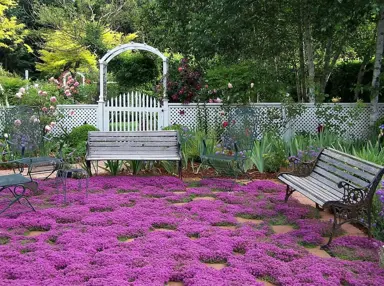
I’ll be honest: I used to spend my Saturday mornings in a state of mild resentment toward my lawnmower. It was loud, it smelled like gasoline, and it felt like I was pouring money and water into a green rectangle that didn’t give much back. That frustration eventually led me to a garden center where I discovered creeping thyme—a resilient, fragrant, and stunningly purple alternative to the traditional suburban monoculture.
If you’re tired of the “mow, water, repeat” cycle, switching to a thyme lawn might be the best gardening decision you ever make. But it’s not a magic fix; it requires a bit of strategy to get right.
The Pros: Why I’m Obsessed with Thyme
The first time I walked across a fully bloomed thyme path, the scent was incredible—like a savory, earthy perfume. That’s just the “surface level” benefit. Here is why people are making the swap:
- You Can Retire Your Mower: Creeping thyme generally stays under two or three inches tall. You might give it a quick “haircut” once a year after the flowers fade, but the weekly grind is over.
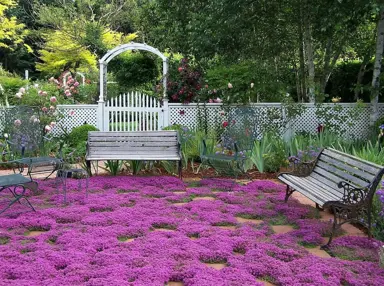
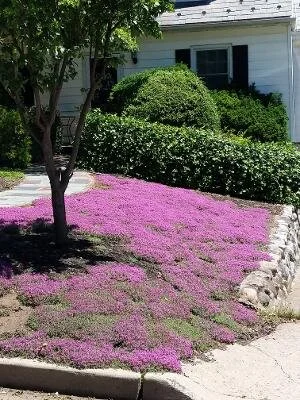
- The “Flower Carpet” Effect: For a few weeks in early summer, your yard transforms into a solid sheet of purple, pink, or white. It looks like something out of a fairy tale.
- Drought Resistance: Traditional grass is a thirsty crop. Once thyme roots are established, they are remarkably efficient at finding water. My water bill dropped noticeably after the first year.
- A Win for the Bees: While my neighbors have “sterile” yards, my lawn is a buzzing, living ecosystem. It’s a vital pit stop for local pollinators.
The Cons: The “Not-So-Pretty” Reality
I’m a big fan of transparency, and creeping thyme isn’t perfect for every situation. Before you rip up your sod, keep these things in mind:
- The “Wait” Period: Grass seed grows fast. Thyme does not. It takes a season or two to fully knit together into a dense mat. In the meantime, you’ll see some bare dirt.
- The Weeding Battle: Because thyme grows in “clumps” initially, weeds will try to invade the gaps. Since you can’t use standard “weed and feed” (which kills broadleaf plants like thyme), you’ll be doing some manual weeding for the first few months.
- The Price Tag: If you have a massive half-acre lot, planting thyme plugs can get expensive. It’s often better to start with a smaller “test” section or a courtyard.
Choosing Your Variety
Not all thyme is created equal. You want a variety that stays low to the ground:
- Red Creeping Thyme: This is the showstopper. It has dark green leaves and vivid magenta flowers.
- Woolly Thyme: This one has soft, silvery-gray foliage. It feels amazing on bare feet but doesn’t handle heavy foot traffic as well as the others.
- Elfin Thyme: The “slow and steady” option. It’s incredibly tight and low, making it perfect for filling gaps between stepping stones.
How to Plant Your New Lawn
I’ve tried starting from seed and starting from plugs. Go with plugs. Seeds are tiny and easily washed away by rain. Here is the play-by-play:
1. Prep the Ground
Don’t just throw thyme onto existing grass; it will lose the fight for nutrients. You need to clear the area entirely. I recommend the “cardboard method” (smothering the grass) or a simple sod cutter.
2. Check Your Drainage
Thyme hates “wet feet.” If your soil is heavy clay, mix in some organic compost or fine grit to help it drain. If water pools in your yard after a rain, you need to fix the leveling before planting.
3. The Spacing Game
Space your plugs about 6 to 12 inches apart. It looks sparse at first, I promise it will fill in. Dig a hole just deep enough for the root ball, tuck it in, and firm the soil around it.
4. The Critical First Month
Even though thyme is drought-tolerant, the babies are not. Water them lightly every day for the first two or three weeks until you see new growth. Once they’ve “settled in,” you can start backing off.
Maintenance and Care
The best part about a thyme lawn is that “maintenance” usually just means enjoying it. However, if it starts looking a little leggy or woody after a few years, you can run a mower over it on a very high setting after the blooms die off. This encourages the plant to push out fresh, soft green growth.
If you find a bare patch, don’t buy more plants! Just snip a few four-inch cuttings from a healthy section, strip the lower leaves, and stick them directly into the moist soil. They root incredibly easily.
Final Thoughts
A creeping thyme lawn is a shift in perspective. It’s a move away from the rigid, striped perfection of a golf course and toward something that feels more intentional and alive. It’s about spending your Sundays sitting in your yard rather than working on it. If you’re tired of the noise of a mower and the dullness of plain green grass, find a small corner of your property and give thyme a chance to grow on you.

About Syprose Kiche
Syprose Kiche is the creator and writer behind My Besuited Home, a practical home and garden website covering DIY projects, gardening, lawn care, landscaping, home improvement, and outdoor living. She focuses on turning everyday homeowner questions into clear, practical guides backed by careful research and useful real-world considerations.