
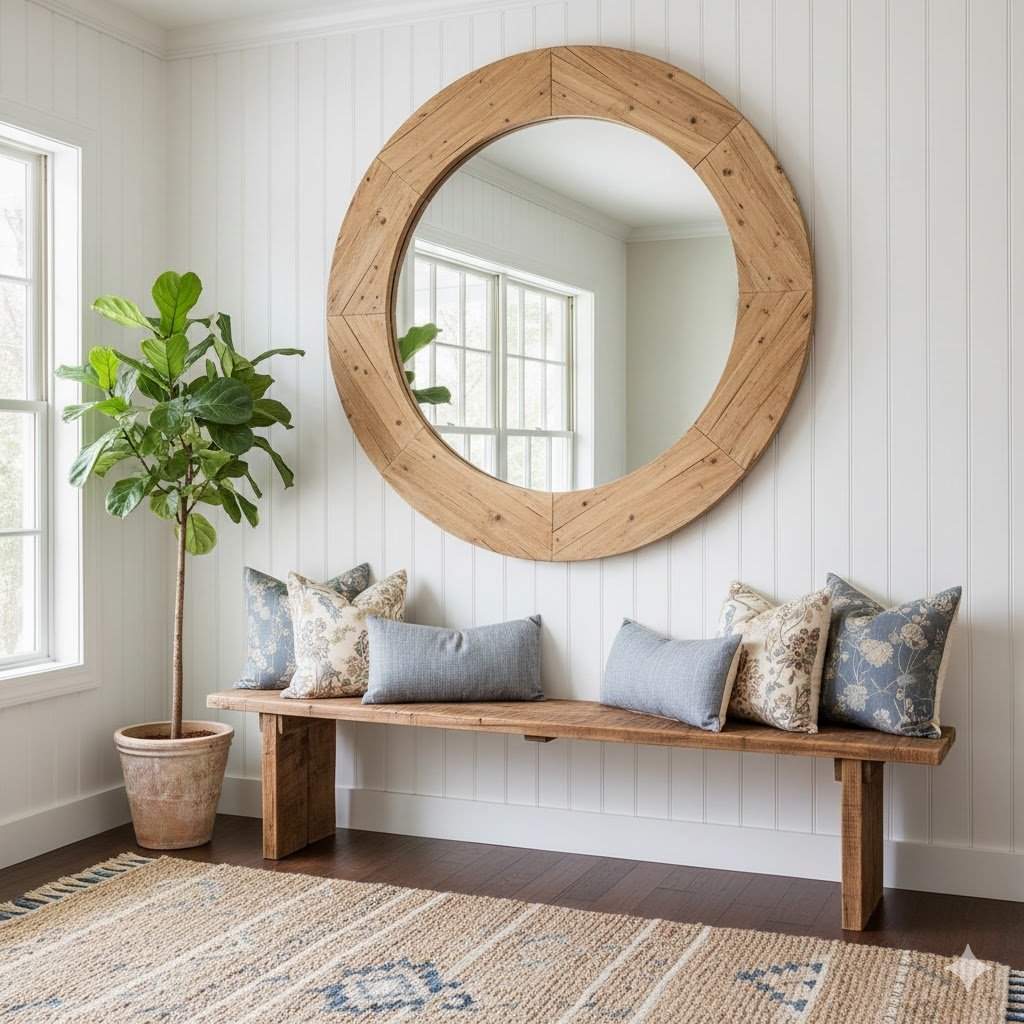
The entryway is arguably the hardest working space in any home. It’s the drop zone for muddy boots, the dumping ground for junk mail, and the frantic search area for lost keys. But beyond the chaos, it’s also the very first thing guests see when they walk through your door. I used to think that getting that crisp, inviting “Modern Farmhouse” look required a contractor and a budget rivaling a small car, but I’ve discovered that this specific aesthetic—with its blend of clean lines and rustic warmth—is actually one of the easiest to fake on a shoestring budget.
You don’t need expensive shiplap installation or custom-built furniture to make a statement. Modern farmhouse style is inherently practical and humble, which makes it the perfect candidate for DIY solutions. I’ve pulled together fourteen actionable projects that range from five-dollar styling hacks to weekend builds. These ideas focus on high impact and low cost, proving that a little sweat equity can completely transform the feeling of your home before you even step past the front door.
Category A: Wall Treatments (The Foundation)
1. The “Sharpie” Shiplap Wall
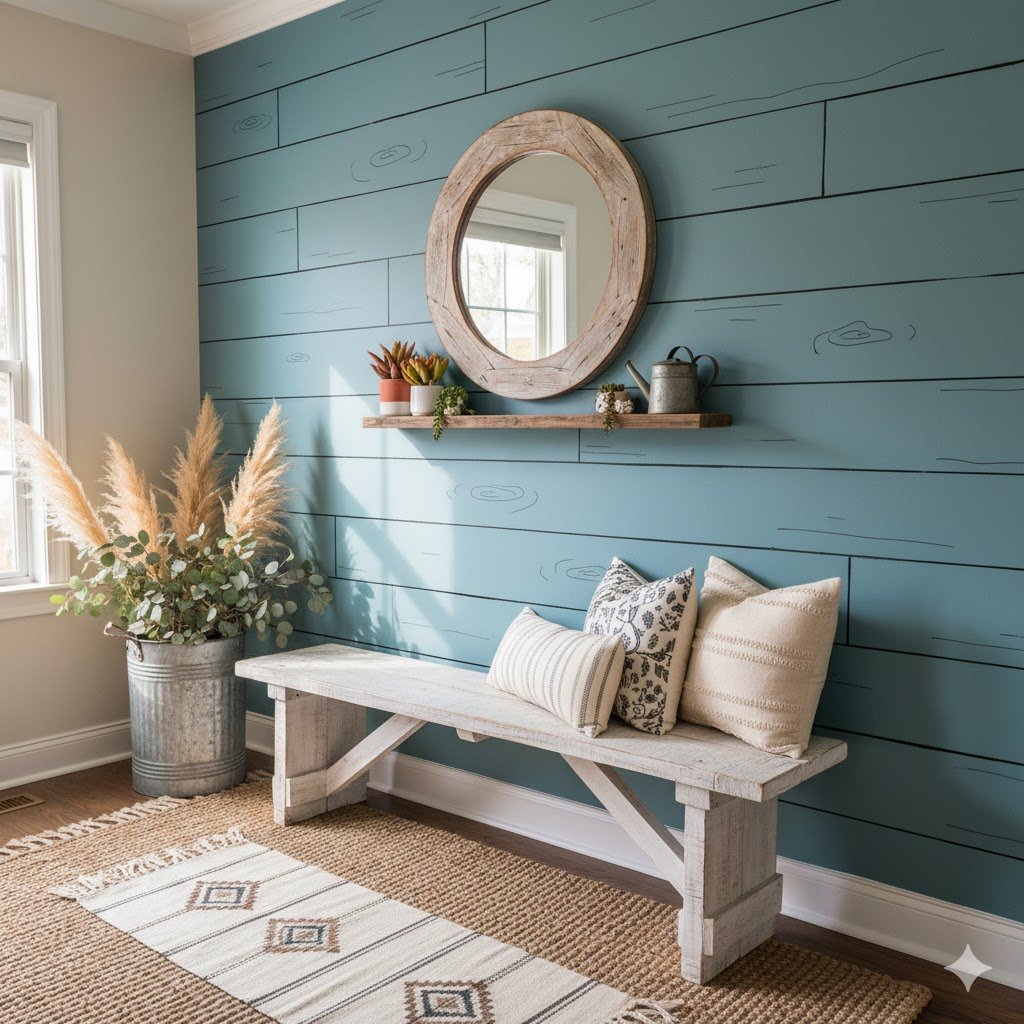
I admit, the first time I heard about drawing “planks” on a wall with a permanent marker, I thought it sounded ridiculous. But if you are renting or simply can’t afford the lumber prices for real wood cladding, this hack is a total game-changer. The concept is incredibly simple: you paint your wall a bright, crisp white, and then use a black permanent marker to draw horizontal lines that mimic the gaps between shiplap boards. From a foot away, your eye tricks you into seeing texture and depth that isn’t actually there.
To pull this off without it looking like a kindergarten project, you need a long level—the longer, the better. Start at the ceiling and work your way down, spacing your lines about six inches apart to mimic standard board widths. The key is to not overthink the line itself; a slight wobble or variation actually makes it look more like authentic, aged wood gaps rather than a sterile graphic. Just be sure to use a water-based marker if you think you’ll ever want to paint over it easily, though a good primer usually covers the permanent ink just fine.
This keeps the look strictly “Modern” Farmhouse rather than “Rustic Barn.” While traditional shiplap can feel heavy and textured, the Sharpie method keeps the wall completely smooth, which looks cleaner and more minimalist. It provides that horizontal visual interest that widens a narrow hallway without eating up a single inch of floor space or requiring you to navigate around outlets with a jigsaw.
2. DIY Board and Batten Grid
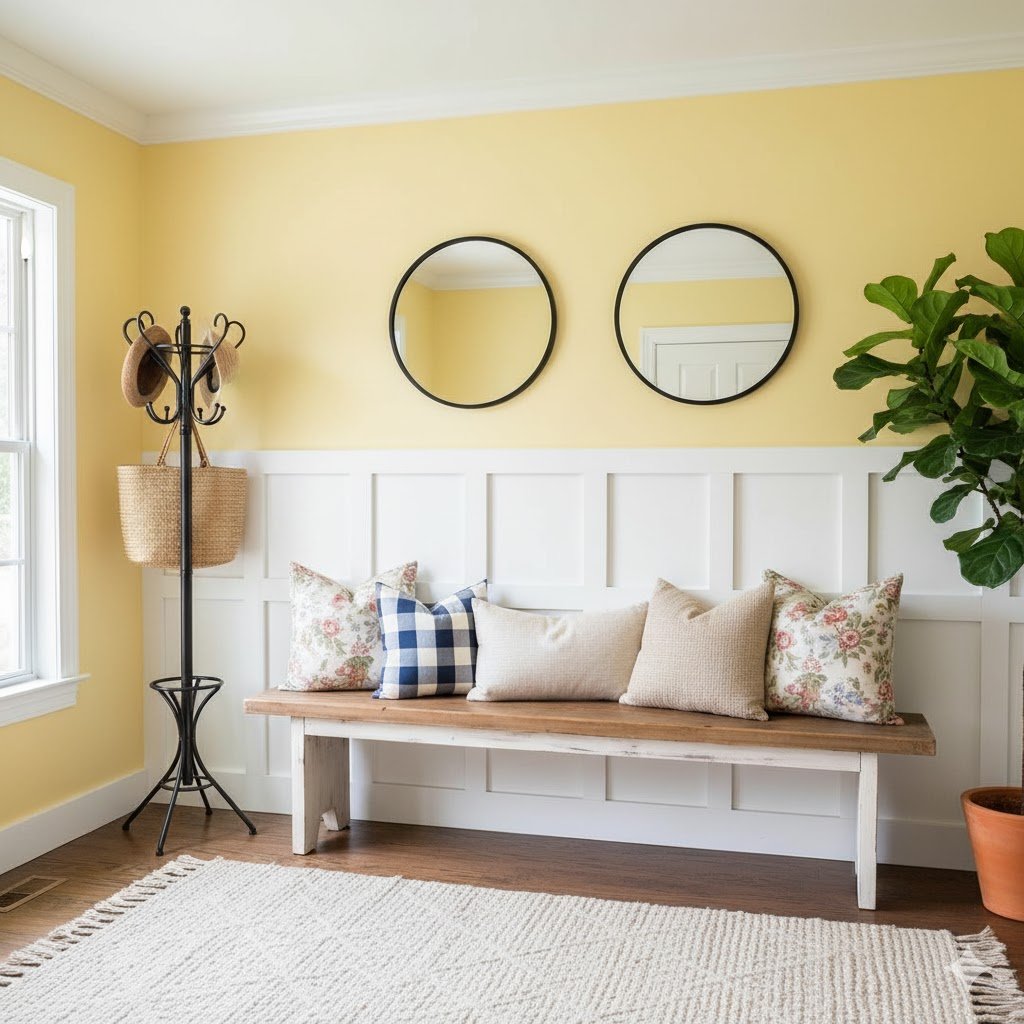
If drawing lines isn’t your thing and you want actual architectural dimension, a board and batten grid is the most accessible woodworking project for a beginner. This involves attaching thin vertical and horizontal strips of wood to your wall to create a geometric pattern. While traditional wainscoting uses thick, expensive lumber, you can achieve the exact same look using inexpensive lattice strips or ripped-down MDF boards found in the trim aisle of any hardware store.
The installation is surprisingly quiet and requires very few tools. I usually rely heavily on construction adhesive (Liquid Nails) to stick the lightweight boards to the drywall, using just a few brad nails to hold them in place while the glue dries. You can choose to do a half-wall to protect your paint from scuffs—perfect for high-traffic entryways—or go for a full floor-to-ceiling grid for a more dramatic, modern statement. The math of spacing the boards can be tricky, so cut a “spacer block” of wood to the exact width you want between battens and use it as a guide to ensure every square is identical.
The magic happens when you paint. Once your grid is up, caulk the seams where the wood meets the wall to make it look seamless, then paint the entire thing—wall, baseboards, and new trim—in a single color. A dark charcoal or moody green looks incredible here. By drenching the wall in one color, the cheap lattice strips suddenly look like expensive, custom millwork. It adds a shadow line and depth that flat paint just can’t achieve on its own.
3. Painted Interior Front Door
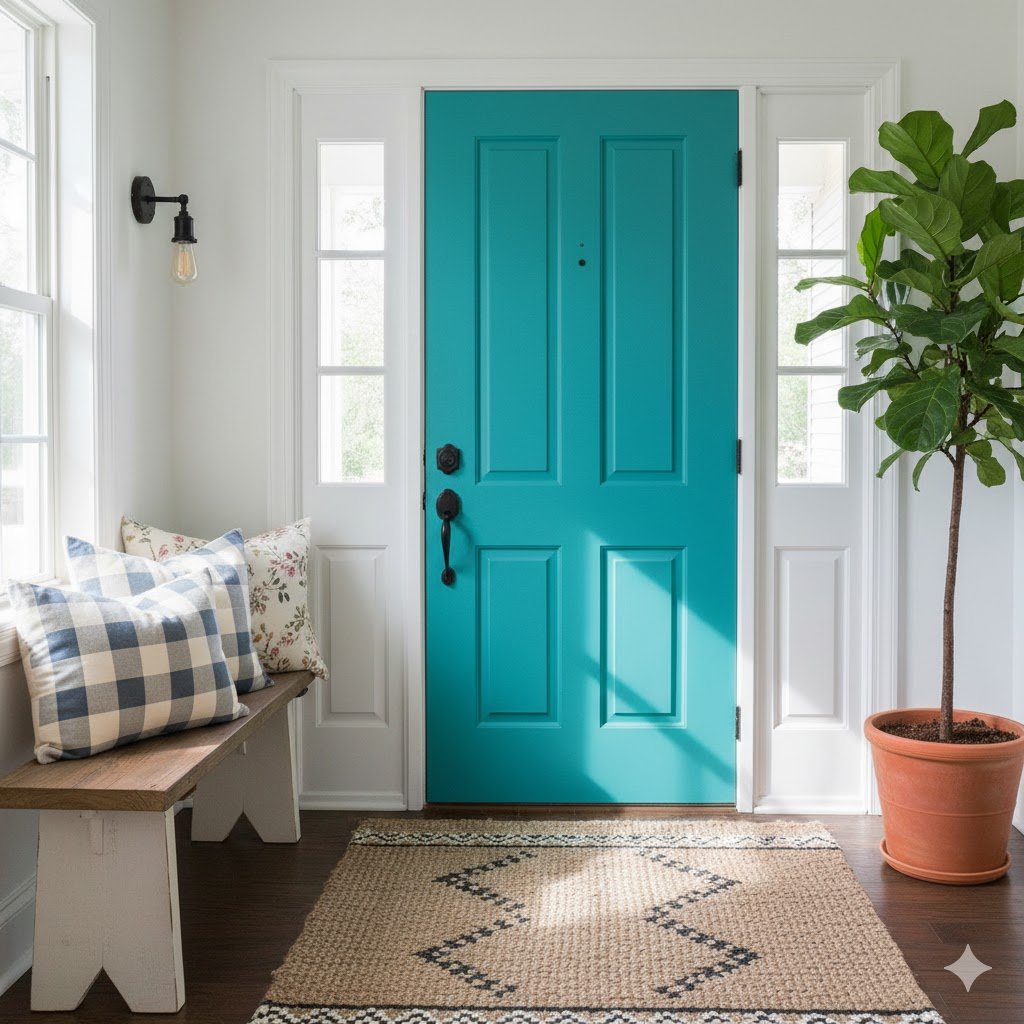
We often obsess over curb appeal and the color of the exterior door, but we forget that the inside of that door is a massive part of the entryway’s design. Leaving the interior door standard white is a missed opportunity to anchor the space. Painting the inside of your front door a bold, contrasting color like matte black or deep iron gray instantly creates a focal point. It frames the view of the outdoors and grounds the airy, white walls typical of farmhouse decor.
This is an afternoon project that requires little more than a quart of paint and a steady hand. You’ll want to tape off your windows and hardware carefully. I recommend using a high-quality sash brush for the recessed panels and a small foam roller for the flat surfaces to avoid brush strokes. If your door is metal or fiberglass, make sure you’re using a paint formulated for that surface so it doesn’t scratch off the first time someone kicks the door open with their grocery bags.
Beyond the aesthetic boost, this trick is incredibly practical for a busy family home. Entryway doors take a beating from dirty hands, dog paws, and shoe scuffs. A darker color hides the grime much better than white semi-gloss ever could. It adds a touch of sophistication and drama that makes the rest of your bright, neutral decor pop, acting as the “period” at the end of the design sentence.
Category B: Furniture Builds & Hacks
4. The $40 X-Brace Console Table
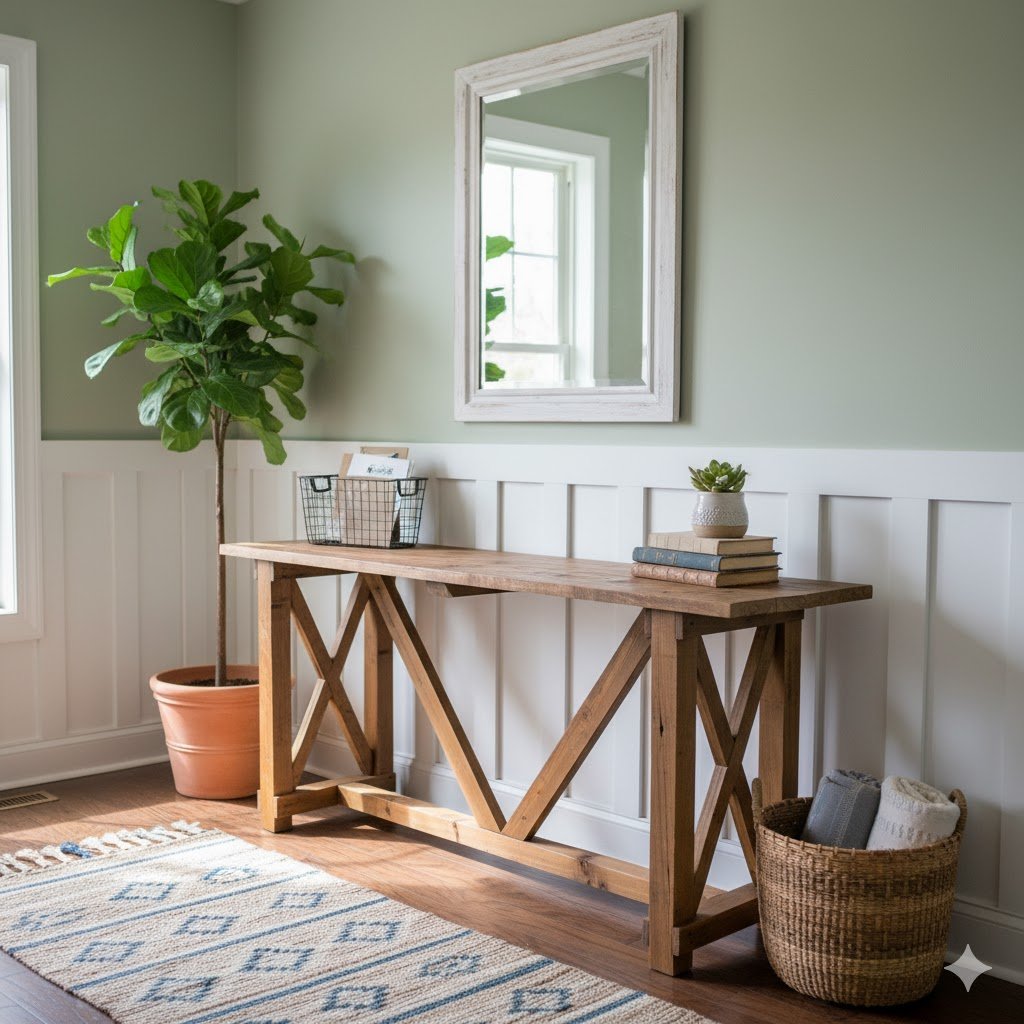
Every farmhouse entryway needs a landing strip for keys and mail, but retail console tables often run upwards of $200. You can build a classic X-brace table for a fraction of that using standard framing lumber. The design typically involves 2x4s for the legs and 2x6s or common boards for the top. The signature “X” on the sides gives it that barn-door aesthetic that defines the style, and the heavy, chunky wood makes it feel substantial and expensive.
You don’t need a fully equipped woodshop to do this. Most big-box hardware stores will make your major cuts for you if you bring in your measurements. Assembly is best done with a pocket-hole jig, which hides the screws on the underside of the wood, but simple wood screws and glue work fine if you countersink them and fill the holes with wood filler. The beauty of farmhouse furniture is that it doesn’t have to be perfect; a little roughness in the joinery just adds to the character.
To get that high-end finish, skip the paint and go for a wood stain. Colors like “Early American,” “Provincial,” or “Dark Walnut” provide that rich, historic tone that contrasts beautifully against white walls. Be sure to use a wood conditioner before staining soft woods like pine to prevent blotchiness. Seal it with a matte polyurethane to keep the look natural and raw, rather than shiny and lacquered, which keeps it firmly in the “modern” category.
5. Thrifted Bench Makeover
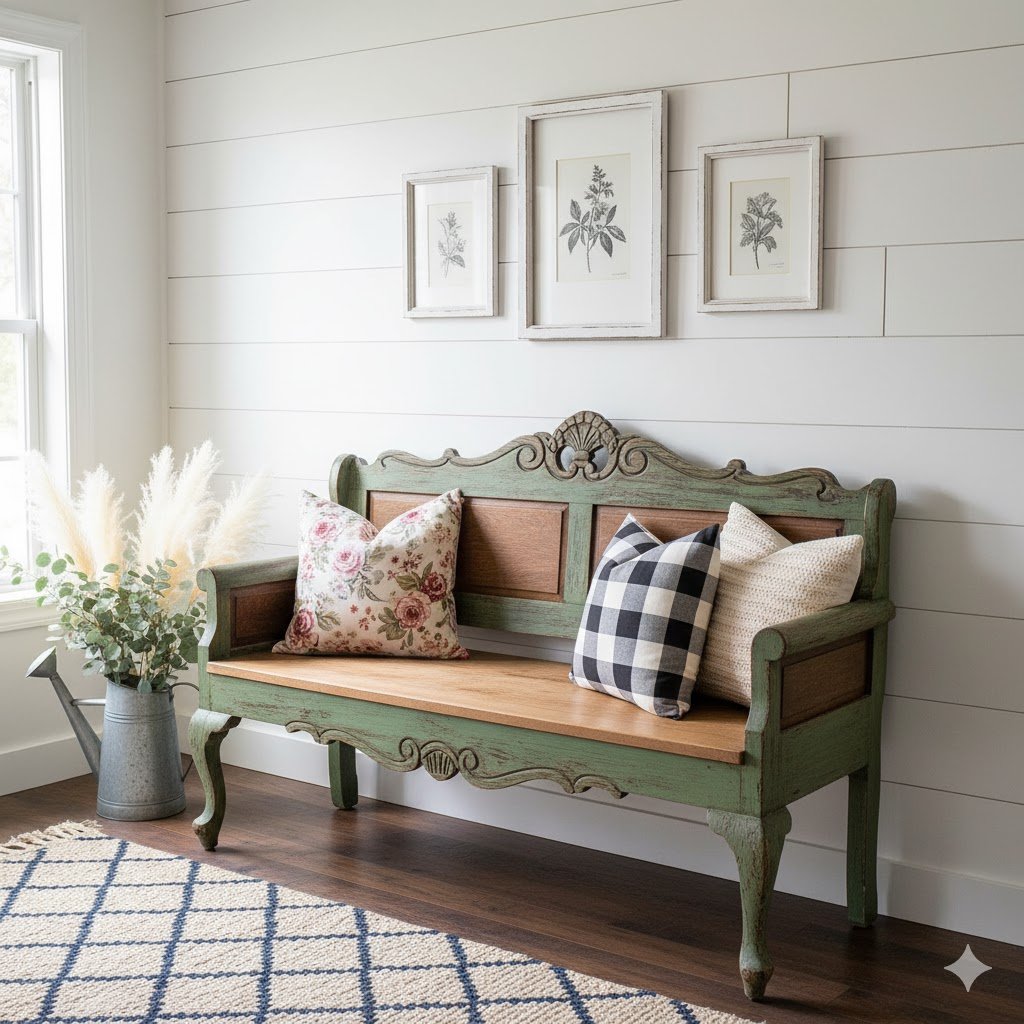
Sometimes the best furniture isn’t built from scratch; it’s rescued. Thrift stores are usually overflowing with dated, orange-oak benches or dining chairs that people have discarded. Look for a piece with good “bones”—sturdy legs and a solid seat—and ignore the ugly finish. With a little vision, a $15 Goodwill find can become the star of your entryway.
The transformation usually involves two steps: modernizing the legs and restoring the seat. I like to sand the seat down to the raw wood, removing all the old, yellowing varnish. You might be surprised to find beautiful grain hiding underneath. For the legs, painting them a crisp white or a matte black instantly modernizes the silhouette. This two-tone look (wood seat, painted base) is a hallmark of farmhouse style and makes the piece look custom.
If the bench has a back that feels too ornate or “country grandmother,” don’t be afraid to saw it off. Converting a spindly chair or a high-backed bench into a simple backless bench creates a lower profile that makes your entryway feel larger. Top it with a textured throw pillow or a sheepskin rug, and no one will ever guess it used to be a piece of 1990s dining room furniture.
6. Industrial Pipe Shoe Rack
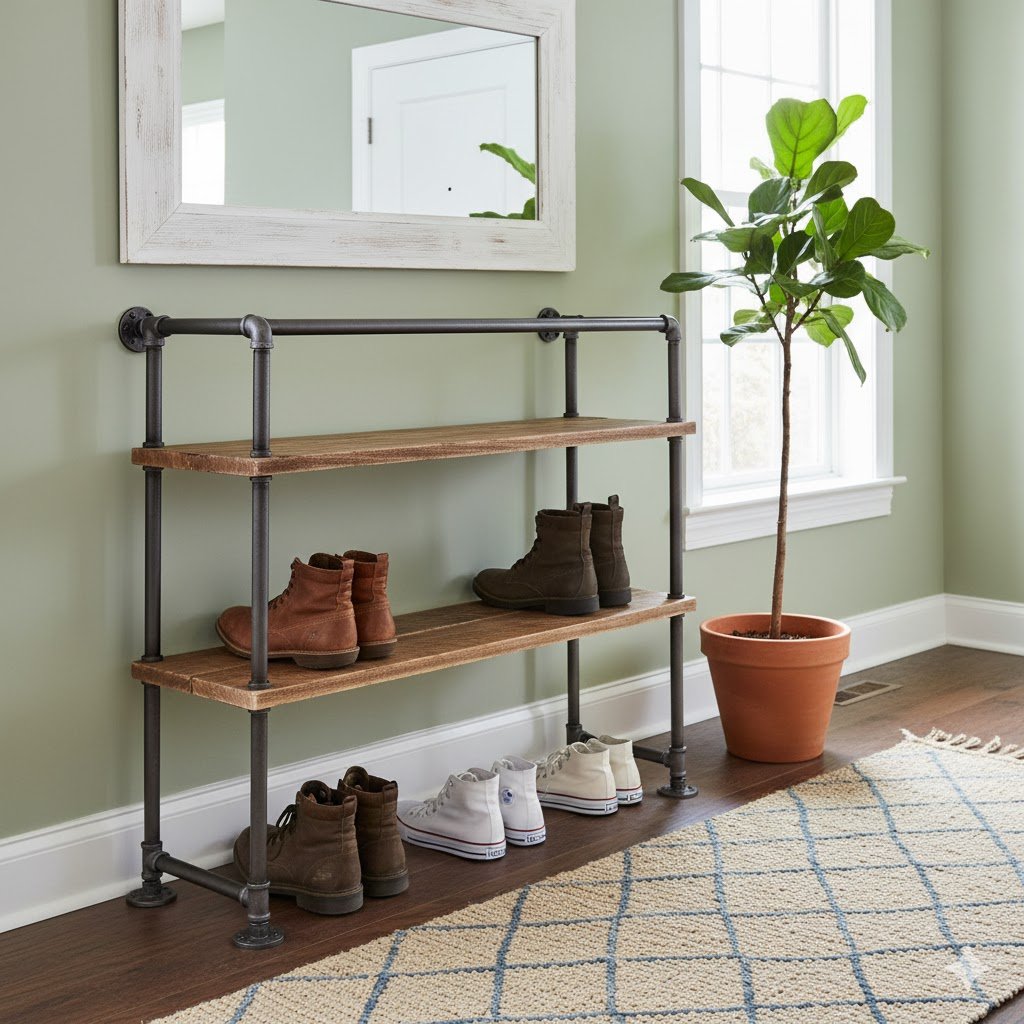
Shoe storage is non-negotiable, but plastic bins ruin the aesthetic. An industrial pipe shoe rack balances form and function perfectly. By using galvanized or black iron plumbing pipes from the hardware store, you can create a sturdy framework that holds wooden planks. This mix of metal and wood brings in the “industrial” edge that prevents modern farmhouse decor from looking too soft or shabby-chic.
The assembly is essentially like playing with adult LEGOs. You screw the pipe fittings together to form the legs and supports—no cutting required if you buy the pre-threaded lengths. You can customize the height and width exactly to your space, which is ideal for weirdly shaped nooks. For the shelves, simple pine boards cut to size and stained to match your console table tie the whole room together.
Because this unit is open, it forces a level of organization that closed cabinets don’t. It keeps shoes off the floor and allows air to circulate, which is practical for damp footwear. To keep it looking tidy, I suggest using the bottom shelf for baskets to hold flip-flops or sandals, and leaving the wood shelves for nicer boots or sneakers. The black metal pipes echo the other black accents in the room, creating a cohesive design thread.
Category C: Functional Storage & Organization
7. DIY Peg Rail
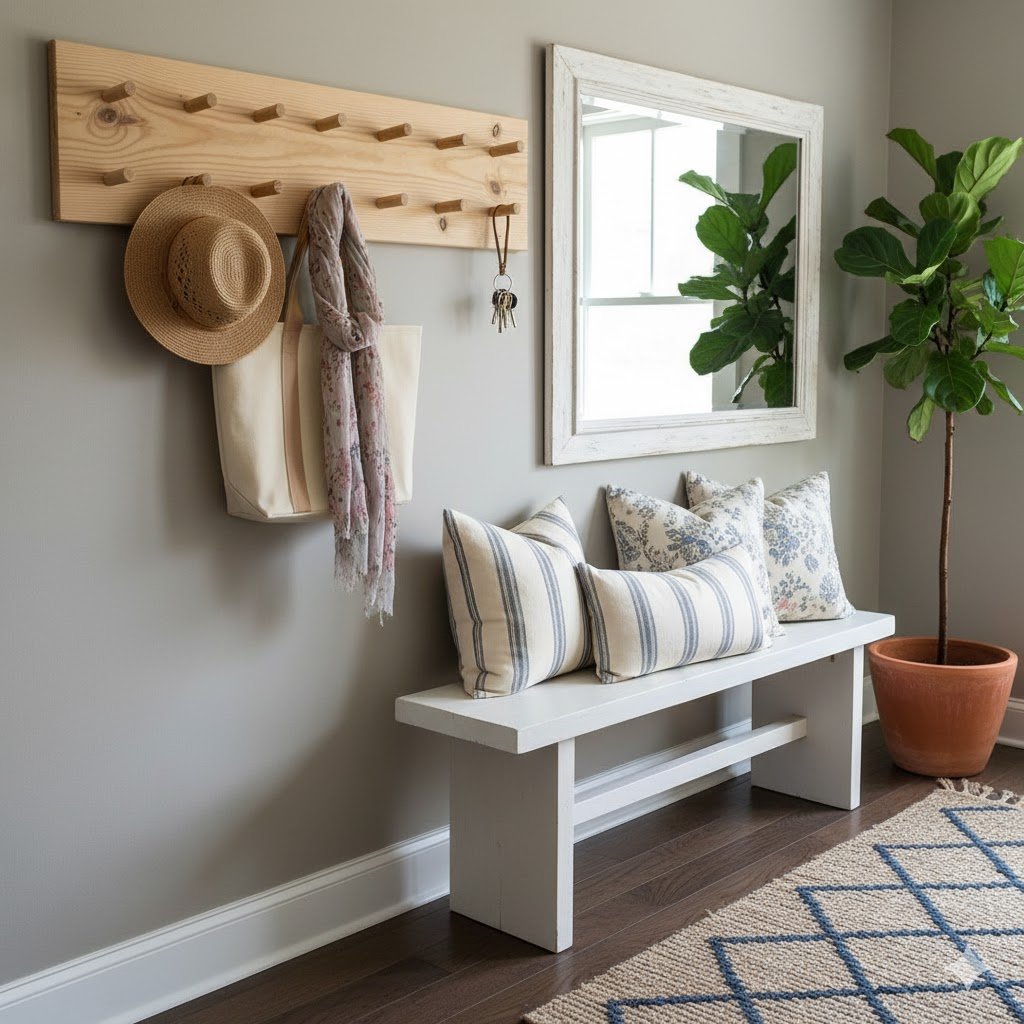
The Shaker peg rail is the ultimate example of “form follows function.” It is essentially a long strip of wood with wooden pegs inserted at regular intervals, spanning the length of a wall. It’s minimalist, incredibly useful, and costs pennies to make. You just need a 1×4 board and a bag of shaker pegs, which you can buy in bulk online. Drill holes down the center of the board, glue in the pegs, and you’re done.
What makes this perfect for a modern farmhouse entryway is its versatility. Unlike bulky coat racks that tip over, a peg rail sits flush against the wall. You can run it the entire length of your hallway to draw the eye down and make the space feel longer. It’s not just for coats; it becomes a display surface. I hang dried flowers, a canvas tote bag, a broom, or even a picture frame from the pegs to style it up when it’s not covered in winter jackets.
You can paint the rail to match your wall color for a “built-in” monochromatic look, or stain it for a natural wood contrast. If you have kids, consider installing two rails: one at standard height for adults and one lower down for the little ones. It keeps backpacks off the floor and teaches them to hang things up, all while maintaining that clean, utilitarian Shaker aesthetic.
8. Wire Basket Wall Bins
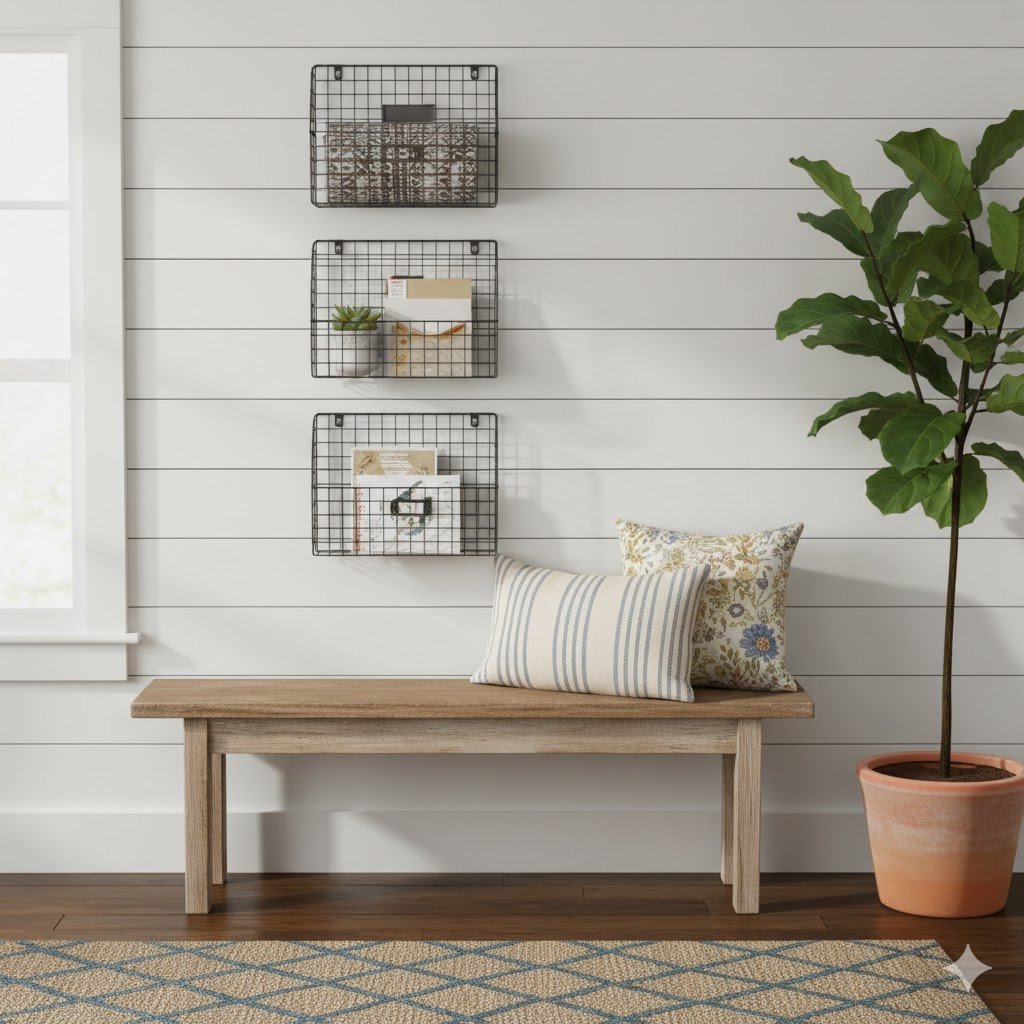
Paper clutter is the enemy of a peaceful entryway. Mail, permission slips, and receipts tend to pile up on any flat surface. Wall-mounted wire baskets are the solution. They get the clutter off the console table and turn it into vertical storage. You can often find cheap wire baskets at the dollar store, but they usually come in bright, cheap-looking chrome or white.
The hack here is a can of matte black spray paint. Giving those cheap baskets a few coats of flat black paint instantly mimics the look of vintage iron locker baskets. Mount them directly to the wall using hooks or screws and washers. I like to label them—one for “In,” one for “Out,” or one for each family member—using little kraft paper tags tied on with twine.
This adds a nice texture to the wall that contrasts with the smooth drywall and wood furniture. Since they are see-through, you can’t hide junk in them forever, which forces you to deal with the mail rather than hoarding it. If you want to soften the look, you can line the baskets with linen fabric, but the bare wire fits perfectly with the industrial-farmhouse vibe.
9. Upcycled “Built-in” Lockers
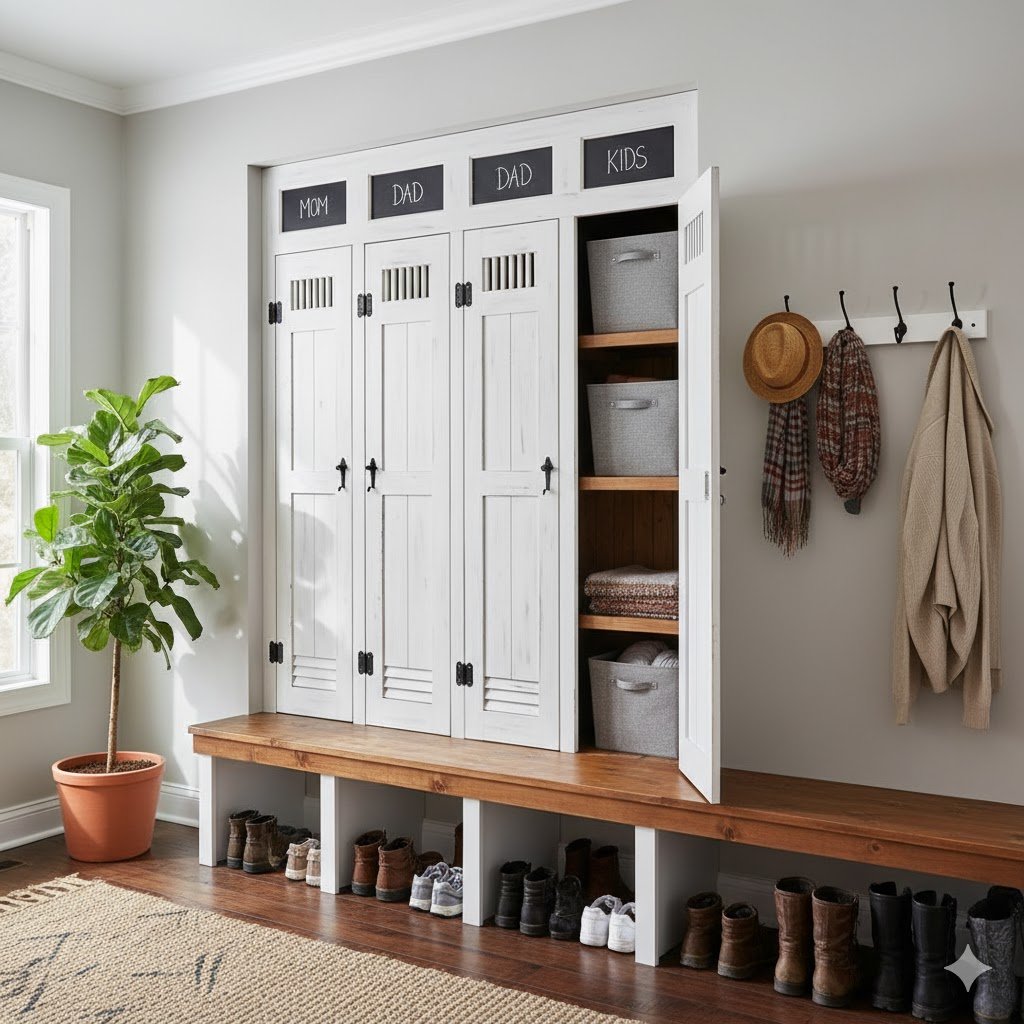
If you have a larger family, a simple peg rail might not cut it. You might crave the look of custom mudroom lockers, but those can cost thousands. The secret is to fake it using IKEA bookcases, like the Billy or Kallax series. By arranging these inexpensive units side-by-side and anchoring them to the wall, you have the skeleton of a mudroom system without the carpentry work.
To make them look like “built-ins” rather than generic flat-pack furniture, add trim. Use baseboard molding along the bottom to match the rest of your room, and crown molding along the top to bridge the gap between the bookcase and the ceiling. You can also add vertical trim strips over the seams where the bookcases meet. Once you caulk the gaps and paint the entire unit the same color as your walls or trim, it looks seamlessly integrated into the house architecture.
Add hooks inside the open cubbies for jackets and use baskets in the lower sections for shoes. This creates a designated “locker” for every family member. It turns a blank wall into a storage powerhouse and looks incredibly high-end. It’s a heavy-duty solution for a budget price, providing a place for everything so the rest of the house stays clean.
Category D: Decor & Finishing Touches
10. The Oversized Round Mirror Hack
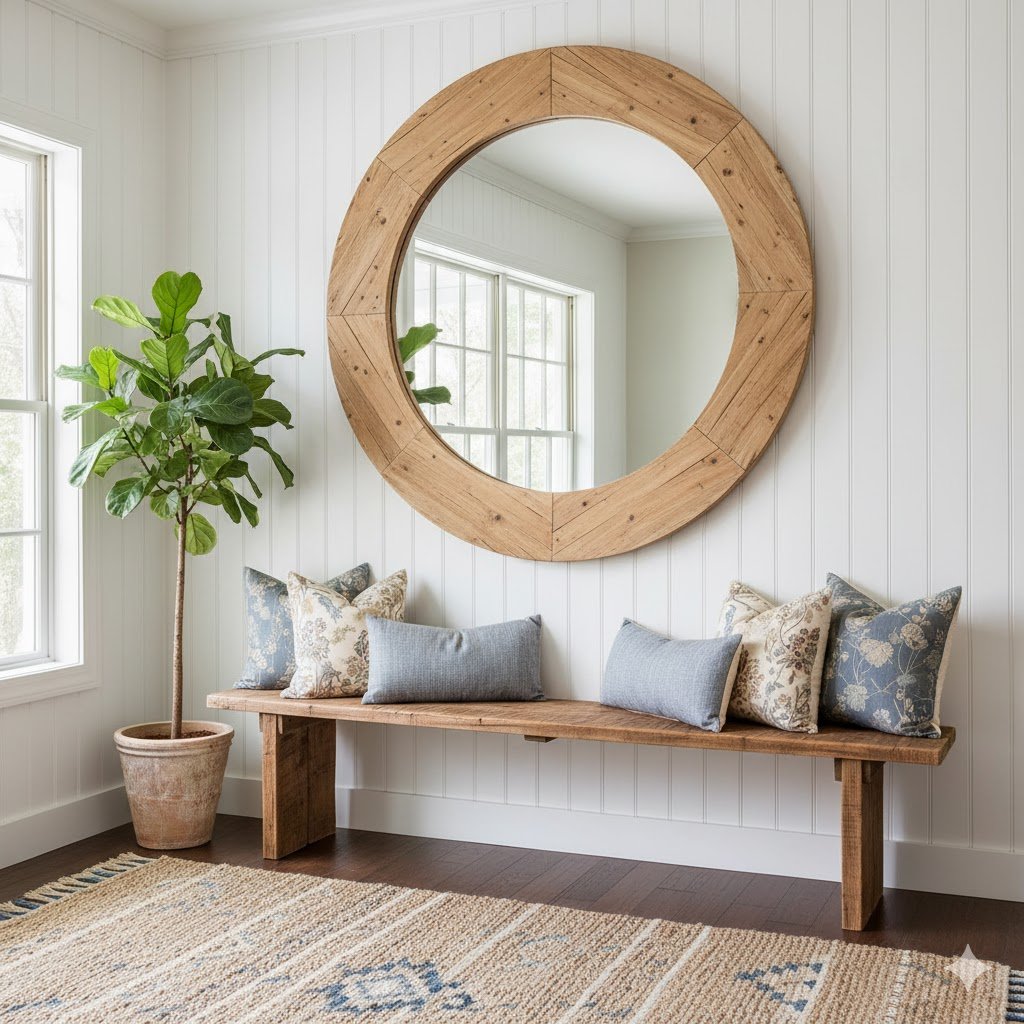
Farmhouse style involves a lot of straight lines—shiplap, floorboards, rectangular tables. To prevent the room from feeling too boxy and rigid, you need to introduce curves. An oversized round mirror is the standard go-to, but large mirrors are notoriously expensive. The hack is to buy a cheap, frameless round bathroom mirror from a hardware store, which usually costs under $20.
You can upgrade this plain sheet of glass into a statement piece by mounting it on a larger circle of plywood. Stain the plywood to frame the mirror in wood, or paint it black. Alternatively, you can glue a thick rope or a couple of old leather belts around the edge of the glass to act as a frame and a hanging strap. This adds texture and makes the mirror look like a boutique find.
Hang this mirror directly over your console table. It reflects light, making a small or dark entryway feel twice as big and much brighter. Ideally, the mirror should be about two-thirds the width of the table below it to keep the scale balanced. It’s the focal point that ties the vignette together, checking your hair one last time before you dash out.
11. Faux Olive Tree or Eucalyptus Stems
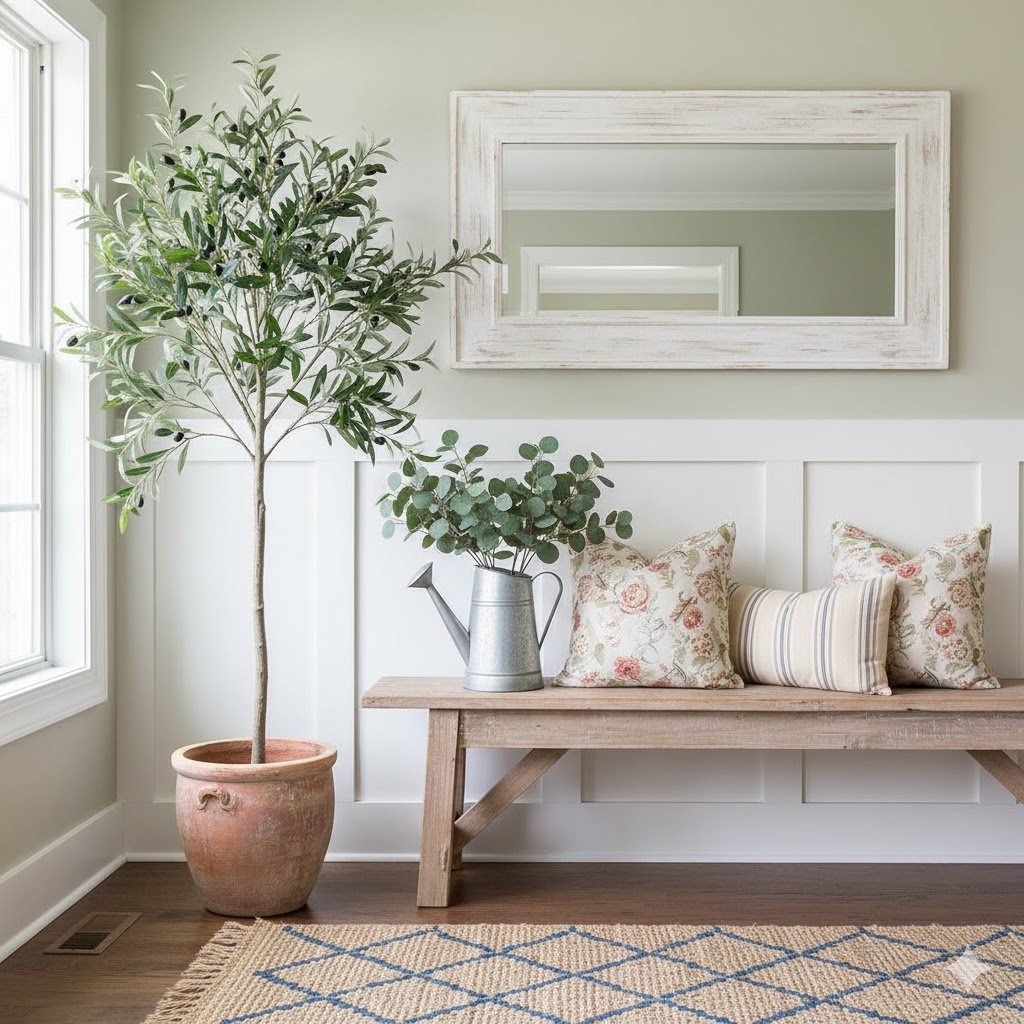
A modern farmhouse space relies heavily on a neutral palette of black, white, and wood. Without greenery, this combination can feel stark and lifeless. You need something organic to break it up. While real fiddle leaf figs are trendy, they are also temperamental and hard to keep alive in a drafty entryway. High-quality faux greenery is the answer, but you don’t have to pay premium prices for it.
I prefer “foraging” from the backyard if possible—clippings of magnolia leaves or evergreen branches are free and look sculptural in a vase. If that’s not an option, buy budget faux eucalyptus or olive stems and place them in a vessel that has character. A large glass demijohn (the kind used for brewing wine) or a galvanized metal bucket works perfectly.
The trick to making cheap faux stems look real is manipulation. Don’t just plop them in the vase straight from the store. Bend the wire stems, fluff the leaves, and create an asymmetrical, airy arrangement. You want it to look like you just gathered them from a field, not like they came from a factory. This pop of muted green breathes life into the entryway and softens the hard edges of the furniture.
12. Stenciled “Tile” Floor
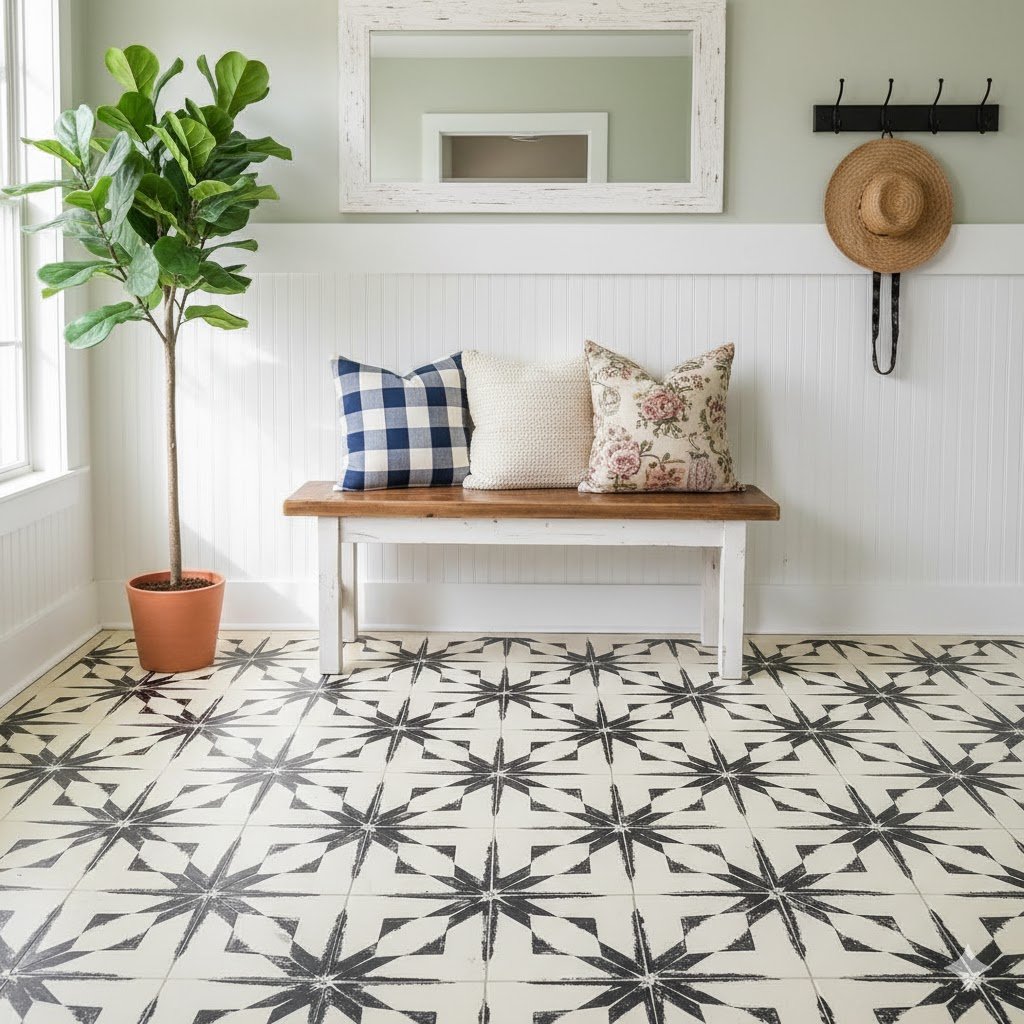
If your entryway floor is outdated linoleum or boring beige tile, ripping it out is a massive, messy, expensive job. But painting it? That’s easy. Stenciling your existing floor to look like cement encaustic tiles is one of the highest-impact projects you can do. These patterned tiles are a staple of modern farmhouse design, but the real deal is pricey and requires a wet saw to install.
You’ll need a good quality porch and floor paint. Start by painting the entire floor your base color (usually white or light gray). Once dry, tape down a large stencil pattern and roll over it with your contrast color (black or charcoal). It takes patience to move the stencil around the room, but the result is a stunning, graphic floor that hides dirt incredibly well.
Durability is the main concern here, so sealing is non-negotiable. Apply several coats of a water-based polyurethane sealer over your design to protect it from foot traffic. While it won’t last forever, it can easily extend the life of your floor for five or ten years until you’re ready for a full renovation. It turns an eyesore into a feature that guests will immediately compliment.
13. Printable Typography Art
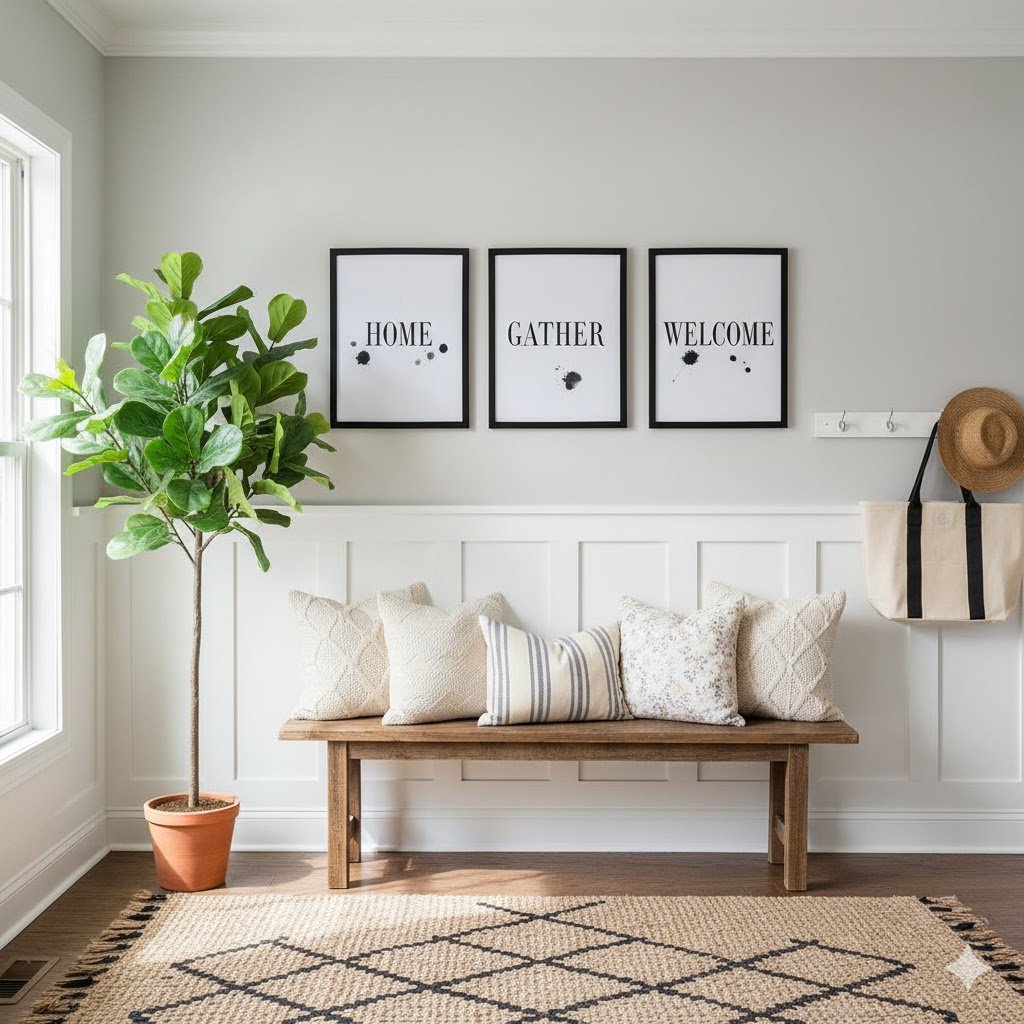
Art can be intimidating and expensive, but farmhouse style embraces simplicity, especially regarding typography. Signs that say “Welcome,” “Stay Awhile,” or feature simple botanical sketches are very popular. Instead of buying these framed at a decor store, you can buy digital downloads from independent artists on sites like Etsy for a few dollars, or even create your own using free design software.
Get the file printed as an “engineering print” or standard blueprint at your local office supply store. These large-format black and white prints are incredibly cheap—often less than $5 for a huge poster size. Because the paper is thin, they have a casual, unpretentious vibe that fits the style perfectly.
To frame it, skip the glass. Build a simple frame using 1×2 lumber stained to match your console table. Mount the print to a backing board or even clip it to the wall using vintage clipboards for a gallery wall effect. This approach allows you to swap out the art seasonally without guilt. It adds personality and voice to the space without breaking the bank.
14. Mason Jar Sconces (No-Wire)
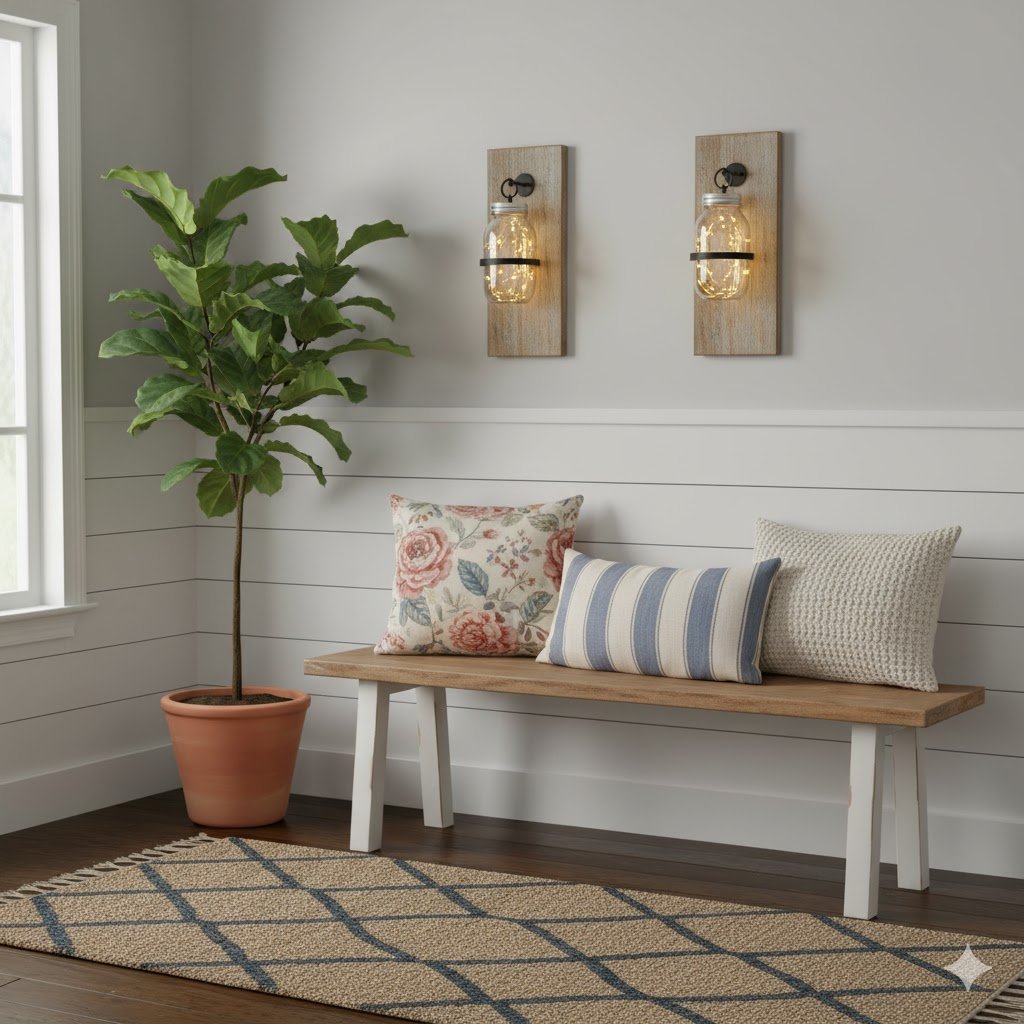
Lighting sets the mood, but hardwiring new sconces requires an electrician and cutting holes in your drywall. You can bypass the electrical work entirely with a clever hack using mason jars. The rustic look of the jar fits the theme naturally. You mount the jar to a simple wooden plaque or hook on the wall, flanking your mirror or art.
The secret ingredient is a battery-operated “puck light” or a remote-controlled LED candle. You simply place the light inside the jar. Since you don’t need a plug, you can hang these sconces anywhere—even in a dark hallway with no outlets. They provide a soft, ambient glow that makes the entryway feel cozy and welcoming in the evenings.
To elevate the look, you can paint the jar lids black or wrap twine around the neck of the jar. This project costs roughly $15 for a pair and can be completed in under an hour. It adds that layer of vertical interest and warmth that makes a house feel like a home, proving that you don’t need high voltage to have high style.
Tips for Styling a Modern Farmhouse Entryway
Now that you have the projects in mind, the key to bringing it all together lies in the styling. First, strict adherence to your color palette is crucial. Modern farmhouse design thrives on high contrast. Stick to warm whites, creams, matte blacks, and natural wood tones. If you start introducing bright reds or yellows, the look quickly veers into “country kitsch.” The discipline of the neutral palette is what gives the space its modern edge.
Secondly, remember that texture is your best friend. Because the colors are neutral, the room can feel flat if everything is smooth. You need to layer different materials to create visual interest. Mix the cold metal of your hooks or lamps with the warmth of your wooden furniture. Add a nubby wool rug, a woven sea-grass basket, or a canvas pillow. These layers make the space feel collected and cozy rather than sterile.
Finally, practice the art of editing. The “Modern” part of Modern Farmhouse implies a certain level of minimalism. It is cleaner and less cluttered than traditional country style. Don’t fill every shelf and surface with knick-knacks. Leave some breathing room on your console table. A single large vase and a tray for keys are often better than a dozen small figurines. Negative space allows the eye to rest and lets your DIY projects—like that shiplap wall or custom bench—truly shine.
Conclusion
Transforming your entryway doesn’t require a winning lottery ticket or a degree in interior design. It’s about looking at standard materials—like lumber, paint, and thrifted finds—with fresh eyes. The modern farmhouse aesthetic is forgiving and flexible, inviting you to mix the old with the new and the polished with the rough.
I encourage you to pick just one of these ideas to tackle this weekend. Maybe it’s painting the inside of your front door or finally organizing those shoes with a pipe rack. Once you see how much impact a single small change can have, you’ll likely find the confidence to take on the bigger projects. Your home should tell a story from the moment the door opens, and with these budget-friendly ideas, you can ensure that story is welcoming, stylish, and uniquely yours.

About Syprose Kiche
Syprose Kiche is the creator and writer behind My Besuited Home, a practical home and garden website covering DIY projects, gardening, lawn care, landscaping, home improvement, and outdoor living. She focuses on turning everyday homeowner questions into clear, practical guides backed by careful research and useful real-world considerations.